
You are using an outdated browser and your browsing experience will not be optimal. Please update to the latest version of Microsoft Edge, Google Chrome or Mozilla Firefox. Install Microsoft Edge

April 20, 2020

Current Requirements for Persons Traveling to Cambodia During the COVID-19 Pandemic

In order to prevent imported cases of COVID-19, on March 27, 2020, Cambodia’s Ministry of Foreign Affairs and International Cooperation imposed new requirements on foreigners entering Cambodia. These requirements are applicable to all foreigners, unless there is ban in effect for foreigners from specific countries. These legal requirements are effective from 23:59 of March 30, 2020.

Therefore, any foreigner considering a trip to Cambodia during this time should note the below requirements, plan appropriately and consider how they may impact their trip.
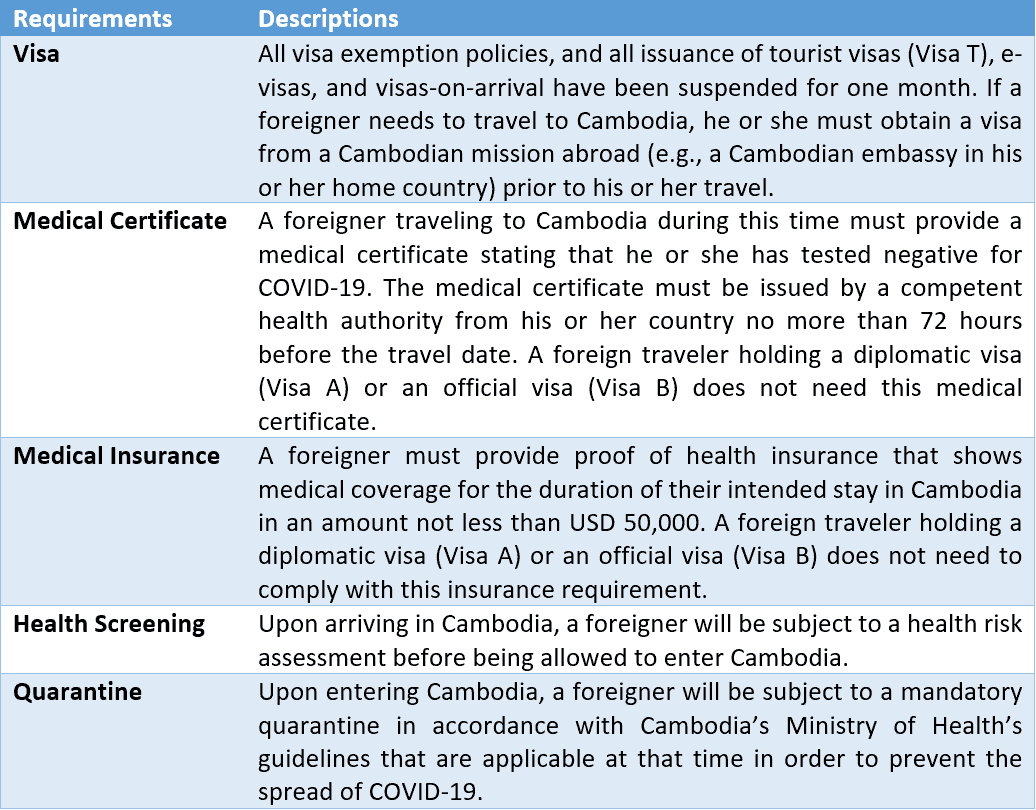
Cambodia’s Ministry of Foreign Affairs and International Cooperation notes that these requirements are temporary. The Cambodian government will review them regularly based on the current COVID-19 situation.

We would like to highlight that these travel requirements are in addition to the travel bans imposed earlier on travelers from the following six countries: France, Germany, Iran, Italy, Spain and the US as noted in our previous alert. These travel bans have been extended indefinitely until further notice, according to the Ministry of Foreign Affairs and International Cooperation’s letter on April 16, 2020.

RELATED INSIGHTS​ 

September 26, 2025
As Vietnam accelerates its digital transformation, data centers have emerged as critical infrastructure supporting the shift toward a digital government, digital economy, and digital society. For businesses targeting Vietnam’s rapidly growing data center market, a clear understanding of the evolving regulatory landscape, compliance obligations, and government incentives is key to successful market entry and operation. This article provides a strategic overview of investment opportunities and key compliance requirements in Vietnam’s dynamic data center sector. Investment Incentives to Boost Data Center Growth Since July 1, 2024, organizations and individuals across all economic sectors have been encouraged to invest in and contribute to the development of data centers. By law, there are no restrictions on shareholding ratios, capital contributions, or foreign investor participation in data center and cloud computing services under business cooperation contracts. Currently, investment in AI data centers is classified as a specially incentivized industry, qualifying for preferential treatments and incentives in terms of investment, taxation, land use, and other related areas. Large-scale data centers, together with AI and cloud computing, are currently considered as strategic technologies and products for which Vietnam offers significant fiscal, tax, and land incentives to promote investment. Additionally, these large-scale projects may receive direct financial support from local development budgets for facility construction, technical infrastructure, and equipment procurement, subject to state budget provisions and applicable laws. AI data center construction projects also enjoy preferential treatment under customs regulations. Regulatory Approvals for Providing Data Center Services The 2023 Telecom Law and its guiding documents marked a significant milestone by classifying data center services as value-added telecom services. Under the law, a data center service is defined as a telecom service that enables users to process, store, and retrieve information via a telecom network through the leasing of part or all of a data center. A
September 25, 2025
Tilleke & Gibbins’ labor and employment team in Hanoi and Ho Chi Minh City has contributed the Vietnam chapter to Labor and Employment Disputes 2026. Drawing on the expertise of three of the firm’s employment specialists, the chapter provides practical guidance for navigating employment disputes in Vietnam and covers: Pre-action considerations: key requirements, third-party funding, contingency fee arrangements Issuing a claim: forum, territorial jurisdiction, standing, commencing claims, fees, service, defendants and legal personality, types of claims, time limits, counterclaims Case management: procedure, rules, amendments to claims, adding parties, consolidating proceedings, class and collective actions, evidence, witnesses, tactical considerations Interim relief: availability, requirements Trial: hearings conduct and time frames, confidentiality and public access, media reporting, elements of successful claims and burden of proof Alternative dispute resolution: available types, requirements and expectations, enforcement Collective employment and labor rights: enforcement and standing Remedies and enforcement: available remedies, assessing compensation, enforcement mechanisms Appeals: procedure, time frames, other means of challenge Updates and trends: recent cases and developments, technology developments, other issues The Vietnam chapter is available for download below. Tilleke & Gibbins also contributed the Cambodia and Thailand chapters to Labor and Employment Disputes 2026. Readers can also gain 30 days of complementary access to the full Labor and Employment Disputes 2026 guide and the rest of Lexology Panoramic’s varied offerings through this link.
September 25, 2025
In the Thailand contribution to Labor and Employment Disputes 2026, four members of Tilleke & Gibbins’ Bangkok labor and employment team outline key aspects of dispute resolution in Thailand. Their analysis, part of Lexology Panoramic’s comparative guide covering jurisdictions worldwide, addresses the following areas: Pre-action considerations: key requirements, third-party funding, contingency fee arrangements Issuing a claim: forum, territorial jurisdiction, standing, commencing claims, fees, service, defendants and legal personality, types of claims, time limits, counterclaims Case management: procedure, rules, amendments to claims, adding parties, consolidating proceedings, class and collective actions, evidence, witnesses, tactical considerations Interim relief: availability, requirements Trial: hearings conduct and time frames, confidentiality and public access, media reporting, elements of successful claims and burden of proof Alternative dispute resolution: available types, requirements and expectations, enforcement Collective employment and labor rights: enforcement and standing Remedies and enforcement: available remedies, assessing compensation, enforcement mechanisms Appeals: procedure, time frames, other means of challenge Updates and trends: recent cases and developments, technology developments, other issues The complete Thailand chapter can be downloaded below. Tilleke & Gibbins also contributed the Cambodia and Vietnam chapters to Labor and Employment Disputes 2026. Readers can also gain 30 days of complementary access to the full Labor and Employment Disputes 2026 guide and the rest of Lexology Panoramic’s varied offerings through this link.
September 25, 2025
Four of Tilleke & Gibbins’ labor and employment specialists in Phnom Penh have authored the Cambodia chapter of Labor and Employment Disputes 2026, the latest edition of Lexology Panoramic’s global guide to handling labor and employment disputes. The chapter provides practical insights on a wide range of dispute resolution issues, including: Pre-action considerations: key requirements, third-party funding, contingency fee arrangements Issuing a claim: forum, territorial jurisdiction, standing, commencing claims, fees, service, defendants and legal personality, types of claims, time limits, counterclaims Case management: procedure, rules, amendments to claims, adding parties, consolidating proceedings, class and collective actions, evidence, witnesses, tactical considerations Interim relief: availability, requirements Trial: hearings conduct and time frames, confidentiality and public access, media reporting, elements of successful claims and burden of proof Alternative dispute resolution: available types, requirements and expectations, enforcement Collective employment and labor rights: enforcement and standing Remedies and enforcement: available remedies, assessing compensation, enforcement mechanisms Appeals: procedure, time frames, other means of challenge Updates and trends: recent cases and developments, technology developments, other issues The full Cambodia chapter is available for download below. Tilleke & Gibbins also contributed the Thailand and Vietnam chapters to Labor and Employment Disputes 2026. Readers can also gain 30 days of complementary access to the full Labor and Employment Disputes 2026 guide and the rest of Lexology Panoramic’s varied offerings through this link.