
You are using an outdated browser and your browsing experience will not be optimal. Please update to the latest version of Microsoft Edge, Google Chrome or Mozilla Firefox. Install Microsoft Edge

April 20, 2020

Current Requirements for Persons Traveling to Cambodia During the COVID-19 Pandemic

In order to prevent imported cases of COVID-19, on March 27, 2020, Cambodia’s Ministry of Foreign Affairs and International Cooperation imposed new requirements on foreigners entering Cambodia. These requirements are applicable to all foreigners, unless there is ban in effect for foreigners from specific countries. These legal requirements are effective from 23:59 of March 30, 2020.

Therefore, any foreigner considering a trip to Cambodia during this time should note the below requirements, plan appropriately and consider how they may impact their trip.
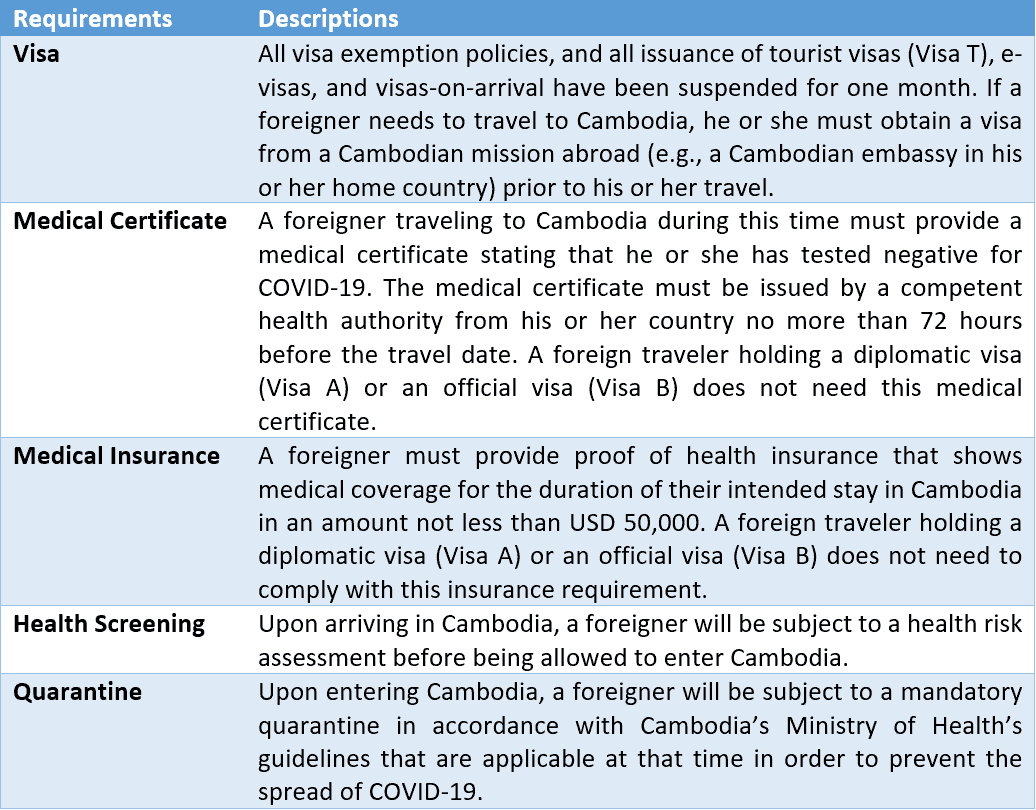
Cambodia’s Ministry of Foreign Affairs and International Cooperation notes that these requirements are temporary. The Cambodian government will review them regularly based on the current COVID-19 situation.

We would like to highlight that these travel requirements are in addition to the travel bans imposed earlier on travelers from the following six countries: France, Germany, Iran, Italy, Spain and the US as noted in our previous alert. These travel bans have been extended indefinitely until further notice, according to the Ministry of Foreign Affairs and International Cooperation’s letter on April 16, 2020.

RELATED INSIGHTS​ 

December 3, 2025
Thailand’s Civil Court has issued a regulation targeting the use of artificial intelligence (AI) in the preparation of pleadings and other documents submitted to the court. Effective November 17, 2025, the regulation aligns with September 2025 guidance from the president of the Supreme Court, and aims to safeguard accuracy, transparency, and public confidence in civil adjudication. The regulation applies to all parties submitting pleadings or any documents to the Civil Court that are prepared using AI tools or contain AI-generated content. It subjects AI used for these purposes to strict requirements on verification, disclosure, and accountability. Core Obligations The regulation imposes four principal obligations: Lawyers who use AI remain subject to duties of honesty, responsibility to the court, professional standards, and legal ethics, including the duty to assess the appropriateness of the AI tool for the work. Parties and lawyers must verify the accuracy and completeness of all facts, legal provisions, and citations in AI-generated content before submission. Parties and lawyers must disclose to the court any AI-generated content by clearly marking the beginning and end of the AI-generated portion with prescribed statements (see below). Additionally, a certification confirming the use of AI must be provided at the end of the pleading or document, stating that AI was used for certain portions and that the party has reviewed and certifies the accuracy of factual and legal content. Parties and lawyers bear the same full legal and ethical responsibility for AI-generated content as they do for personally authored documents; they cannot evade responsibility or avoid liability by citing AI-related errors. Likewise, parties must ensure that any AI-generated content is truthful, accurate, and unbiased. Prescribed Disclosure Language Each instance of AI-generated content must be preceded by the statement “[The following content was prepared using artificial intelligence]” and must end with “[End
December 2, 2025
Investing in Mainland Southeast Asia is Tilleke & Gibbins’ essential guide for investors looking to do business in this vibrant region, whether it’s starting operations as a newly established entity or expanding into new territories or business models.
November 28, 2025
On November 26, 2025, the government of Vietnam issued Resolution No. 8/2025/NQ-CP to extend and expand the pilot program allowing Vietnamese citizens who meet certain conditions to gamble at three integrated casino resorts in Vietnam: Corona Resorts & Casino Phu Quoc (An Giang Province) – Effective immediately, and continuing an ongoing pilot program that started in 2019. The Grand Casino Ho Tram (Ho Chi Minh City) – New pilot program for five years starting November 26, 2025. Van Don Integrated Casino & Tourism Complex (Quang Ninh Province) – New pilot program for five years from the date the casino receives its license. The pilot program was originally established under Decree No. 03/2017/ND-CP on casino business, which also sets out the specific eligibility conditions for Vietnamese citizens. After the pilot period, these projects must stop allowing Vietnamese players until the government issues further decisions. This expansion of the pilot program comes after Vietnam’s Ministry of Finance (MOF) released a draft decree earlier this year proposing significant changes to the regulatory framework governing casino operations. These revisions, which focus on increasing fiscal contributions from local players and strengthening compliance obligations for casino operators nationwide, are detailed below. Proposed Increase in Casino Entry Fees for Vietnamese Players The draft decree increases the entry fees applicable to Vietnamese citizens permitted to play at casinos. Under the current regulations, Vietnamese players are required to pay an entry fee of VND 1 million (approx. USD 38) for 24 consecutive hours or VND 25 million (approx. USD 950) per month. The draft decree proposes increasing these fees to VND 2.5 million (approx. USD 95) for 24 consecutive hours and VND 50 million (approx. USD 1,900) per month, effectively doubling the existing amounts and marking the first major fee revision since the pilot program allowing Vietnamese players
November 20, 2025
Lawyers from Tilleke & Gibbins’ labor and employment team have contributed a new Vietnam chapter to Thomson Reuters Practical Law’s Employment and Employee Benefits Global Guide. The guide provides a high-level comparative overview of employment laws and regulations across various jurisdictions around the world. Tilleke & Gibbins also contributed the Myanmar chapter of the guide. The Vietnam chapter covers a wide range of typical employment matters, such as limitations on working hours, paid leave requirements, minimum wage, and health and safety obligations. In addition, the guide provides insight on various topics of special interest to foreign investors doing business in Vietnam, including the following: Mandatory contents of a labor contract; Visas and permits required for expatriate employees; Employers’ obligations for protecting employees’ privacy and personal data; Procedural requirements for the dismissal of an employee; Employer and parent company liability. To view the latest version of the Employment and Employee Benefits Vietnam chapter, please visit the Practical Law website and enroll in the free Practical Law trial to gain full access.