
You are using an outdated browser and your browsing experience will not be optimal. Please update to the latest version of Microsoft Edge, Google Chrome or Mozilla Firefox. Install Microsoft Edge

April 20, 2020

Current Requirements for Persons Traveling to Cambodia During the COVID-19 Pandemic

In order to prevent imported cases of COVID-19, on March 27, 2020, Cambodia’s Ministry of Foreign Affairs and International Cooperation imposed new requirements on foreigners entering Cambodia. These requirements are applicable to all foreigners, unless there is ban in effect for foreigners from specific countries. These legal requirements are effective from 23:59 of March 30, 2020.

Therefore, any foreigner considering a trip to Cambodia during this time should note the below requirements, plan appropriately and consider how they may impact their trip.
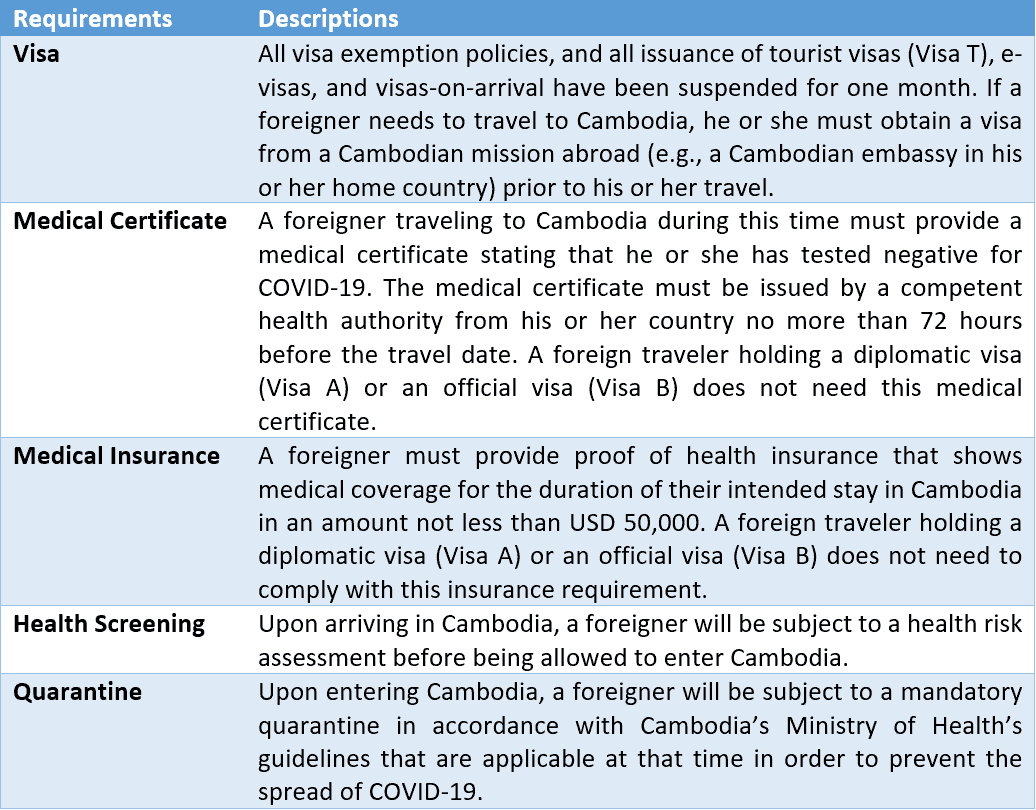
Cambodia’s Ministry of Foreign Affairs and International Cooperation notes that these requirements are temporary. The Cambodian government will review them regularly based on the current COVID-19 situation.

We would like to highlight that these travel requirements are in addition to the travel bans imposed earlier on travelers from the following six countries: France, Germany, Iran, Italy, Spain and the US as noted in our previous alert. These travel bans have been extended indefinitely until further notice, according to the Ministry of Foreign Affairs and International Cooperation’s letter on April 16, 2020.

RELATED INSIGHTS​ 

December 15, 2025
Thailand is taking steps to energize its startup scene by drafting the Startup Promotion Law. This draft law aims to remove obstacles, open new funding opportunities, and provide coordinated government support. The goal is to make it easier for Thailand-based startups to grow and compete on a global stage. Why Is This Law Needed? For many years, Thai startups have operated under traditional company law frameworks that were not designed with high-growth businesses or with fundraising opportunities in mind. Restrictions on issuing bonds, offering shares to outside investors, and repurchasing shares for employee incentive programs made it challenging for emerging companies to access capital and accelerate their growth. The draft Startup Promotion Act seeks to remove these obstacles and foster a more competitive, entrepreneur-friendly environment in Thailand. Who’s in Charge? Two main organizations will oversee the startup ecosystem: Startup Promotion Committee: This group, to be appointed by the National Science, Research, and Innovation Policy Council, will set national strategies, policies, and budget; design promotional campaign and incentives; and propose further legislative amendments to promote startups. National Innovation Agency (NIA): Under the draft act, the NIA will be the main contact for startups and will serve as the secretariat office of the Startup Promotion Committee, coordinating data, advising startups, maintaining the public registry, and providing funding and investment (grants, repayable grants, loans, and equity) under committee criteria and, where applicable, cabinet approval. What Startups Are Eligible for Benefits? To be officially recognized and access benefits, a company must: Be a private limited company less than 10 years old at the time of application. Existing companies that already exceed the 10-year threshold may still apply for startup statues within one year of the law’s enactment, as long as they otherwise still qualify for the new regime. Have average annual revenue not
December 12, 2025
Similar to other types of corporate disputes, tax-related conflicts often begin with an earnest attempt to resolve matters outside the courtroom. The prospect of engaging in tax litigation can be daunting, given the potential strain on commercial relationships, the legal expenses, and the uncertainty surrounding its resolution. However, there are instances when tax litigation becomes the sole avenue for seeking redress. For individuals and entities contemplating the pursuit of tax-related legal remedies, the Thai legal system offers an accessible, impartial, and equitable platform for dispute resolution. Tilleke & Gibbins’ latest update to Tax Litigation in Thailand provides an outline for navigating tax-related disputes within the Thai legal framework. It aims to equip readers with a fundamental understanding of procedures and practices within the Thai tax litigation landscape. The full guide is available through the button below.
December 12, 2025
Cross-border disputes often end with a judgment or arbitral award issued outside Thailand. When a party has assets or operations in Thailand, the key question becomes simple: will a Thai court enforce it? Thai law treats foreign court judgments and foreign arbitral awards very differently. Foreign court judgments cannot be recognized or enforced directly and must effectively be re-litigated. Foreign arbitral awards, however, benefit from a clear recognition and enforcement process under the New York Convention and Thailand’s Arbitration Act. Thailand’s Overall Approach Thailand does not have a general law or treaty that allows automatic enforcement of foreign court judgments. To rely on a foreign judgment, a party must initiate a new lawsuit in a Thai court, plead the claim under Thai law, and prove the case again. The foreign judgment can be used as evidence, but it is not binding, and the Thai court retains full discretion to reassess both the facts and the law. Foreign arbitral awards are treated more favorably. Thailand is a longstanding member of the New York Convention and has implemented it through the Arbitration Act. The act provides a straightforward process for asking a Thai court to recognize and enforce a qualifying award, without retrying the dispute, and subject only to limited refusal grounds. Foreign Court Judgments: Persuasive but Not Binding Although Thai courts do not recognize or enforce foreign court judgments, they may rely on them as persuasive evidence under certain conditions. Courts generally give more weight to judgments that are final on the merits, issued by a court with proper jurisdiction, and reached after proper notice and an opportunity for the defendant to be heard. Default judgments or rulings based primarily on procedural grounds carry less weight, and the ultimate relevance and weight are left to the court’s discretion. In practical
December 8, 2025
As Thailand transitions into an aged society, retirement policy and workplace protections for older workers have come into sharper focus. With public sentiment increasingly open to working beyond the traditional retirement age, questions about employee rights and employer obligations are more relevant than ever. In October 2025, Prime Minister Anutin Charnvirakul proposed increasing the statutory retirement age to 65 for government officers, citing Thailand’s aged-society status and the potential social and economic benefits of longer working lives. While academics and stakeholders have raised concerns about systemic impacts, public opinion remains divided, with many workers signaling a willingness to continue working beyond the current norm. Against this backdrop, it’s worth revisiting what the Labor Protection Act B.E. 2541 (1998) (LPA) requires in regard to retirement and severance pay. This article explains the current legal landscape under the LPA, with a focus on retirement and severance pay for employees over 60, recent judicial developments, and practical options for structuring postretirement engagements. Retirement as Termination Under the LPA Under the LPA, retirement—whether set by agreement between employer and employee or unilaterally stipulated by the employer—is deemed a termination of employment. As a result, employees who retire under such terms are entitled to severance pay. The law also adds a default rule: if there is no agreed or prescribed retirement age, or if the prescribed retirement age exceeds 60, an employee aged 60 or older may declare an intention to retire. The declaration takes effect 30 days after notice, and the employer must pay severance accordingly. In short, retirement triggered by agreement, the employer’s work rules, or an employee’s valid notice is treated as a termination, and statutory severance pay is owed. Hiring or Rehiring Employees Over 60 Practical issues arise when an employer’s work rules set a retirement age that does not