
You are using an outdated browser and your browsing experience will not be optimal. Please update to the latest version of Microsoft Edge, Google Chrome or Mozilla Firefox. Install Microsoft Edge

April 20, 2020

Current Requirements for Persons Traveling to Cambodia During the COVID-19 Pandemic

In order to prevent imported cases of COVID-19, on March 27, 2020, Cambodia’s Ministry of Foreign Affairs and International Cooperation imposed new requirements on foreigners entering Cambodia. These requirements are applicable to all foreigners, unless there is ban in effect for foreigners from specific countries. These legal requirements are effective from 23:59 of March 30, 2020.

Therefore, any foreigner considering a trip to Cambodia during this time should note the below requirements, plan appropriately and consider how they may impact their trip.
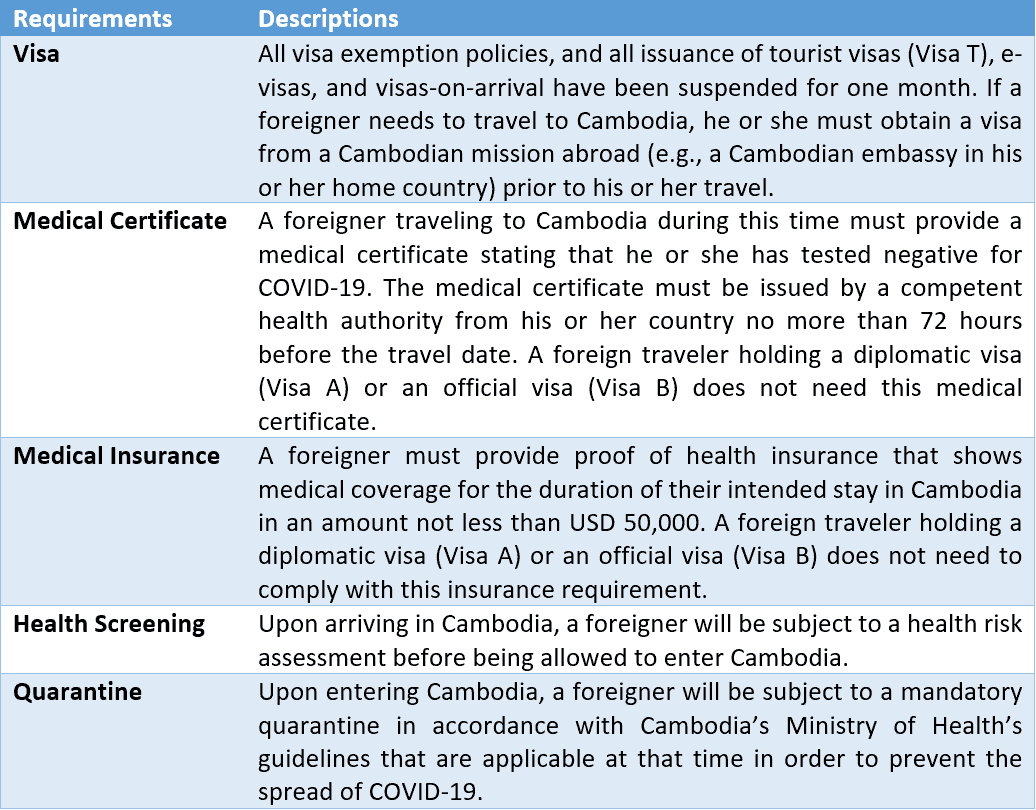
Cambodia’s Ministry of Foreign Affairs and International Cooperation notes that these requirements are temporary. The Cambodian government will review them regularly based on the current COVID-19 situation.

We would like to highlight that these travel requirements are in addition to the travel bans imposed earlier on travelers from the following six countries: France, Germany, Iran, Italy, Spain and the US as noted in our previous alert. These travel bans have been extended indefinitely until further notice, according to the Ministry of Foreign Affairs and International Cooperation’s letter on April 16, 2020.

RELATED INSIGHTS​ 

March 20, 2026
Thailand’s Board of Investment (BOI) now requires data center projects to demonstrate measurable benefits for local workforce development, R&D, SME capability, and domestic supply chains to qualify for corporate income tax (CIT) exemptions. BOI Notification No. Por. 3/2569, issued on February 6, 2026, updates the requirements for projects seeking promotion under BOI category 8.2.1 (data centers). All data center projects must now submit and implement plans covering development of Thai human resources and domestic supply chain support before benefiting from any CIT exemption. Human Resources Development Plan The BOI seeks to promote local talent development beyond basic training. Plans must include the following elements: Training for data center design, construction, and operations targeting vocational students, engineering and ICT undergraduates and postgraduates, and energy and building personnel in Thailand. Joint curricula with Thai universities and technical institutes. Collaborative R&D with Thai nationals or institutions in areas including AI, resource allocation, high-performance computing, and data center hardware and systems. Thai SME upskilling in electrical and energy systems and IT services. Domestic Supply Chain Support Plan Plans must demonstrate knowledge transfer in design, construction, cooling, security, and power and water management. Projects must also include usage or installation of domestically manufactured equipment or engage specialist domestic entities. Criteria for BOI Evaluation The BOI will assess data center operators’ eligibility for CIT incentives based on two criteria: Scale requirement: Training and joint-curriculum initiatives must reach a total participants equal to at least 10 times the project headcount and run for the duration of the CIT incentive. If this threshold is not met, the applicant must also implement continuous R&D or SME skills-development plans throughout the incentive period. Substantiality test: Supply-chain plans must be substantive, meet industry standards, and show measurable development of the domestic digital and data center supply base. To ensure compliance,
March 13, 2026
For decades, intellectual property rights holders seeking to eliminate counterfeit goods from the Thai market have relied primarily on criminal raid actions to seize infringing products and hold infringers accountable. The deterrent value of this approach is typically threefold: imposing criminal liability on infringers, removing counterfeit goods from circulation, and subjecting violators to imprisonment and fines. However, these outcomes often fall short of fulfilling brand owners’ broader objectives. In many cases, those prosecuted are merely staff or intermediaries rather than the principals orchestrating the infringing operations. Moreover, any fines imposed are remitted to the Thai government—not to the rights holders who have suffered commercial harm and invested substantial resources in investigation and coordination with law enforcement authorities. As in other jurisdictions worldwide, rights holders seeking monetary compensation for IP infringement in Thailand have traditionally pursued separate civil litigation. Before initiating such proceedings, a brand owner must gather sufficient evidence to establish both the infringement and the resulting damages. Notably, Thai law does not recognize punitive damages; courts award only actual damages proven by the claimant. In the absence of seized infringing goods, the damages awarded in such cases are typically minimal. This all leaves rights holders with limited recourse despite possibly having suffered significant commercial injury. In 2005, Thailand amended its Criminal Procedure Code to introduce Section 44/1, which enables rights holders to claim damages within criminal proceedings at the Intellectual Property and International Trade Court prior to the evidentiary hearing. In practice, this mechanism allows an injured party to submit a petition for civil damages directly within the criminal case initiated by the public prosecutor. Historically, rights holders in Thailand have been reluctant to use Section 44/1 because the compensation awarded by courts was often insufficient to justify the effort. However, recent years have seen a notable shift
March 9, 2026
Over the past several years, numerous automobile manufacturers have brought electric vehicles (EVs) to the market and received positive feedback from consumers in Thailand and around the world. EVs have gained popularity due to their lower maintenance costs, reduced energy expenses, and environmental benefits. However, reports have emerged of EVs causing problems such as battery fires, autopilot malfunctions leading to accidents, and safety systems such as brakes engaging automatically under inappropriate conditions. Even when these situations do not cause injury to drivers or passengers, they raise significant concerns for EV manufacturers, importers, and sellers operating in Thailand. These problems may seriously impact businesses if the products are identified as unsafe under Thailand’s Product Liability Act (PLA), officially known as the Liability for Damages Arising from Unsafe Products Act. Under this law, authorities or courts can order business operators to recall products from the market or prohibit their export, import, or sale. To manage and mitigate the risk of being found liable for damages due to an unsafe product under the PLA, EV business operators should be aware of the scope of the law. Potentially Liable Parties The PLA identifies several types of entrepreneurs and business operators—both individuals and entities—as “potentially liable parties” (PLPs) who may be held liable under the law. In the EV context, this could include vehicle manufacturers, battery suppliers, software developers whose systems are integrated into the vehicle, and local importers or distributors. Specifically, the PLA covers: Manufacturers or hirers Importers Sellers of goods for which the manufacturer, hirer, or importer cannot be identified Any other party who uses the name, trade name, trademark, or statements associated with the alleged unsafe products, or acts in a manner that causes them to be perceived as a manufacturer, hirer, or importer Definition of “Product” and “Unsafe Product” The
March 5, 2026
Amid increasing financial globalization, Vietnam’s establishment of an International Financial Center (IFC) represents a strategic initiative to attract high-quality foreign investment and enhance the country’s position in the global financial system. In support of this objective, a Specialized Court was introduced under Resolution No. 222/2025/QH15 as a dedicated dispute resolution mechanism within the IFC framework. The Specialized Court at the IFC was subsequently operationalized by Law on the Specialized Court No. 150/2025/QH15, effective from January 1, 2026. Organizational Structure of the Specialized Court The Specialized Court at the IFC is a court within the system of the People’s Courts, organized and operating in accordance with the Law on the Specialized Court, and vested with jurisdiction to adjudicate and resolve cases at the IFC. The Specialized Court is located in Ho Chi Minh City and comprises (i) a Court of First Instance; (ii) a Court of Appeal, and (iii) a supporting apparatus. Jurisdiction of the Specialized Court The jurisdiction of the Specialized Court at the IFC is strictly defined based on both (i) the subject matter of the cases and (ii) the membership status of the parties involved. Specifically, the Specialized Court has jurisdiction over (except for cases involving public interests or the interests of the state) the following: Disputes arising from investment and business activities. Requests for recognition and enforcement in Vietnam of judgments and decisions of foreign courts and foreign arbitral awards. Requests related to dispute resolution by arbitration. Other disputes directly related to investment and business activities (to be specified by the Supreme People’s Court). Additionally, at least one party in the case must be a member of the IFC. The IFC’s membership status is established through registration, recognition as a member, or the grant of a license for establishment and operation within the IFC. In the