
You are using an outdated browser and your browsing experience will not be optimal. Please update to the latest version of Microsoft Edge, Google Chrome or Mozilla Firefox. Install Microsoft Edge

April 20, 2020

Current Requirements for Persons Traveling to Cambodia During the COVID-19 Pandemic

In order to prevent imported cases of COVID-19, on March 27, 2020, Cambodia’s Ministry of Foreign Affairs and International Cooperation imposed new requirements on foreigners entering Cambodia. These requirements are applicable to all foreigners, unless there is ban in effect for foreigners from specific countries. These legal requirements are effective from 23:59 of March 30, 2020.

Therefore, any foreigner considering a trip to Cambodia during this time should note the below requirements, plan appropriately and consider how they may impact their trip.
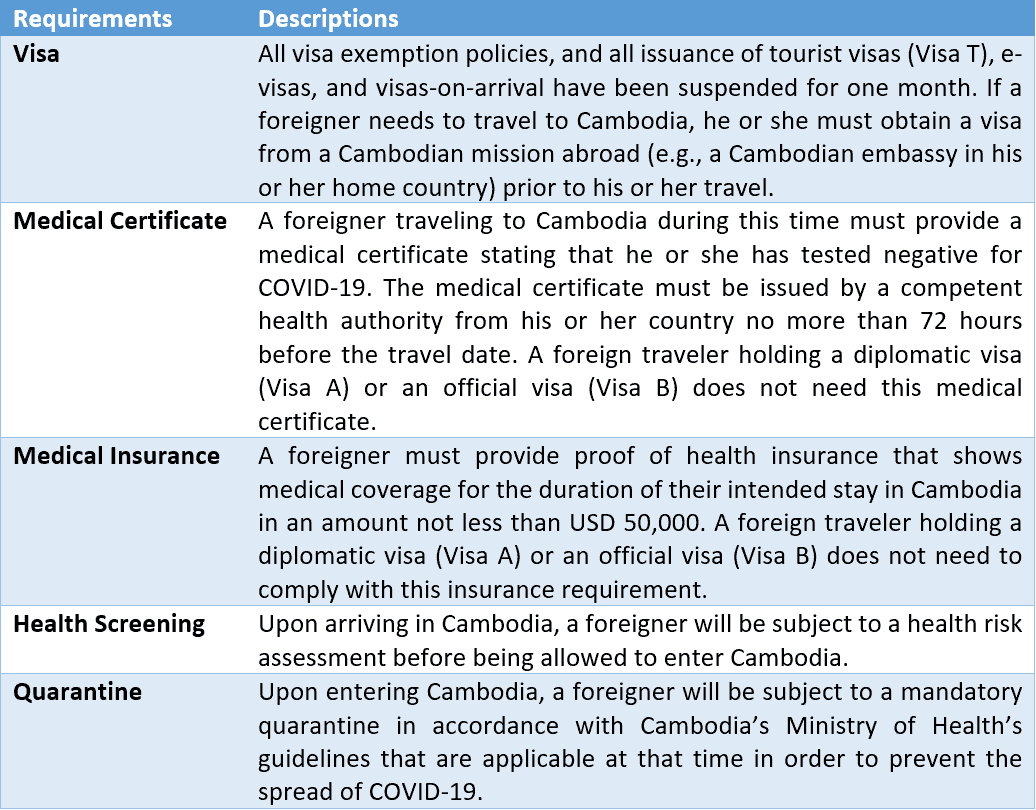
Cambodia’s Ministry of Foreign Affairs and International Cooperation notes that these requirements are temporary. The Cambodian government will review them regularly based on the current COVID-19 situation.

We would like to highlight that these travel requirements are in addition to the travel bans imposed earlier on travelers from the following six countries: France, Germany, Iran, Italy, Spain and the US as noted in our previous alert. These travel bans have been extended indefinitely until further notice, according to the Ministry of Foreign Affairs and International Cooperation’s letter on April 16, 2020.

RELATED INSIGHTS​ 

July 4, 2025
On July 1, 2025, new minimum daily wage rates for Bangkok and certain business types nationwide were published in the Government Gazette, taking effect on the same day. The daily minimum wage rate for Bangkok has been increased to THB 400 per day, while the minimum wage rates for other provinces remain unchanged from the rates that took effect on January 1, 2025. However, daily minimum wage rates have also been increased to THB 400 nationwide for type 2, type 3, and type 4 hotels under the Hotel Act and for entertainment establishments under the Entertainment Place Act. This THB 400 rate applies to all businesses that meet the criteria, even if the province’s general rate is lower. The new minimum wage rates supersede any lower wages agreed upon in existing employment contracts or conditions of employment that were in force before this announcement came into effect. As a result, these employees must be paid their wages at the newly prescribed rate for work performed from July 1, 2025, onward.
July 2, 2025
On June 17, 2025, Cambodia’s Ministry of Economy and Finance issued Instruction No. 18574 on Tax Obligations for Share Premiums to clarify that enterprises are not required to pay any income tax on share premiums that meet the conditions set out in the instruction. As outlined in the relevant provisions of the Law on Taxation (Royal Kram No. NS/RKM/0523/004) and Prakas No. 578 MEF.PrK.GDT on Tax on Income, taxable income is the difference between an asset’s value at the beginning and end of a period. This calculation deducts capital contributions, which are not taxable. A share premium is the amount of money that a company receives in excess of the par value of a share when the company issues new shares to a shareholder through a share subscription. In other words, share premiums are capital contributions made by shareholders into the equity of the company and, as a result, are not taxable. However, the government may nevertheless view share premiums as taxable if the company fails to meet certain legal conditions. Cambodian law requires share subscriptions to be properly recorded in the company’s accounting books and supported by documentary evidence. The recent instruction states that if an enterprise does not have proper documentation, any increase in equity, such as a capital increase through share premiums, will be treated as taxable income in accordance with the law. The instruction provides the following example: Enterprise A issues 200,000 new shares to an investor. The shares were registered with a par value of KHR 4,000 per share and were sold for a sale price of KHR 10,000 per share. The share premium of KHR 1.2 billion, which is calculated by subtracting the total par value (KHR 800 million) from the total value of the new capital (KHR 2 billion), is a capital
July 2, 2025
As of July 1, 2025, all companies in Vietnam have new addresses. The country’s administrative map has been redrawn and relabeled as part of an ambitious government restructuring, and every address in the country has been modified to at least a small degree due to provinces merging, the district level of local government being eliminated, and the surviving administrative divisions being reconfigured and renamed. Companies operating in Vietnam should note the guidance below regarding their obligations. Business Registration Guidance issued by Vietnam’s Ministry of Finance under Official Letter No. 4370/BTC-DNTN dated April 5, 2025, regarding business registration in the event of changes to administrative boundaries, provides the following principles: Enterprises may continue to use their existing Enterprise Registration Certificates even when administrative boundaries have changed. There is no requirement to register a change of address solely due to these changes. Enterprises may choose to update their registered addresses either when submitting applications for other business registration changes or at their own discretion. Tax-Related Matters The Tax Department of the Ministry of Finance and Regional Tax Sub-Departments have further issued the following guidance on tax-related matters: The tax authorities will issue notifications regarding the update of taxpayers’ addresses according to the new administrative boundaries. These notifications will also include information on the directly managing tax authority. The notifications will be communicated via the taxpayer’s electronic tax transaction account, or the taxpayer’s email address through the legal representative’s eTax Mobile application. These notifications will serve as a basis for taxpayers to explain to relevant authorities or clarify to customers in cases where the address shown on the invoice is the address updated by the tax authority according to the new administrative boundaries, but the information on the Enterprise Registration Certificate still shows the address according to the old administrative boundaries. Summary
June 30, 2025
On March 4, 2025, Cambodia’s Ministry of Labor and Vocational Training (MLVT) issued Prakas No. 073/25 on Procedures for Resolving Individual Labor Disputes, replacing Prakas No. 318 on the same topic from 2001 and introducing significant changes to how individual labor disputes are filed, processed, and escalated. In addition, Prakas No. 073 outlines the roles and responsibilities of labor inspectors, the process for filing and handling complaints, and the steps for conciliation and further legal recourse, as described below. Filing a Complaint Any party to an individual labor dispute can file a complaint with the Labor Dispute Department of the MLVT or the Department of Labor at the capital or provincial level. Upon receiving a complaint, a labor inspector will review the case and may initiate either conciliation or a labor inspection. Invitation letters will be issued to the disputing parties to provide relevant information and documents. Conciliation Process Prakas No. 073 places strong emphasis on the conciliation process, introducing strict procedural rules and deadlines with clear consequences for noncompliance: If the claimant fails to provide required information within the specified deadline (or within three working days thereafter without reasonable excuse), the complaint is deemed void. If the respondent fails to attend the conciliation meeting within the deadline (or within three working days thereafter without reasonable excuse), the conciliation is considered unsuccessful, and the respondent is deemed guilty as claimed. Once all necessary information is gathered, a labor inspector will invite both parties to a joint conciliation meeting, which must be held within three weeks of the complaint being received. If the claimant fails to attend the meeting or sign the minutes without a reasonable excuse, the complaint is void. If the respondent fails to attend the meeting without a reasonable excuse, the conciliation is unsuccessful, and the respondent