
You are using an outdated browser and your browsing experience will not be optimal. Please update to the latest version of Microsoft Edge, Google Chrome or Mozilla Firefox. Install Microsoft Edge

April 20, 2020

Current Requirements for Persons Traveling to Cambodia During the COVID-19 Pandemic

In order to prevent imported cases of COVID-19, on March 27, 2020, Cambodia’s Ministry of Foreign Affairs and International Cooperation imposed new requirements on foreigners entering Cambodia. These requirements are applicable to all foreigners, unless there is ban in effect for foreigners from specific countries. These legal requirements are effective from 23:59 of March 30, 2020.

Therefore, any foreigner considering a trip to Cambodia during this time should note the below requirements, plan appropriately and consider how they may impact their trip.
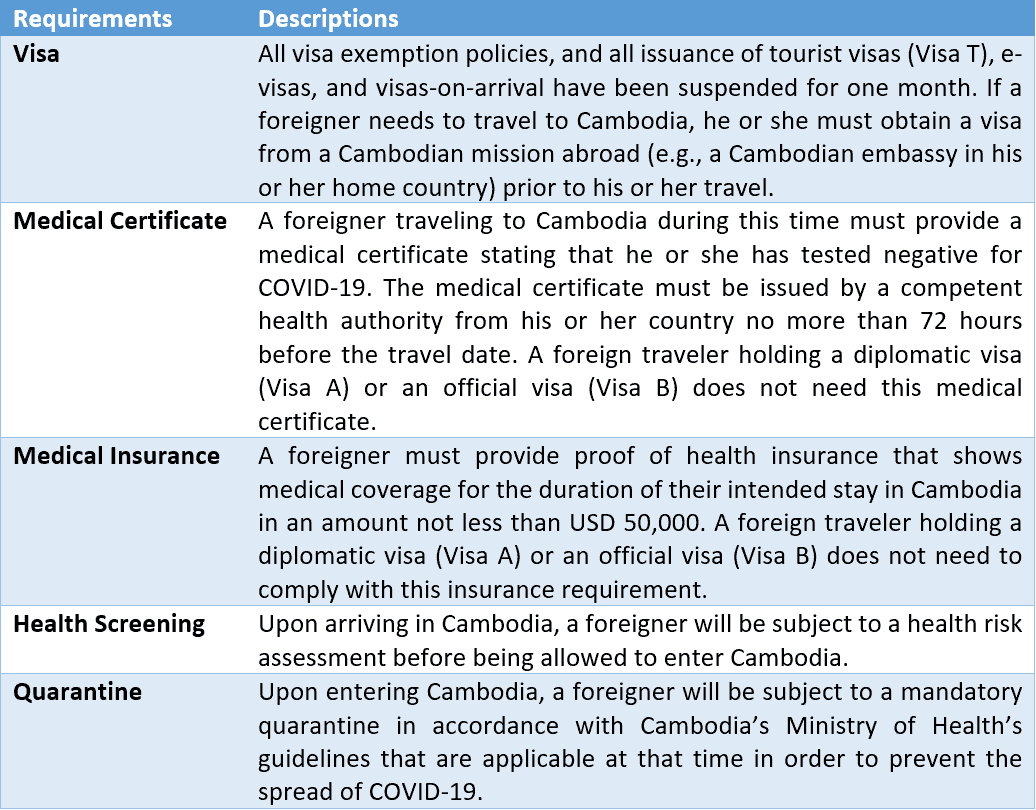
Cambodia’s Ministry of Foreign Affairs and International Cooperation notes that these requirements are temporary. The Cambodian government will review them regularly based on the current COVID-19 situation.

We would like to highlight that these travel requirements are in addition to the travel bans imposed earlier on travelers from the following six countries: France, Germany, Iran, Italy, Spain and the US as noted in our previous alert. These travel bans have been extended indefinitely until further notice, according to the Ministry of Foreign Affairs and International Cooperation’s letter on April 16, 2020.

RELATED INSIGHTS​ 

September 23, 2026
Arbitration under Thai law rests on consent. Section 11 of the Arbitration Act B.E. 2545 (2002) requires an arbitration agreement to be in writing and signed by the parties. This may also be satisfied by communications, an unchallenged allegation in pleadings, or incorporation by reference to a document containing an arbitration clause. A non-signatory cannot, as a general rule, be compelled to arbitrate merely because it participated in the transaction, received a benefit, or belongs to the corporate group of a signatory. Thai law nevertheless permits arbitration agreements and awards to affect third parties indirectly in limited circumstances. Under section 24, an arbitration clause is separable from the main contract; the invalidity of the contract does not invalidate the clause. In Supreme Court Judgment No. 3918/2563, an apparent sales contract concealed a construction contract and was void under the Civil and Commercial Code. However, the concealed construction contract and written arbitration clause remained effective. The tribunal had jurisdiction, and its award was enforceable under the Arbitration Act. Under the Arbitration Act, when a claim or liability is validly transferred, the transferee is bound by the related arbitration agreement. This includes assignment, transfer of obligations, legal succession, and subrogation. Depending on the facts and contract and agency law, consent may arise through execution by an authorized agent, ratification, assumption of obligations, or conduct accepting the contract and its arbitration clause. Thai law respects separate corporate personality. The group-of-companies doctrine has no statutory basis under the Arbitration Act, while alter egos or sham allegations require compelling evidence and an identifiable legal basis. Supreme Court Judgment No. 9161/2568 illustrates the procedural treatment of non-signatories. A consultancy contract required LCIA arbitration seated in Dubai. When the employer sued a consultant and his spouse in Thailand concerning a housing loan, the court disposed of
September 15, 2026
The Myanmar Investment Commission (MIC) has issued a notification that gives investors with projects in Myanmar clearer guidance for securing approval and for changing, expanding, or exiting an approved project. Issued on August 19, 2026, MIC Notification No. 5/2026 replaces MIC Notification No. 26/2021 and sets procedures for state or regional investment committees to review, approve, and supervise investment projects, including project amendments, investment increases, land-use rights applications, compliance inspections, and suspension or termination of approved businesses. Endorsement Application Timeline and Deemed Acceptance In Myanmar, prospective investors seeking approval under the Myanmar Investment Law generally do so through an MIC permit or an MIC endorsement, depending on the nature of the investment. While certain large-scale investment projects require an MIC permit, projects that are not required to obtain an MIC permit may instead apply for an MIC endorsement. Investors seeking MIC endorsement for their planned projects typically submit their applications to the relevant state or regional investment committee. These committees are established under the Myanmar Investment Law and are authorized to approve investments of less than USD 5 million, subject to the project’s nature and location. MIC Notification No. 5/2026 specifies that upon receiving an endorsement application, the relevant investment committee office will check it for completeness and determine whether it can be considered at the state or regional level or must be referred to the MIC; if it must be forwarded to the MIC, this will be done within 10 working days. If an application is within its purview, the committee may reject the endorsement application within 15 working days of receipt; otherwise, the application is deemed accepted. If approved, the endorsement certificate will be issued within 10 working days of the approval decision, subject to applicable procedures. Endorsement Certificate Amendment The notification clarifies which amendments a state
September 9, 2026
Certain securities, derivatives, and treasury activities in Thailand were opened to foreign investors when Thailand’s Ministry of Commerce published two new ministerial regulations in the Government Gazette on August 28, 2026. The regulations significantly broaden the service activities that foreign-owned businesses may conduct without a license or certificate under the Foreign Business Act B.E. 2542, as amended (FBA). Securities and Derivatives Business Exemptions Prior to the issuance of these ministerial regulations, the exemptions covered (1) securities brokerage and derivatives brokerage with their only underlying assets being agricultural commodities, financial instruments, and securities; and (2) dealers, advisers, and fund managers conducting derivatives business under Thailand’s derivatives laws. The ministerial regulations provide broader exemptions. In addition to derivatives under the laws on derivatives as before, the following two major categories are provided: Derivatives whose underlying assets or variables fall outside the scope of Thailand’s laws on derivatives. This addresses a gap in the previous framework, which did not comprehensively exempt derivatives tied to nonregulated underlying assets or variables, such as certain commodities. Foreign brokers, advisors, and fund managers can now facilitate a broader range of hedging and risk management instruments without triggering FBA licensing requirements. Derivatives traded outside a derivatives exchange, or over the counter (OTC), whose payments are calculated by reference to foreign exchange rates or interest rates. This removes an FBA licensing barrier for foreign providers of widely used OTC hedging products, broadening the solutions available to importers and exporters managing currency exposure and to borrowers seeking greater certainty over financing costs. The ministerial regulations also exempt brokers and agents handling transactions involving either of these two derivatives categories. For securities businesses, the ministerial regulations add exemptions for margin loans used to purchase securities and for securities repurchase transactions. These additions clarify whether such activities qualify as exempt brokerage
September 9, 2026
On August 25, 2026, Thailand’s cabinet approved in principle a draft amendment that would extend mandatory social security coverage to three categories of workers currently excluded from Thailand’s compulsory social security system. The amendment, proposed by the Ministry of Labour, would modify the Royal Decree Prescribing Businesses and Employees Excluded from the Social Security Act B.E. 2560 (2017). Newly Covered Workers The cabinet-approved proposal would remove the exclusions for the following three categories of employees, bringing them within Thailand’s mandatory social security system: Workers in seasonal cultivation (pho pluk), forestry (pa mai), and livestock (liang sat) businesses that do not employ workers year-round and whose operations do not include other types of business activities. Notably, fishery (pramong) workers were excluded from this amendment following objections raised at a Social Security Board meeting on April 30, 2025, because employers and employees in the fishery sector can already agree to opt into social security coverage under fishery labor laws. Domestic workers and other employees of individual employers where the work performed is not part of a business operation (e.g., housekeepers, gardeners, drivers). This group has actively demanded inclusion in the social security system. Workers employed in street-stall businesses operating fixed street stalls (kan kha phaeng loi). The rationale for including street-stall workers is that their employers have fixed, identifiable places of business that can be inspected. Accordingly, workers engaged in itinerant street hawking (kan kha re) remain excluded. The expanded coverage would apply to both Thai and foreign employees who possess valid identity documents and work permits, including migrant workers who have been granted special permission to work in Thailand. The Social Security Act B.E. 2533 (1990) does not restrict social security registration based on nationality, allowing these workers to register as insured persons under section 33. Employer Obligations and Employee