
You are using an outdated browser and your browsing experience will not be optimal. Please update to the latest version of Microsoft Edge, Google Chrome or Mozilla Firefox. Install Microsoft Edge

April 20, 2020

Current Requirements for Persons Traveling to Cambodia During the COVID-19 Pandemic

In order to prevent imported cases of COVID-19, on March 27, 2020, Cambodia’s Ministry of Foreign Affairs and International Cooperation imposed new requirements on foreigners entering Cambodia. These requirements are applicable to all foreigners, unless there is ban in effect for foreigners from specific countries. These legal requirements are effective from 23:59 of March 30, 2020.

Therefore, any foreigner considering a trip to Cambodia during this time should note the below requirements, plan appropriately and consider how they may impact their trip.
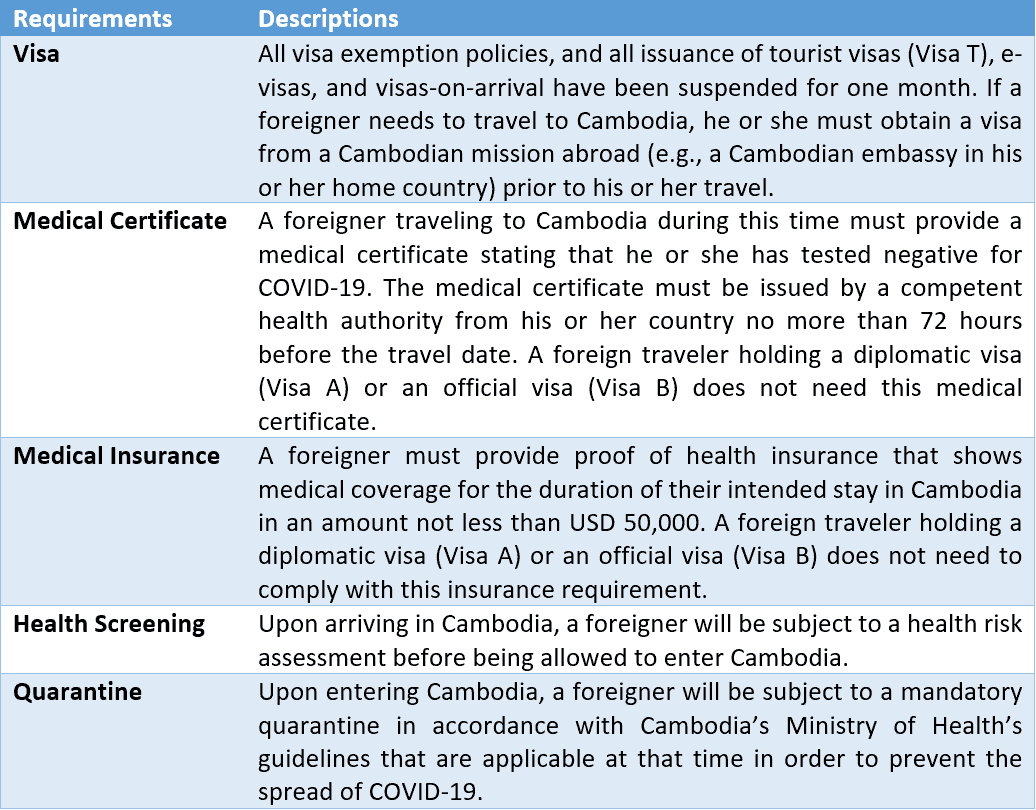
Cambodia’s Ministry of Foreign Affairs and International Cooperation notes that these requirements are temporary. The Cambodian government will review them regularly based on the current COVID-19 situation.

We would like to highlight that these travel requirements are in addition to the travel bans imposed earlier on travelers from the following six countries: France, Germany, Iran, Italy, Spain and the US as noted in our previous alert. These travel bans have been extended indefinitely until further notice, according to the Ministry of Foreign Affairs and International Cooperation’s letter on April 16, 2020.

RELATED INSIGHTS​ 

November 19, 2025
Litigation has its place in resolving business disputes, but it is often time-consuming and costly. In Thailand, a straightforward civil case can take a year or more to reach judgment at first instance, and appeals can extend that timeline further. Court filing fees are tied to the value of the claim, typically amounting to around two percent for claims up to THB 50 million, before accounting for attorney fees, translation costs, expert work, and the internal time that management must devote to the case. Against this backdrop, Thai law provides an alternative pathway for parties to attempt resolution before filing suit, and Thai courts commonly encourage mediation as part of the dispute-resolution process. Specifically, prelitigation mediation is a court-supervised process designed to facilitate confidential settlement discussions at an early stage. Participation is voluntary and requires the consent of both parties. The process does not replace litigation but is available in parallel as an initial step for interested parties. If the parties reach an agreement, the settlement can be recorded as a consent judgment that is directly enforceable in Thailand. If no settlement is reached, the parties retain their full right to proceed with a court claim. Reasons to Consider Prelitigation Mediation Prelitigation mediation can offer several advantages. It may shorten timelines from months or years to just weeks, reduce legal costs, and keep discussions confidential. It also allows parties to pursue practical, business-driven solutions or tailored remedies that address their specific needs—outcomes that may not be available through traditional litigation. To facilitate this process, under Thailand’s Civil Procedure Code, parties may petition the court to initiate prelitigation mediation before filing a suit. If the opposing party agrees, the court appoints a mediator to work with the parties under established mediation rules. In such a scenario, there are no court
November 14, 2025
Interest in data center land acquisition has increased significantly over the past year, with a notable rise in inquiries from investors seeking to establish digital infrastructure in Thailand. Although the sector is still in its early stages, this emerging wave of development represents a significant shift in Thailand’s technology infrastructure landscape, driven primarily by multinational technology companies and operators looking to expand their regional presence. Project Development The data center sector in Thailand is attracting a diverse range of international investors, though with clear geographic patterns. Most investors are from China, Singapore, and Japan, with some additional interest from countries outside Asia, including the United States and Europe. This investor base consists primarily of multinational tech companies and operators seeking to establish new facilities rather than acquire existing assets. Data center business activities are also a sector promoted by Thailand’s Board of Investment (BOI), which offers investors both tax and nontax privileges as well as exemptions to foreign investment and land-ownership restrictions. Projects currently underway are still largely in the land acquisition and construction phase. Unlike more mature markets where many facilities are operational and generating revenue, the predominant focus in Thailand remains on securing suitable land and beginning the building process. This means that while interest is high and land assembly is accelerating, the sector as a whole has not yet reached the operational phase that will ultimately drive licensing applications and full regulatory compliance. The licensing process itself remains at an early stage, as most projects must first complete their facilities before applying for the specific licenses required from the telecommunications authority. Once the facilities are built, the next critical step will be obtaining these telecommunications licenses, which are mandatory for data center operations. Legal and Regulatory Considerations The complexity of data center development in Thailand requires
November 13, 2025
Tilleke & Gibbins has contributed the Thailand chapter to Franchise 2026, part of the International Comparative Legal Guides (ICLG) series published by Global Legal Group. This annual guide offers comparative analysis of franchise laws and regulations across jurisdictions worldwide, providing practical insights for businesses and legal practitioners operating in the global franchise sector. Each country chapter in the 12th edition follows a Q&A format covering key aspects of franchise law and operations, including: Relevant legislation and rules governing franchise transactions Business organization options for franchised operations Competition law considerations Protection of intellectual property and brands Liability issues and risk mitigation Governing law and dispute resolution Real estate matters Online trading regulations Termination requirements Joint employer risks and vicarious liability Currency controls and taxation Commercial agency considerations Good faith obligations and fair dealing requirements Ongoing relationship management Franchise renewal processes Franchise migration procedures Sustainability commitments Electronic signatures and document retention Current developments in the franchise sector The Thailand chapter, authored by Alan Adcock and Kasama Sriwatanakul, provides an in-depth overview of the legal landscape for franchising and franchising-related activities in Thailand. The complete Thailand chapter is available as a PDF below. The Thailand chapter—and the full Franchise 2026 guide—are also freely available on the ICLG website.
November 13, 2025
The Land Department in Thailand’s Ministry of the Interior (MOI) plays a central role in ensuring the stability and legality of real estate transactions in the country. Its core responsibilities include issuing land title deeds, registering transactions (e.g., sales, mortgages, leases), conducting surveys for subdivision or consolidation of land, and providing information and guidance on land and property development laws. These administrative functions secure investor confidence and support transparency in the Thai property market, so any delay can have a significant impact. This is especially true for investors who depend on timely registration to secure or transfer property rights. Delays can create liquidity risks, postpone project timelines, and even reduce Thailand’s attractiveness as a real estate investment destination. This article explores the nature of these challenges, the legal framework governing the timelines for administrative actions, and remedies available under Thai law. Sources of Delay Procedural delays at land offices can arise for a variety of structural and operational reasons. These include approval processes that require several levels of internal review, heavy staff workloads, and occasional communication gaps within the bureaucratic chain. Many processes still rely upon manual documentation, which can prolong administrative steps and increase the likelihood of bottlenecks. Some delays stem from ongoing investigations into the legality of land titles. For example, a land title deed may have an annotation indicating that the title deed is under investigation to verify its legality. Even though this annotation does not legally prohibit the sale or transfer of the land, in practice, most prospective purchasers are reluctant to proceed with a transaction until the annotation is removed. As a result, the land can become effectively illiquid during the investigation period, leading to significant investment delays. While such investigations are essential to maintaining the integrity of Thailand’s land registration system, prolonged inquiries