
You are using an outdated browser and your browsing experience will not be optimal. Please update to the latest version of Microsoft Edge, Google Chrome or Mozilla Firefox. Install Microsoft Edge

April 20, 2020

Current Requirements for Persons Traveling to Cambodia During the COVID-19 Pandemic

In order to prevent imported cases of COVID-19, on March 27, 2020, Cambodia’s Ministry of Foreign Affairs and International Cooperation imposed new requirements on foreigners entering Cambodia. These requirements are applicable to all foreigners, unless there is ban in effect for foreigners from specific countries. These legal requirements are effective from 23:59 of March 30, 2020.

Therefore, any foreigner considering a trip to Cambodia during this time should note the below requirements, plan appropriately and consider how they may impact their trip.
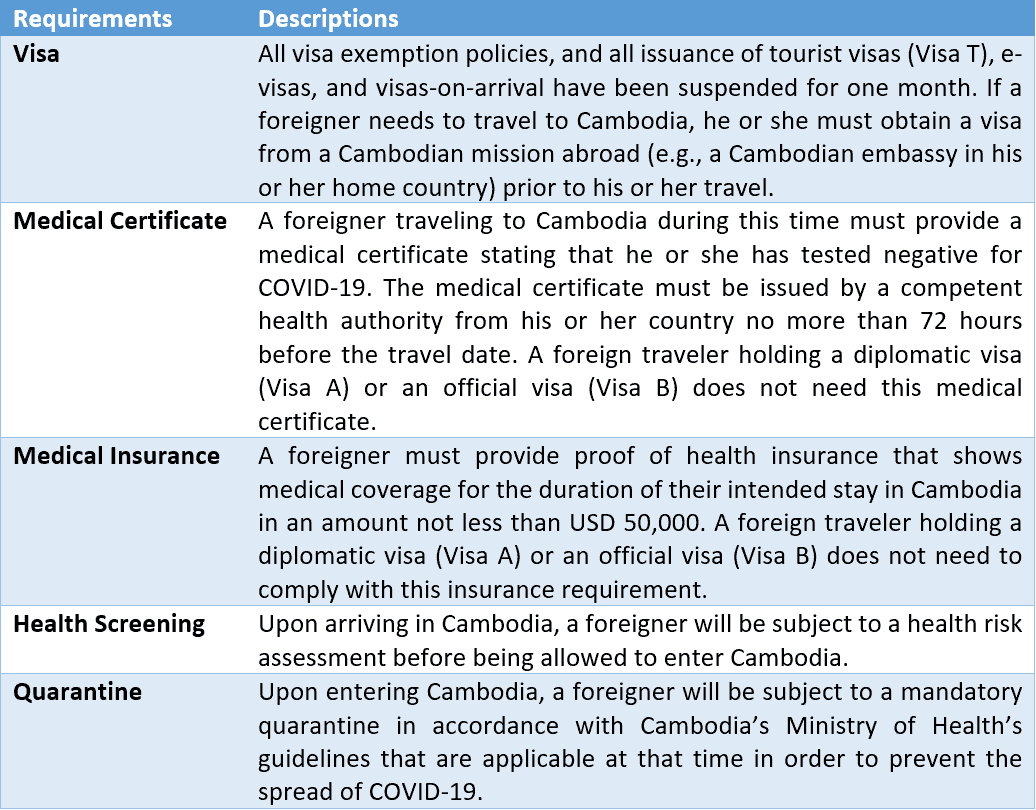
Cambodia’s Ministry of Foreign Affairs and International Cooperation notes that these requirements are temporary. The Cambodian government will review them regularly based on the current COVID-19 situation.

We would like to highlight that these travel requirements are in addition to the travel bans imposed earlier on travelers from the following six countries: France, Germany, Iran, Italy, Spain and the US as noted in our previous alert. These travel bans have been extended indefinitely until further notice, according to the Ministry of Foreign Affairs and International Cooperation’s letter on April 16, 2020.

RELATED INSIGHTS​ 

January 20, 2026
Thailand’s Board of Investment (BOI) has imposed new restrictions on foreign-majority shareholding and land ownership for companies in certain promoted activities. The changes took effect on September 1, 2025, but were not published in the Government Gazette until December 30, 2025, under Notification of the Board of Investment No. Sor. 7/2568 on the Amendment to List of Activities Eligible for Investment Promotion under Notification of the Board of Investment No. 9/2565, dated July 22, 2025. Foreign Land Ownership Restrictions Generally, foreign land ownership is one of the privileges granted to BOI-promoted companies, allowing them to own land to engage in the promoted activities. However, with these new restrictions, the BOI will no longer grant land-ownership privileges to foreign-majority-owned companies that conduct business activities in the following categories: Rolling, drawing, casting, or forging of nonferrous metals (category 5.4.9) Manufacturing of ferrous metal products or ferrous metal parts (category 5.4.11.2) Manufacturing of nonferrous metal products and/or nonferrous metal parts for industrial use (category 5.4.11.4) Manufacturing of other metal products, including other metal parts for industrial use (category 5.4.11.5) Manufacture of chemical products for industry (category 6.2) Manufacture of plastic products for industrial goods and parts (category 6.4.1) These restrictions do not apply to existing BOI-promoted companies that have at least three projects granted promotion under the same juristic person during the past 15 years (2011–2025) with total investment of at least THB 5 billion, excluding the cost of land and working capital. Foreign Shareholding Restrictions For companies to be eligible for BOI promotion in three other categories of business activities, at least 51% of the company’s registered capital must be held by Thai individual shareholders, unless the BOI-promoted activity is located within a special border economic zone as designated by the BOI. These three categories are: Manufacture of bags made of
January 16, 2026
Employment law specialists from Tilleke & Gibbins in Vietnam have contributed the Vietnam chapter to the Guide to Restructuring a Cross-Border Workforce from International Employment Lawyer. This comprehensive global guide, covering 50 jurisdictions worldwide, addresses the complex issue of workplace restructurings, with a particular focus on the needs of multinational companies. The Vietnam chapter was authored by partner Kien Trung Trinh, counsel Sarah Galeski, and associates Dung Thi Phuong Le and Nguyen Thi Huong Nguyen. The Q&A-style chapter provides in-depth analysis of key areas related to workplace restructuring, including: Reduction in workforce; Restructuring or reorganization of the business; Changing terms and conditions; and Areas to watch. A PDF of the Vietnam chapter can be downloaded through the button below. Tilleke & Gibbins also contributed the Cambodia, Laos, Myanmar, and Thailand chapters to the Guide to Restructuring a Cross-Border Workforce 2026. To browse the full guide for all 45 jurisdictions, please visit the International Employment Lawyer website.
January 16, 2026
Employment law specialists from Tilleke & Gibbins’ office in Bangkok have contributed the Thailand chapter to the Guide to Restructuring a Cross-Border Workforce from International Employment Lawyer. This comprehensive global guide, covering 50 jurisdictions worldwide, addresses the complex issue of workplace restructurings, with a particular focus on the needs of multinational companies. The Thailand chapter was authored by Pimvimol (June) Vipamaneerut, Chusert Supasitthumrong, Dusita Khanijou, and Chomanut Arif. The Q&A-style chapter provides in-depth analysis of key areas related to workplace restructuring, including: Reduction in workforce; Restructuring or reorganization of the business; Changing terms and conditions; and Areas to watch. A PDF of the Thailand chapter can be downloaded through the button below. Tilleke & Gibbins also contributed the Cambodia, Laos, Myanmar, and Vietnam chapters to the Guide to Restructuring a Cross-Border Workforce 2026. To browse the full guide for all 45 jurisdictions, please visit the International Employment Lawyer website.
January 16, 2026
Tilleke & Gibbins’ office in Yangon has contributed the Myanmar chapter to the Guide to Restructuring a Cross-Border Workforce from International Employment Lawyer. This comprehensive global guide, covering 50 jurisdictions worldwide, addresses the complex issue of workplace restructurings, with a particular focus on the needs of multinational companies. The Myanmar chapter was prepared by Kyaw Min Tun, an associate in the firm’s Myanmar office. The Q&A-style chapter provides in-depth analysis of key areas related to workplace restructuring, including: Reduction in workforce; Restructuring or reorganization of the business; Changing terms and conditions; and Areas to watch. A PDF of the Myanmar chapter can be downloaded through the button below. Tilleke & Gibbins also contributed the Cambodia, Laos, Thailand, and Vietnam chapters to the Guide to Restructuring a Cross-Border Workforce 2026. To browse the full guide for all 45 jurisdictions, please visit the International Employment Lawyer website.