
You are using an outdated browser and your browsing experience will not be optimal. Please update to the latest version of Microsoft Edge, Google Chrome or Mozilla Firefox. Install Microsoft Edge

March 19, 2020

COVID-19 Status Update for Southeast Asia – March 18, 2020

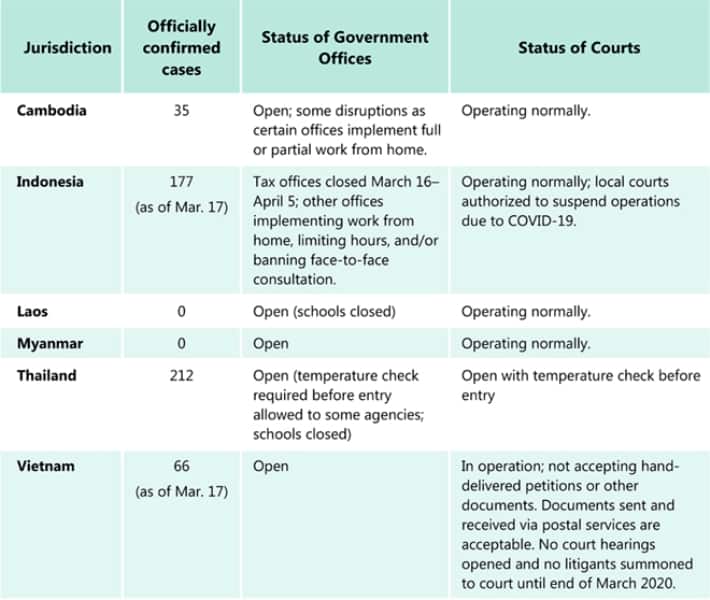
The effects of the global COVID-19 pandemic on Southeast Asia are a deep concern shared by all with connections to the region. To encourage clear understanding of the facts on the ground, Tilleke & Gibbins has prepared this high-level snapshot of the legal situation as it currently stands in each of our jurisdictions.

Administrative and Judicial Functions
Travel Restrictions

Cambodia
The government has imposed the following:

  • Ban on incoming foreign nationals traveling from France, Germany, Iran, Italy, Spain, and the USA for 30 days, effective from March 17, 2020 (or from March 18 for Iran only).
  • Mandatory 14-day self-quarantine for Cambodian citizens traveling from European countries, Iran, or the USA required.
  • Restriction on Cambodian public officials attending meetings in European countries, Iran, or the USA.
  • Ban on entry of cruise ships via Kaam Samnor International Border.

Indonesia
The government has imposed the following:

  • Cancellation of all direct flights to and from China.
  • Suspensions of all visa-on-arrival allowances for one month starting March 20, 2020.
  • Restrictions on incoming travelers who have been in any of the following countries within 14 days of arrival: China, France, Germany, Iran, Italy, South Korea, Spain, Switzerland, the UK, and Vatican City.

Laos
Various border checkpoints have been closed. Further recommendations for travelers from certain affected areas have been issued by the National Taskforce Committee for COVID-19 Prevention and Control on March 16. However, prohibitions, restrictions, and mandatory actions are not formally in place.

Myanmar
An announcement made on March 15, 2020, applies requirements to travelers coming from the following countries:

Thailand
Incoming travelers with a temperature of 37.5 degrees Celsius or higher, and with any symptom associated with COVID-19, will be taken to a hospital approved by the Ministry of Public Health for testing, diagnosis, isolation, and quarantine as necessary.

For all other incoming travelers, the following measures apply:

  • Mandatory 14-day self-quarantine for travelers arriving from China (including Hong Kong and Macau), Iran, Italy, and South Korea.
  • Mandatory self-monitoring and reporting of symptoms in the Ministry of Public Health system for travelers arriving from Denmark, France, Germany, Netherlands, Norway, Spain, Sweden, Switzerland, the UK, and the USA. In addition, travelers from these countries must notify a disease control officer of their location and itinerary so their movements and contacts can be monitored.
  • All of the above incoming travelers must inform a disease control officer immediately upon the onset of any symptom associated with COVID-19.

As for outbound travelers, no blanket restriction has been issued for government employees, but many individual agencies have issued such prohibitions.

Vietnam
As of March 18, 2020, the following measures are in effect:

  • Visas on arrival suspended for all foreign nationals.
  • Travelers entering with visa exemption certificates granted to overseas Vietnamese (Viet Kieu), their relatives, and some other special cases (such as experts, business managers, and skilled workers) must have a certificate proving they have tested negative for the COVID-19 virus. The certificate must be issued by the relevant authority of the host country and also approved by Vietnam, except for those on official or diplomatic trips.
  • All travelers from outside of Vietnam entering with a visa will be subject to health checks and a mandatory 14-day quarantine.

***********

Our primary professional concern, in all things, is for the wellbeing and commerciality of our clients. For that reason, we are implementing practical social distancing measures designed to ensure that we work together safely, effectively, and without change to the quality and efficiency of the services you receive. If you have any queries about these measures, or about any of the information given above, please contact [email protected].

RELATED INSIGHTS​ 

March 19, 2026
Thailand’s Electronic Transactions Development Agency (ETDA), which describes itself as a “co-creation regulator” working collaboratively with industry rather than imposing top-down rules, has unveiled its regulatory roadmap for digital platform businesses under the Royal Decree on Digital Platform Service Businesses B.E. 2565 (2022). The 2026 regulatory approach is guided by three core principles—“practicable, verifiable, shared responsibility”—aimed at elevating digital services to be safe, transparent, and fair. These principles inform ETDA’s 2026 priorities, which focus on three key dimensions: product and service standards on platforms, fair competition and fee transparency, and online fraud prevention. Product and Service Standards ETDA’s 2026 agenda addresses product and service standards across several platform categories: Online marketplace platforms. The Notification on Additional Measures for Online Marketplace Platforms under Section 18(2) came into force on December 31, 2025, designating 21 marketplace platforms that must verify products and merchants. Among other obligations, covered platforms must remove or suspend substandard products under the “notice and take down” principle. The ETDA has collaborated with the Food and Drug Administration and the Thai Industrial Standards Institute to develop inspection manuals and coordinate compliance procedures. Social commerce. The ETDA is preparing a new notification under Section 18(2) specifically targeting social commerce platforms with sales support functions, aiming to align regulation with evolving digital market conditions. Ride sharing. Since the postponement of the deadline to comply with the ETDA’s notification on ride-sharing platforms to March 31, 2026, the ETDA has supported drivers in registering with the Department of Land Transport through the Driver Verify registration system, which has already issued certifications to approximately 27,900 riders. The ETDA is also examining structural issues relating to appropriate insurance packages, motorcycle engine capacity expansion, and fair leasing fees and contract transfer costs in coordination with the Department of Land Transport, the Office of Insurance Commission,
March 19, 2026
Thailand’s Personal Data Protection Committee (PDPC) has launched a public consultation period to gather input for a forthcoming set of guidelines under the country’s Personal Data Protection Act (PDPA). This initiative follows the PDPC’s issuance of guidelines on consent and notification requirements in September 2022. The main consultation period, using an online questionnaire to gather feedback, runs until March 23, 2026. In addition, an interview-style online session for private-sector participants was held on March 17, and a two-day in-person event will be held on April 1–2—this is already fully booked and  walk-ins will not be accepted, but the session will be livestreamed on the PDPC’s Facebook page. The PDPC will use the public feedback to design draft guidelines that accurately reflect the operational realities of both public and private organizations, after which the guidelines will be shared with the public. Consultation Scope The PDPC has identified six priority areas for which upcoming guidance may be issued: Legal bases for processing: The online questionnaire assesses respondents’ understanding of consent requirements and seeks views on priority issues, such as explanations of the legal bases and considerations for selecting an appropriate legal basis depending on the nature of the processing activity. Security measures and data breach notification: The questionnaire examines respondents’ understanding of data breach reporting and security measure obligations. Topics proposed for inclusion in the guidelines include data breach prevention measures, incident response plans, risk assessment methods, and reporting procedures. Data protection officers: Respondents are invited to share their expectations regarding the DPO’s role and their experiences in contacting a DPO. The survey also asks respondents to identify priority issues, such as response timeframes for data subject requests and complaint procedures. Marketing and direct marketing: The online questionnaire seeks input on preferred topics for guidance, including individuals’ rights to refuse marketing
March 17, 2026
Thailand’s Office of Insurance Commission (OIC) has introduced comprehensive group-wide supervision requirements for insurers operating within corporate groups. Published on February 26, 2026, in two separate notifications in the Government Gazette, the new rules establish parallel frameworks for life and non-life insurance companies. Both notifications take effect on July 1, 2026, and impose significant new requirements on insurance business groups. Affected insurers should begin reviewing their group structures, governance frameworks, and risk management systems now to ensure timely compliance. The notifications aim to ensure that group-level operations are orderly, stable, and reliable, and prevent the accumulation of systemic risk that could undermine public confidence in the insurance sector. Both notifications share a substantially parallel structure and require insurers to assess and manage the financial position, risk exposure, reliability, and corporate governance of their entire insurance business group on a comprehensive and ongoing basis. The regulations introduce definitions for several key terms. An “insurance business group” encompasses the insurer together with its ultimate parent company, parent companies, subsidiaries, and related companies. The “head of the insurance business group” is the entity responsible for overseeing group-wide supervision, operations, and governance. An “ultimate parent company” is one that exercises control without itself being controlled by another entity. Key Requirements The notifications establish the following core obligations for insurers: Group structure and shareholding reporting: Insurers must report the organizational chart and shareholding structure of their insurance business group—covering the ultimate parent company, parent companies, subsidiaries, and related entities—to the OIC registrar by June of each year, and whenever material changes occur. The regulations prescribe specific thresholds for determining when shareholding proportions constitute control. Corporate governance standards: Board members, executives, and authorized persons of the ultimate parent company or parent company must not be disqualified (e.g., bankrupt individuals, persons convicted of property-related fraud, or
March 16, 2026
Thailand’s Securities and Exchange Commission (SEC) has broadened the definition of institutional investors, expanded the types of qualifying investments, and updated financial qualification thresholds for various investor categories through a revised notification on the definitions of institutional investors, ultra-high net worth investors, and high net worth investors. The amended framework, which came into force on March 1, 2026, adds digital asset business operators, investment planners, and investment consultants to the roster of entities recognized as institutional investors, and broadens the definition of investment to account for digital tokens. Expanded Definition of Institutional Investors Under the SEC’s revised notification, the category of institutional investors now expressly includes digital asset business operators licensed under the Royal Decree on Digital Asset Businesses B.E. 2561 (2018). This addition recognizes the growing role of digital asset platforms and service providers in Thailand’s investment ecosystem and aligns the regulatory treatment of digital markets with that of traditional markets. The definition of institutional investors now also encompasses investment planners and investment consultants approved by the SEC. Previously, only SEC-approved investment analysts held this status; the expansion covers a broader scope of professionals who possess comparable expertise and experience in evaluating investment opportunities. Broadened Investment Definition The revised framework now defines investment to mean direct or indirect investment in a wider range of assets beyond deposits. Specifically, the definition covers: Securities under the Securities and Exchange Act Derivatives under the Derivatives Act Investment tokens offered to the public Government-issued digital tokens (G-tokens) as specified in a separate SEC notification This expansion ensures that financial status assessments reflect the full spectrum of an investor’s holdings, including emerging digital assets. Updated Financial Qualification Thresholds The amended SEC notification also provides updated qualification thresholds for angel investors, ultra-high net worth investors, and high net worth investors. While the core criteria