
You are using an outdated browser and your browsing experience will not be optimal. Please update to the latest version of Microsoft Edge, Google Chrome or Mozilla Firefox. Install Microsoft Edge

March 19, 2020

COVID-19 Status Update for Southeast Asia – March 18, 2020

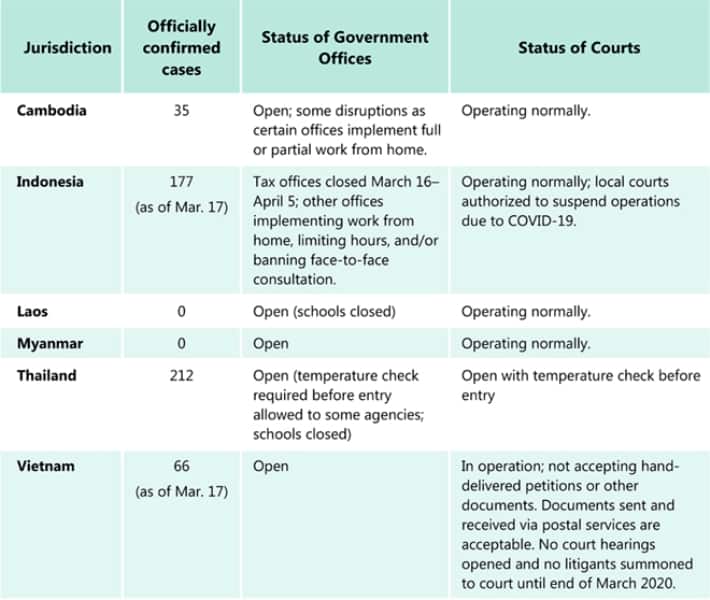
The effects of the global COVID-19 pandemic on Southeast Asia are a deep concern shared by all with connections to the region. To encourage clear understanding of the facts on the ground, Tilleke & Gibbins has prepared this high-level snapshot of the legal situation as it currently stands in each of our jurisdictions.

Administrative and Judicial Functions
Travel Restrictions

Cambodia
The government has imposed the following:

  • Ban on incoming foreign nationals traveling from France, Germany, Iran, Italy, Spain, and the USA for 30 days, effective from March 17, 2020 (or from March 18 for Iran only).
  • Mandatory 14-day self-quarantine for Cambodian citizens traveling from European countries, Iran, or the USA required.
  • Restriction on Cambodian public officials attending meetings in European countries, Iran, or the USA.
  • Ban on entry of cruise ships via Kaam Samnor International Border.

Indonesia
The government has imposed the following:

  • Cancellation of all direct flights to and from China.
  • Suspensions of all visa-on-arrival allowances for one month starting March 20, 2020.
  • Restrictions on incoming travelers who have been in any of the following countries within 14 days of arrival: China, France, Germany, Iran, Italy, South Korea, Spain, Switzerland, the UK, and Vatican City.

Laos
Various border checkpoints have been closed. Further recommendations for travelers from certain affected areas have been issued by the National Taskforce Committee for COVID-19 Prevention and Control on March 16. However, prohibitions, restrictions, and mandatory actions are not formally in place.

Myanmar
An announcement made on March 15, 2020, applies requirements to travelers coming from the following countries:

Thailand
Incoming travelers with a temperature of 37.5 degrees Celsius or higher, and with any symptom associated with COVID-19, will be taken to a hospital approved by the Ministry of Public Health for testing, diagnosis, isolation, and quarantine as necessary.

For all other incoming travelers, the following measures apply:

  • Mandatory 14-day self-quarantine for travelers arriving from China (including Hong Kong and Macau), Iran, Italy, and South Korea.
  • Mandatory self-monitoring and reporting of symptoms in the Ministry of Public Health system for travelers arriving from Denmark, France, Germany, Netherlands, Norway, Spain, Sweden, Switzerland, the UK, and the USA. In addition, travelers from these countries must notify a disease control officer of their location and itinerary so their movements and contacts can be monitored.
  • All of the above incoming travelers must inform a disease control officer immediately upon the onset of any symptom associated with COVID-19.

As for outbound travelers, no blanket restriction has been issued for government employees, but many individual agencies have issued such prohibitions.

Vietnam
As of March 18, 2020, the following measures are in effect:

  • Visas on arrival suspended for all foreign nationals.
  • Travelers entering with visa exemption certificates granted to overseas Vietnamese (Viet Kieu), their relatives, and some other special cases (such as experts, business managers, and skilled workers) must have a certificate proving they have tested negative for the COVID-19 virus. The certificate must be issued by the relevant authority of the host country and also approved by Vietnam, except for those on official or diplomatic trips.
  • All travelers from outside of Vietnam entering with a visa will be subject to health checks and a mandatory 14-day quarantine.

***********

Our primary professional concern, in all things, is for the wellbeing and commerciality of our clients. For that reason, we are implementing practical social distancing measures designed to ensure that we work together safely, effectively, and without change to the quality and efficiency of the services you receive. If you have any queries about these measures, or about any of the information given above, please contact [email protected].

RELATED INSIGHTS​ 

April 3, 2026
Thailand’s Securities and Exchange Commission (SEC) has established a comprehensive governance framework for the use of artificial intelligence and machine learning (AI/ML) in the capital markets. The framework provides guidance to capital market business operators on understanding the risks associated with AI/ML implementation and adopting appropriate practices to build public confidence in Thailand’s capital markets. While the guidelines are principle-based rather than prescriptive, they reflect the SEC’s expectations for responsible AI/ML governance and are likely to inform supervisory activities and industry standards going forward. Scope The framework applies to capital market business operators supervised by the SEC. This includes, for example, securities and derivatives firms, asset management companies, mutual fund and private fund managers, investment advisors and investment consultants (including robo-advisory service providers), derivatives intermediaries, and other licensed intermediaries and market operators in the Thai capital markets that deploy AI/ML in their operations. Core Principles of the Guidelines The framework is presented as a best-practice manual rather than prescriptive regulation, providing guidance that regulated entities may apply to their AI/ML governance and risk management as appropriate. While currently nonbinding, the guidelines signal the SEC’s expectations for the sector, particularly in relation to other binding SEC regulations such as those covering IT risk management and market conduct. The guidelines name four core principles for AI/ML deployment: Fairness: Design and develop AI/ML with consideration for fairness, equality, and social diversity to prevent discrimination against individuals or groups. Legal and ethical compliance: Ensure AI/ML use aligns with applicable laws, ethical standards, and organizational values and policies. Accountability: Establish clear responsibility—both internally and externally—for AI/ML activities and outcomes. Transparency: Provide adequate disclosure to users about AI/ML use, including explainability of decisions and traceability of activities. AI/ML Best Practices The guidelines prescribe best practices across four stages of the AI/ML lifecycle, as described below.
April 2, 2026
Thailand’s Personal Data Protection Act (PDPA) enforcement has entered a new phase, and the insurance industry is squarely in the regulatory spotlight. The Personal Data Protection Committee (PDPC) considers insurers “large-scale” processors of sensitive data—including health records, financial information, and biometric data—making the sector a focal point for enforcement action. In August 2025 alone, the PDPC issued administrative fines totaling THB 21.5 million, and fines for individual violations have ranged from THB 50,000 to THB 2 million. The PDPC has also deployed its “Eagle Eye Crawler,” an AI-driven surveillance tool that monitors websites around the clock for data leaks and noncompliant privacy notices. This article highlights the key regulatory developments directly affecting insurers and outlines practical steps toward compliance. What Has Changed: OIC and PDPC Alignment The Office of Insurance Commission (OIC) has synchronized its sector-specific rules with the PDPA through the Notification on Customer Personal Data Protection (No. 2) B.E. 2568 (2025). The combined effect of the PDPC’s general enforcement push and the OIC’s sectoral guidance creates four critical compliance areas for insurers. Consent unbundling. Consent for marketing must be strictly separated from the core insurance contract; bundling marketing consent into the policy application is no longer permissible. Agent and intermediary oversight. Insurance intermediaries are generally classified as data processors, meaning that insurers—as data controllers—must provide specific written instructions and security protocols to all agents and brokers. A 2026 enforcement trend shows controllers being held liable for the “weak security” of their vendors and downstream processors. Enhanced privacy notices. Insurers must provide a summary privacy notice alongside the full policy, plainly stating categories of data, purposes, lawful bases, disclosure recipients, cross-border transfers, retention periods, data subject rights, and easy marketing opt-out channels. DPO registration and ROPA. All organizations involved in “regular or systematic monitoring of data subjects on
March 30, 2026
In response to an emerging crisis on food safety, the government of Vietnam promulgated Decree No. 46/2026/ND-CP (Decree 46) on January 26, 2026, and Resolution No. 66.13/2026/NQ-CP (Resolution 66.13) on January 27, 2026, setting out a number of substantive changes to the procedure and strict requirements for the declaration, registration, and importation of food products. Both instruments took effect upon issuance. However, shortly after they entered into force, food businesses encountered significant implementation challenges, particularly with respect to state inspection procedures at the customs clearance stage for imported products. In response, the government issued Resolution No. 09/2026/NQ-CP (Resolution 09) on February 4, 2026, temporarily suspending Decree 46 and Resolution 66.13 until a new effective date of April 16, 2026. Continued Suspension of Implementation of Decree 46 and Resolution 66.13 After considering feedback gathered by the Ministry of Health from food businesses and other stakeholders during the suspension period, the Vietnam Government Office issued a notice on March 20, 2026, agreeing to extend the suspension until the issuance of an amended Law on Food Safety and its guiding decree. Following this notice, on March 22, 2026, the Ministry of Health prepared a draft resolution to implement the notice and replace Resolution 09. Under the draft resolution, the effectiveness of Decree 46 and Resolution No. 66.13 would continue to be suspended until the amended Law on Food Safety takes effect, except for the provisions under Resolution 66.13 allowing flexibility in documents evidencing product efficacy, which would take effect on April 16, 2026, and remain effective until the Law on Food Safety is replaced (but not later than February 28, 2027). Accordingly, for products subject to the registration declaration procedure, such as health supplements, efficacy may be substantiated by either (i) scientific evidence supporting the declared function and effects of the product
March 30, 2026
On March 24, 2026, the Trade Competition Commission of Thailand (TCCT) published its long-anticipated Guidelines on Multi-Sided Platforms and E-Commerce Businesses in the Government Gazette, following the conclusion of a public hearing conducted last year. The guidelines entered into force on March 25, 2026, and significantly expand the application of Thai competition law to digital platform ecosystems. These rules introduce targeted restrictions on platform conduct, such as price-ranking algorithms and tying and bunding, that leverages network effects, and will have far-reaching implications across Thailand’s digital economy—affecting not only platform operators but also platform participants, including sellers, logistics providers, advertisers, and payment service providers operating on or alongside such platforms. The guidelines clarify how existing prohibitions under the Trade Competition Act B.E. 2560 (2017) (TCA)—including abuse of market dominance, cartel conduct, and unfair trade practices—apply in the context of platform-based business models. While many provisions reflect earlier draft guidelines, the final version delivers more precise definitions and clearer enforcement parameters, increasing regulatory certainty while also raising compliance expectations. Applicability The guidelines introduce core definitions that determine their coverage: Multi-sided platform: A platform that acts as an intermediary connecting two or more groups of users, enabling them to have direct interaction in order to exchange or rely on services from one another. Examples include digital platforms for trading goods or services (e-commerce), as defined below. Digital platform for trading goods or services (e-commerce): A platform that acts as an intermediary connecting the distribution, purchase, sale, or exchange of goods or services. This includes operations carried out to facilitate transactions or interactions between business operators through an electronic transaction system, regardless of whether a service fee is charged. Operator of a digital platform business for trading goods or services: A provider of digital platform services for trading goods or services, as described