
You are using an outdated browser and your browsing experience will not be optimal. Please update to the latest version of Microsoft Edge, Google Chrome or Mozilla Firefox. Install Microsoft Edge

March 19, 2020

COVID-19 Status Update for Southeast Asia – March 18, 2020

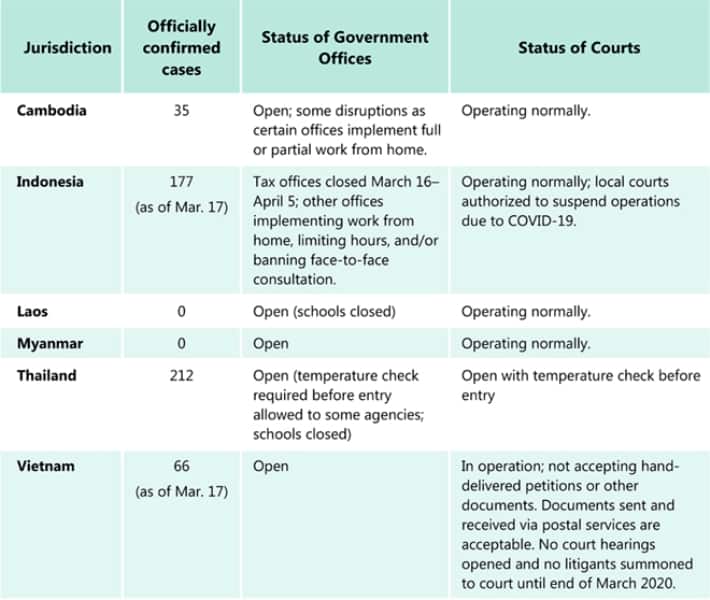
The effects of the global COVID-19 pandemic on Southeast Asia are a deep concern shared by all with connections to the region. To encourage clear understanding of the facts on the ground, Tilleke & Gibbins has prepared this high-level snapshot of the legal situation as it currently stands in each of our jurisdictions.

Administrative and Judicial Functions
Travel Restrictions

Cambodia
The government has imposed the following:

  • Ban on incoming foreign nationals traveling from France, Germany, Iran, Italy, Spain, and the USA for 30 days, effective from March 17, 2020 (or from March 18 for Iran only).
  • Mandatory 14-day self-quarantine for Cambodian citizens traveling from European countries, Iran, or the USA required.
  • Restriction on Cambodian public officials attending meetings in European countries, Iran, or the USA.
  • Ban on entry of cruise ships via Kaam Samnor International Border.

Indonesia
The government has imposed the following:

  • Cancellation of all direct flights to and from China.
  • Suspensions of all visa-on-arrival allowances for one month starting March 20, 2020.
  • Restrictions on incoming travelers who have been in any of the following countries within 14 days of arrival: China, France, Germany, Iran, Italy, South Korea, Spain, Switzerland, the UK, and Vatican City.

Laos
Various border checkpoints have been closed. Further recommendations for travelers from certain affected areas have been issued by the National Taskforce Committee for COVID-19 Prevention and Control on March 16. However, prohibitions, restrictions, and mandatory actions are not formally in place.

Myanmar
An announcement made on March 15, 2020, applies requirements to travelers coming from the following countries:

Thailand
Incoming travelers with a temperature of 37.5 degrees Celsius or higher, and with any symptom associated with COVID-19, will be taken to a hospital approved by the Ministry of Public Health for testing, diagnosis, isolation, and quarantine as necessary.

For all other incoming travelers, the following measures apply:

  • Mandatory 14-day self-quarantine for travelers arriving from China (including Hong Kong and Macau), Iran, Italy, and South Korea.
  • Mandatory self-monitoring and reporting of symptoms in the Ministry of Public Health system for travelers arriving from Denmark, France, Germany, Netherlands, Norway, Spain, Sweden, Switzerland, the UK, and the USA. In addition, travelers from these countries must notify a disease control officer of their location and itinerary so their movements and contacts can be monitored.
  • All of the above incoming travelers must inform a disease control officer immediately upon the onset of any symptom associated with COVID-19.

As for outbound travelers, no blanket restriction has been issued for government employees, but many individual agencies have issued such prohibitions.

Vietnam
As of March 18, 2020, the following measures are in effect:

  • Visas on arrival suspended for all foreign nationals.
  • Travelers entering with visa exemption certificates granted to overseas Vietnamese (Viet Kieu), their relatives, and some other special cases (such as experts, business managers, and skilled workers) must have a certificate proving they have tested negative for the COVID-19 virus. The certificate must be issued by the relevant authority of the host country and also approved by Vietnam, except for those on official or diplomatic trips.
  • All travelers from outside of Vietnam entering with a visa will be subject to health checks and a mandatory 14-day quarantine.

***********

Our primary professional concern, in all things, is for the wellbeing and commerciality of our clients. For that reason, we are implementing practical social distancing measures designed to ensure that we work together safely, effectively, and without change to the quality and efficiency of the services you receive. If you have any queries about these measures, or about any of the information given above, please contact [email protected].

RELATED INSIGHTS​ 

May 11, 2026
Vietnam’s legal framework governing chemicals has undergone significant reform, with the Law on Chemicals No. 69/2025/QH15 (Law on Chemicals 2025) taking effect on January 1, 2026. Together with a comprehensive set of implementing instruments issued in January 2026, including three decrees (No. 24/2026/ND‑CP, No. 25/2026/ND‑CP, and No. 26/2026/ND‑CP) and two circulars (No. 01/2026/TT‑BCT and No. 02/2026/TT‑BCT), the Law on Chemicals 2025 has significantly reshaped chemical registration and management requirements. Determining What Constitutes a “New Chemical” Among the most notable changes introduced under the Law on Chemicals 2025 are the rules governing the registration and management of new chemicals, which must be registered with the authority before being placed on the Vietnam market. Although the concept of new chemical registration was first introduced under the Law on Chemicals 2007, the corresponding registration mechanism has remained largely dormant in practice. Under the Law on Chemicals 2025, a “new chemical” is defined as a substance that is not yet included in Vietnam’s National Chemical Inventory and the list of foreign chemical inventories recognized by the competent Vietnamese authority (List of Foreign Chemicals). On a literal reading, the definition in the new law may suggest that a substance qualifies as a new chemical only if it is absent from both lists. Accordingly, a chemical present in either list should be treated as an existing chemical without the registration burden. However, a different interpretation emerges from Decree 26, which specifically requires registration of “new chemicals” even where such substances already appear in the List of Foreign Chemicals. This implies that inclusion in a recognized foreign inventory does not automatically exempt a substance from new chemical registration in Vietnam. This inconsistency between the statutory definition in the Law on Chemicals 2025 and the implementing provisions of Decree 26 creates significant interpretative and compliance challenges. At
May 6, 2026
Thailand has introduced new requirements for online social media platforms to verify the identity of paying advertisers before publishing their advertisements. On May 5, 2026, the Electronic Transactions Commission published the Notification on Measures for Prevention of Technology Crime for Online Social Media (No. 2) in the Government Gazette. The notification, which aims to prevent technology crimes such as fraud and scams, takes effect 180 days after publication (i.e., on November 1, 2026). Mandatory Advertiser Identity Verification Online social media service providers must verify the identity of every advertiser before publishing an advertisement. Verification remains valid for up to one year from the most recent verification date. The notification requires social media providers to use either of the following methods when verifying advertisers: Document-based verification: Examine government-issued identity documents (e.g., national ID, passport, or juristic person registration certificate), cross-check the connection between the advertiser and the identity documents (e.g., facial comparison with photo ID), and ensure that the identity documents are verifiable against reliable sources. Digital identity verification: Use an identity verification system with a level of assurance no lower than that prescribed by the Electronic Transactions Commission. Advertiser Data Collection and Retention Service providers must collect and retain certain data—including name, identification number, and contact details—from the start of the advertising service and for a minimum of 90 days after the end of the advertising service relationship. The same requirements apply where there is a third-party payer, such as an ad agency. Implications for Affected Businesses The notification raises two key areas of concern for affected businesses: Social media platforms must implement know-your-advertiser (KYA) onboarding as described above, including document upload and identity matching processes. The 180-day implementation window requires immediate technical and operational planning. The collection and retention of national ID cards, passport copies, and other personal
April 30, 2026
Vietnam’s Decree No. 134/2026/ND‑CP, which took effect on 9 April 2026, plays an important role in detailing and implementing Vietnam’s Intellectual Property (IP) Law in the context of rapid digital transformation and the growing application of artificial intelligence (AI). The new decree provides comprehensive guidance on the application of copyright and related‑rights regulations, addressing key issues such as authorship, ownership, statutory exceptions and limitations, registration procedures, and enforcement mechanisms. Through these measures, Decree 134 seeks to achieve an appropriate balance between safeguarding the legitimate interests of rightsholders and fostering innovation, research, and technological advancement, thereby strengthening the state’s framework for the effective management, protection, and exploitation of intellectual property in the digital and AI‑driven environment. Some notable aspects of Decree 134 are discussed below. Copyright for AI-Created Works Decree 134 provides important guidance on the determination of copyright and related rights in works created with the assistance of AI. Article 5a reaffirms the principle that human creativity remains central to copyright protection, clarifying that copyright or related rights arise only where a human makes a substantial and decisive intellectual contribution, exercises effective control over the creative outcome, and assumes responsibility for the content and its legality. At the same time, the provision confirms that AI is regarded solely as a technological tool rather than a rights‑holding subject, thus ensuring consistency with the fundamental concepts of authorship and ownership under the IP Law. By introducing requirements on transparency, proof of human contribution, and compliance with AI‑specific labelling and technical marking obligations, Decree 134 establishes a clear and enforceable legal framework for the responsible use of AI in creative activities. Lawful Use of Copyrighted Texts and Data Article 37a of Decree 134 sets out the specific conditions under which copyrighted texts and data may be lawfully used for scientific research, experimentation,
April 29, 2026
Effective June 22, 2026, Thai Industrial Standards (TIS) for food contact paper and cooking paper will be enforced as mandatory for sale in the Thai market. This move has important implications for product licensing and tightens hygiene, labeling, and chemical-safety requirements for food-contact and cooking paper products. Thailand is strengthening its regulatory framework for paper-based culinary materials against a backdrop of accelerating global commitments to ESG and sustainability, as such materials—particularly those derived from natural or recycled fibers—have emerged as key alternatives to plastics in food preparation, cooking, and packaging applications. As a result, regulators worldwide are tightening controls to ensure that sustainability initiatives do not compromise consumer safety, particularly regarding the potential migration of chemical substances into food. Regulatory Framework: Voluntary vs. Mandatory Standards Standards under the TIS regime are generally classified into two categories. Voluntary standards allow manufacturers or importers to apply for a product license and affix the TIS mark to demonstrate product quality and build consumer confidence, but compliance is not legally required. Mandatory standards, by contrast, require manufacturers and importers to obtain a product license and affix the TIS mark before placing products on the Thai market, and noncompliant products cannot be legally sold. Previously, the TIS standards for food contact paper (TIS 2948-2562) and cooking paper (TIS 3438-2022) fell under the voluntary standard regime, meaning that obtaining a TIS license and displaying the TIS mark was optional. However, due to the increasing use of paper in food preparation and cooking, the Thai Industrial Standards Institute has determined that upgrading these standards to mandatory status is necessary to enhance consumer safety. As a result, all paper intended for food contact or cooking purposes must now obtain a TIS product license prior to sale in Thailand. Scope of the Standards The primary distinction between the