
You are using an outdated browser and your browsing experience will not be optimal. Please update to the latest version of Microsoft Edge, Google Chrome or Mozilla Firefox. Install Microsoft Edge

March 19, 2020

COVID-19 Status Update for Southeast Asia – March 18, 2020

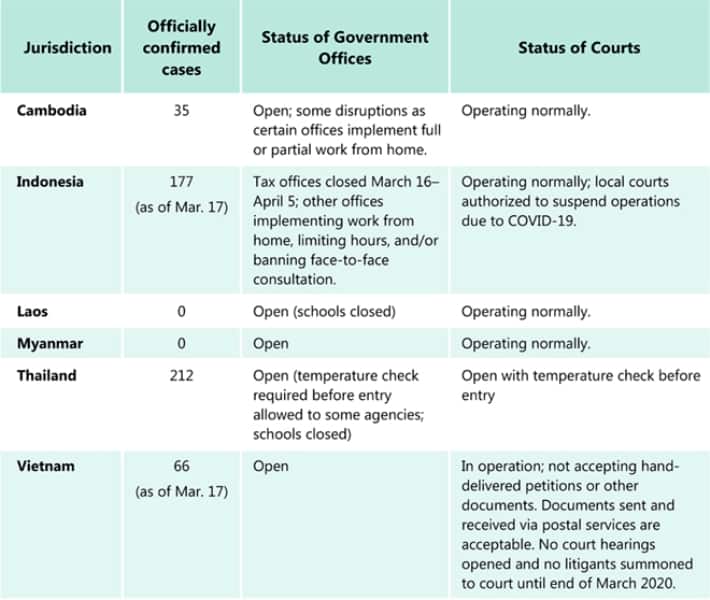
The effects of the global COVID-19 pandemic on Southeast Asia are a deep concern shared by all with connections to the region. To encourage clear understanding of the facts on the ground, Tilleke & Gibbins has prepared this high-level snapshot of the legal situation as it currently stands in each of our jurisdictions.

Administrative and Judicial Functions
Travel Restrictions

Cambodia
The government has imposed the following:

  • Ban on incoming foreign nationals traveling from France, Germany, Iran, Italy, Spain, and the USA for 30 days, effective from March 17, 2020 (or from March 18 for Iran only).
  • Mandatory 14-day self-quarantine for Cambodian citizens traveling from European countries, Iran, or the USA required.
  • Restriction on Cambodian public officials attending meetings in European countries, Iran, or the USA.
  • Ban on entry of cruise ships via Kaam Samnor International Border.

Indonesia
The government has imposed the following:

  • Cancellation of all direct flights to and from China.
  • Suspensions of all visa-on-arrival allowances for one month starting March 20, 2020.
  • Restrictions on incoming travelers who have been in any of the following countries within 14 days of arrival: China, France, Germany, Iran, Italy, South Korea, Spain, Switzerland, the UK, and Vatican City.

Laos
Various border checkpoints have been closed. Further recommendations for travelers from certain affected areas have been issued by the National Taskforce Committee for COVID-19 Prevention and Control on March 16. However, prohibitions, restrictions, and mandatory actions are not formally in place.

Myanmar
An announcement made on March 15, 2020, applies requirements to travelers coming from the following countries:

Thailand
Incoming travelers with a temperature of 37.5 degrees Celsius or higher, and with any symptom associated with COVID-19, will be taken to a hospital approved by the Ministry of Public Health for testing, diagnosis, isolation, and quarantine as necessary.

For all other incoming travelers, the following measures apply:

  • Mandatory 14-day self-quarantine for travelers arriving from China (including Hong Kong and Macau), Iran, Italy, and South Korea.
  • Mandatory self-monitoring and reporting of symptoms in the Ministry of Public Health system for travelers arriving from Denmark, France, Germany, Netherlands, Norway, Spain, Sweden, Switzerland, the UK, and the USA. In addition, travelers from these countries must notify a disease control officer of their location and itinerary so their movements and contacts can be monitored.
  • All of the above incoming travelers must inform a disease control officer immediately upon the onset of any symptom associated with COVID-19.

As for outbound travelers, no blanket restriction has been issued for government employees, but many individual agencies have issued such prohibitions.

Vietnam
As of March 18, 2020, the following measures are in effect:

  • Visas on arrival suspended for all foreign nationals.
  • Travelers entering with visa exemption certificates granted to overseas Vietnamese (Viet Kieu), their relatives, and some other special cases (such as experts, business managers, and skilled workers) must have a certificate proving they have tested negative for the COVID-19 virus. The certificate must be issued by the relevant authority of the host country and also approved by Vietnam, except for those on official or diplomatic trips.
  • All travelers from outside of Vietnam entering with a visa will be subject to health checks and a mandatory 14-day quarantine.

***********

Our primary professional concern, in all things, is for the wellbeing and commerciality of our clients. For that reason, we are implementing practical social distancing measures designed to ensure that we work together safely, effectively, and without change to the quality and efficiency of the services you receive. If you have any queries about these measures, or about any of the information given above, please contact [email protected].

RELATED INSIGHTS​ 

July 21, 2026
Thailand’s Ministry of Digital Economy and Society (MDES) published a notification establishing an expedited court-ordered takedown mechanism for online content in cases of “urgent necessity.” The notification, which was issued on July 17, 2026, under the Computer Crime Act B.E. 2550 (2007), as amended, took effect the following day. It significantly expands the categories of content subject to rapid government-initiated removal. Content Categories Subject to Takedown The notification defines “urgent necessity” (section 20, paragraph 5, of the Computer Crime Act) as circumstances where any delay in suppressing computer data may impact national security, religion, the monarchy, good morals, social culture, or public order. In this regard, it establishes four broad categories of content: Computer Crime Act offenses. National security offenses. IP and other criminal offenses, where it is contrary to public order or good morals and a competent officer has requested its suppression. Content contrary to public order or good morals, a broad residual category encompassing 14 subcategories approved by the Computer Data Screening Committee. The fourth category is the most expansive. Its 14 subcategories include: Content defaming, mocking, satirizing, or devaluing the monarchy. Online gambling advertising or facilitation. Offering illegal firearms for sale. Offering baraku (hookah) products or e-cigarettes for sale. Offering cannabis inflorescences or processed cannabis products for sale. Advertising or soliciting prostitution. Content inciting violence, hatred, or social division. Unauthorized overseas employment advertising. Offering boiled kratom juice for sale. Online sale or advertising of alcoholic beverages. Content satirizing or degrading Buddhism. Money lending at interest rates exceeding legally prescribed limits. Advertising or disseminating information about surrogacy services. Forgery of documents, cards, or official documents. Enforcement Procedure In cases of urgent necessity, a competent official assigned by the MDES permanent secretary must file a petition with supporting evidence to the court with jurisdiction, requesting an order to
July 20, 2026
On July 16, 2026, Thailand’s Personal Data Protection Committee (PDPC) published a notification in the Government Gazette establishing detailed rules governing data subjects’ right of access under section 30 of the Personal Data Protection Act B.E. 2562 (2019) (PDPA). The notification will take effect 60 days after publication—mid-September 2026—giving data controllers a limited window to bring their processes into compliance. Scope The notification covers requests to access or obtain copies of personal data and requests for disclosure of the source of data collected without consent. Data subjects may exercise their rights directly or through authorized representatives. Key Requirements Important requirements set by the notification include the following: Required request channels. Controllers must provide at least two request channels: direct submission at the business location and registered mail. Electronic channels are optional but, if offered, may also be used for fulfilling requests. Request contents. Requests must be in writing or in electronic form and include the data subject’s name, the preferred access method, details of the data requested, and the requester’s signature. Controllers may request additional identifying information as needed. Identity and authority verification. Controllers may require official identity documents for verification. Authorized representatives must provide authorization documents and identity documents for both the data subject and the representative. Alternative verification methods (e.g., digital authentication) are permitted if they do not unreasonably obstruct data subjects’ rights. Review and response timelines. Controllers must review requests within 15 days. If the request is incomplete, the controller must notify the requester and allow at least 15 days to correct deficiencies. If not corrected, the request may be treated as abandoned. Once verified, controllers must fulfill requests within 30 days, extendable by another 30 days for large-volume or complex requests with notice to the requester. Methods for providing access or copies. Controllers may fulfill
July 16, 2026
Thailand’s Office of the Personal Data Protection Committee (PDPC) published a series of draft guidance documents for public consultation on July 7, 2026. Issued under the Personal Data Protection Act B.E. 2562 (2019) (PDPA), the drafts address a range of compliance issues and offer insight into the regulator’s current enforcement priorities. This article examines two of those drafts: one on lawful bases for processing personal data, and another on marketing and direct marketing. Together, they reflect the Office of the PDPC’s evolving expectations on lawful-basis selection, accountability, and the use of personal data in marketing. Organizations operating in Thailand should assess the practical implications now, before the guidance is finalized. Lawful Bases: A Structured Selection Process The draft guidance on lawful bases introduces a systematic five-step process for selecting an appropriate lawful basis for each processing activity. Organizations are expected to: Identify the processing activity involved. Assess the appropriate lawful basis. Evaluate whether the data is necessary for the processing. Conduct a legitimate interest assessment (LIA) where applicable. Ensure transparency through privacy notices. The guidance provides practical explanations and examples for each lawful basis under section 24 of the PDPA—including archiving, research, statistics, vital interests, contractual necessity, legal obligation, public task, legitimate interests, and consent—as well as the bases applicable to sensitive personal data under section 26. The aim is to promote more consistent and accurate lawful-basis selection across public- and private-sector organizations. A recurring theme throughout the guidance is that organizations should select the lawful basis that most accurately reflects the actual purpose and circumstances of the processing activity. The guidance cautions against treating consent as a default or catch-all basis where another lawful basis is more appropriate. For processing based on legitimate interests, organizations should conduct and document an LIA. Processing involving sensitive personal data may require
July 14, 2026
Thailand’s National Broadcasting and Telecommunications Commission (NBTC) has published guidelines establishing a risk-based framework for the responsible use of artificial intelligence by telecom licensees. Released on July 2, 2026, the Guidelines on the Use of Artificial Intelligence for Telecommunications Services address governance structures, ethical principles, lifecycle management, and consumer protection obligations. Scope and Legal Context The nonbinding guidelines apply to holders of telecom business licenses under Thailand’s telecom licensing laws, but only with respect to the use of AI in providing licensed telecom services. Entities without such licenses are not directly subject to the guidelines, though they may be affected as third-party AI solution providers to licensees. The guidelines supplement and should be read alongside existing laws, including the Cybersecurity Act, the Personal Data Protection Act (PDPA), the Computer Crime Act, and the NBTC Notification regarding Measures to Protect Telecommunications Service Users’ Rights Regarding Personal Data, Privacy Rights, and Freedom of Telecommunications, as well as forthcoming AI governance legislation being drafted by the ETDA. AI Governance Structure Licensees are expected to establish committees, working groups, or designated officers at both policy and operational levels to set strategic direction for AI use, formulate governance policies and tools, and oversee risk management. Roles, responsibilities, and accountability should be clearly defined for all personnel across every stage of the AI lifecycle—including for third-party AI solution providers and outsourced service providers, whose obligations should be explicitly documented in service agreements. Core Principles The guidelines identify six core principles that licensees should adhere to when deploying AI: Compliance with laws, ethics, and international standards: AI should respect privacy, dignity, and human rights, and content filtering for inputs and outputs should be considered. For example, the AI should not be designed and developed to be used in generating false information, supporting illegal activities, or causing