
You are using an outdated browser and your browsing experience will not be optimal. Please update to the latest version of Microsoft Edge, Google Chrome or Mozilla Firefox. Install Microsoft Edge

March 19, 2020

COVID-19 Status Update for Southeast Asia – March 18, 2020

The effects of the global COVID-19 pandemic on Southeast Asia are a deep concern shared by all with connections to the region. To encourage clear understanding of the facts on the ground, Tilleke & Gibbins has prepared this high-level snapshot of the legal situation as it currently stands in each of our jurisdictions.

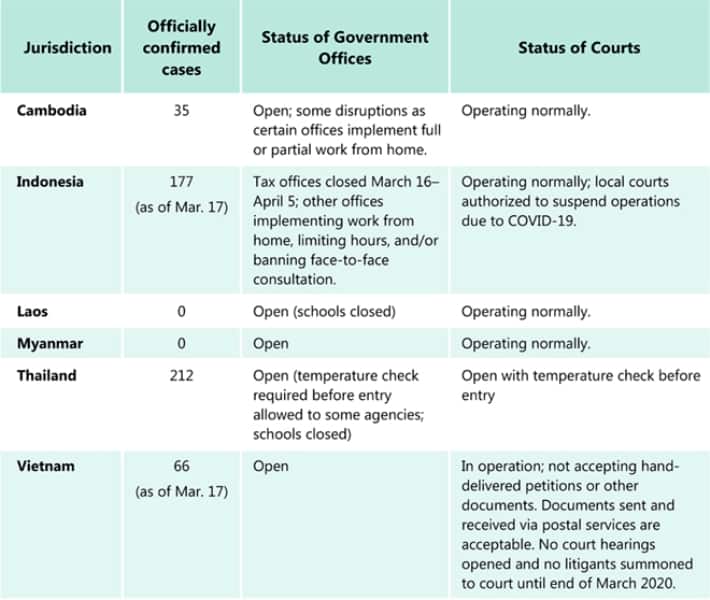
Administrative and Judicial Functions
Travel Restrictions

Cambodia
The government has imposed the following:

  • Ban on incoming foreign nationals traveling from France, Germany, Iran, Italy, Spain, and the USA for 30 days, effective from March 17, 2020 (or from March 18 for Iran only).
  • Mandatory 14-day self-quarantine for Cambodian citizens traveling from European countries, Iran, or the USA required.
  • Restriction on Cambodian public officials attending meetings in European countries, Iran, or the USA.
  • Ban on entry of cruise ships via Kaam Samnor International Border.

Indonesia
The government has imposed the following:

  • Cancellation of all direct flights to and from China.
  • Suspensions of all visa-on-arrival allowances for one month starting March 20, 2020.
  • Restrictions on incoming travelers who have been in any of the following countries within 14 days of arrival: China, France, Germany, Iran, Italy, South Korea, Spain, Switzerland, the UK, and Vatican City.

Laos
Various border checkpoints have been closed. Further recommendations for travelers from certain affected areas have been issued by the National Taskforce Committee for COVID-19 Prevention and Control on March 16. However, prohibitions, restrictions, and mandatory actions are not formally in place.

Myanmar
An announcement made on March 15, 2020, applies requirements to travelers coming from the following countries:

Thailand
Incoming travelers with a temperature of 37.5 degrees Celsius or higher, and with any symptom associated with COVID-19, will be taken to a hospital approved by the Ministry of Public Health for testing, diagnosis, isolation, and quarantine as necessary.

For all other incoming travelers, the following measures apply:

  • Mandatory 14-day self-quarantine for travelers arriving from China (including Hong Kong and Macau), Iran, Italy, and South Korea.
  • Mandatory self-monitoring and reporting of symptoms in the Ministry of Public Health system for travelers arriving from Denmark, France, Germany, Netherlands, Norway, Spain, Sweden, Switzerland, the UK, and the USA. In addition, travelers from these countries must notify a disease control officer of their location and itinerary so their movements and contacts can be monitored.
  • All of the above incoming travelers must inform a disease control officer immediately upon the onset of any symptom associated with COVID-19.

As for outbound travelers, no blanket restriction has been issued for government employees, but many individual agencies have issued such prohibitions.

Vietnam
As of March 18, 2020, the following measures are in effect:

  • Visas on arrival suspended for all foreign nationals.
  • Travelers entering with visa exemption certificates granted to overseas Vietnamese (Viet Kieu), their relatives, and some other special cases (such as experts, business managers, and skilled workers) must have a certificate proving they have tested negative for the COVID-19 virus. The certificate must be issued by the relevant authority of the host country and also approved by Vietnam, except for those on official or diplomatic trips.
  • All travelers from outside of Vietnam entering with a visa will be subject to health checks and a mandatory 14-day quarantine.

***********

Our primary professional concern, in all things, is for the wellbeing and commerciality of our clients. For that reason, we are implementing practical social distancing measures designed to ensure that we work together safely, effectively, and without change to the quality and efficiency of the services you receive. If you have any queries about these measures, or about any of the information given above, please contact [email protected].

RELATED INSIGHTS​ 

April 23, 2026
Vietnam has progressively positioned blockchain as a strategic technology within its broader digital transformation agenda over the past decade. From early policy orientations to more recent legislative developments, the regulatory approach has gradually shifted from high-level recognition to more concrete legal integration. Against this backdrop, a new draft decree regulating activities relating to product and goods identification, authentication, and traceability (the “Draft Decree”) marks a notable turning point. Rather than merely referencing blockchain as a policy priority, the Draft Decree incorporates blockchain directly into a nationwide regulatory system, positioning it as part of the underlying infrastructure for data governance and public administration in relation to the management, verification, and traceability of product-related data. Evolution of Vietnam’s Blockchain Legal Framework: The Draft Decree in Context Vietnam’s blockchain legal framework has developed in several distinct phases. The first phase, beginning around 2019, was characterized by high-level policy recognition in several resolutions of the Party Central Committee. Particularly, blockchain was identified as part of the broader category of digital technologies critical to industrial modernization and participation in the Fourth Industrial Revolution. These resolutions did not regulate blockchain directly, but established its strategic importance at the national level. The second phase (2023 to 2025) saw the introduction of national strategies and technology policies that more explicitly recognized blockchain as a priority technology. Those policies collectively signaled a clear policy commitment to developing blockchain infrastructure and applications. However, these instruments remained largely at a policy-level and did not establish binding regulatory frameworks. The third phase (from 2025) involves the gradual integration of blockchain into sectoral legislation. Laws such as the Law on Digital Technology Industry (2025), the Law on Personal Data Protection (2025), and the Law on Science, Technology, and Innovation (2025) have introduced concepts such as digital assets, crypto assets, and even specific
April 22, 2026
A new decree in Vietnam brings significant implementation clarity to the country’s existing extended producer responsibility (EPR) legal framework. An EPR mechanism was first codified in Vietnam in the 2020 Law on Environmental Protection amid ongoing challenges surrounding the collection and treatment of product and packaging waste. The mechanism was progressively detailed through Decree No. 08/2022/ND‑CP and its successive amendments, but the regulatory framework remained insufficiently developed, notably in terms of support mechanisms for waste collection, recycling, and treatment. The newly launched regulations in Decree No. 110/2026/ND-CP (Decree 110), issued on April 1, 2026, and taking effect on May 25, 2026, stipulate fully and clearly the responsibility of manufacturers and importers to recycle products and packaging and to treat waste. Some key provisions of Decree 110 for manufacturers, importers, and related stakeholders are presented below. Subjects of EPR The Law on Environmental Protection assigns responsibility to manufacturers and importers for product and packaging recycling (under Article 54) or waste collection and treatment (under Article 55), depending on the type of products and packaging they produce or import. Decree 110 elaborates on these EPR provisions by specifying the responsible entities and listing out the types of products and packaging subject to recycling and waste treatment responsibilities. Decree 110 clarifies the responsible entities in special cases, such as when products under the same brand are made by multiple manufacturers, when there is a contract manufacturing or entrusted import relationship, and when the manufacturer or importer is part of a corporate group. Notably, exemptions may be applied in some scenarios, such as for manufacturers and importers of products and packaging exclusively for export, temporary import and re-export, or research and testing purposes, as well as for entities with annual revenue from related products not exceeding VND 30 billion. Recycling Responsibilities Decree 110
April 21, 2026
Thailand’s Personal Data Protection Committee (PDPC) has launched a public consultation period on a draft notification setting out criteria for data subject access requests (DSARs). The draft notification addresses practical uncertainties in handling DSARs by introducing standardized procedural requirements for data controllers. The consultation period runs from April 16 to May 15, 2026. The notification will enter into force 30 days from the date of its publication in the Government Gazette. Key Features of the Draft Notification The draft notification covers the following key areas: Scope of information subject to access. Data controllers must enable data subjects to access at least the following upon request: (1) personal data collected directly from them; (2) personal data obtained from other sources; and (3) the source of personal data obtained from other sources without consent. Information required under section 23 of the PDPA and information that must be recorded pursuant to section 39 of the PDPA—such as the categories of personal data collected and purposes of processing—must also be made available. Submission channels and formal requirements. Data controllers must provide at least in-person and postal channels for DSARs, while electronic or other channels are optional. Requests may be made either directly by the data subject or through an authorized representative, and must be signed and include sufficient identifying information, a preferred response method, and DSAR details. Identity verification documents (and proof of authority if the request is through a representative) are required, and additional documentation may be requested for verification or communication purposes. Data controllers may use different verification methods for DSARs submitted via electronic or other channels, provided this does not create undue obstacles to the exercise of data subject rights. Verification and response timelines. Data controllers must complete preliminary verification within seven business days of receiving a request. If a
April 10, 2026
Thailand has introduced new regulatory guidance requiring digital platform operators to adopt structured, transparent, and fair fee practices. On March 16, 2026, the Electronic Transactions Development Agency (ETDA) published Announcement No. DPS 2/2569, titled “Guidelines for Transparency and Fairness in Digital Platform Service Fee Determination,” issued under the Royal Decree on Digital Platform Service Business Operations B.E. 2565 (2022). The guidelines establish a framework governing how digital platform operators should set, disclose, and adjust fees charged to users and related service providers such as logistics and payment providers. Although framed as best-practice guidance rather than legally binding rules with explicit penalties, the guidelines carry regulatory weight under the royal decree and represent a significant step toward structured governance of digital platform fee practices in Thailand. The guidelines establish various transparency principles and divide fees into two distinct categories—compulsory and additional—with specific governance principles for each. Transparency Principles The guidelines recommend that digital platform operators adopt several transparency measures to ensure that users can fully understand the costs of using a platform. Fee catalog. All fees should be consolidated into a single, accessible location, which should include the fee name, definition, scope of covered services, calculation methodology, rate, billing period, and calculation examples. Minimum service disclosure. Operators should disclose the minimum service that users can expect, such as baseline visibility, product listing capabilities, access to transaction data, and back-end dashboard access. Price structure disclosure. Operators should disclose the categories of costs underlying their fees, such as system maintenance, cybersecurity, and operational costs. While exact cost figures need not be made public, operators should be able to provide numerical data to regulators upon request. Clear fee formulas. Fee calculations should be simple and easy to understand—for example, percentage of net sales, cost per order, or cost per product listing. Operators should