
You are using an outdated browser and your browsing experience will not be optimal. Please update to the latest version of Microsoft Edge, Google Chrome or Mozilla Firefox. Install Microsoft Edge

August 10, 2026

Changes in Nutrition Labeling Requirements in Indonesia

On June 17, 2026, Indonesia’s National Agency of Drug and Food Control (BPOM) issued BPOM Regulation No. 10 of 2026 on Nutritional Information on Processed Food Labels.

The new regulation, which revokes three previous nutrition labeling regulations, introduces several notable changes affecting food and beverage manufacturers, importers, and distributors. These changes range from updated nutrient reference values and serving-size requirements to the introduction of the Nutri-Level front-of-pack labeling system for certain beverage products. Businesses operating in Indonesia should carefully review these developments and assess their products’ compliance with the new requirements during the transition period.

Implementation of the Nutri-Level Labeling System

To implement the recently issued decree on Nutri-Level labeling, BPOM Regulation No. 10 of 2026 stipulates the requirements to implement the Nutri-Level labeling system on the front-of-pack. Under the new framework, ready-to-drink beverages, powdered beverages, and liquid or solid concentrates are required to display Nutri-Level labeling on the front label of their packaging.

The Nutri-Level labeling system classifies products into color-coded levels A through D based on their sugar, sodium, and total fat content. The applicable Nutri-Level is determined based on the lowest level measured in the assessment of sugar, sodium, and total fat content.

For products classified as level C or D, the Nutri-Level label must be accompanied by information on the relevant sugar, sodium, and total fat content per 100 ml of the ready-to-consume product. Products classified as level A or B may either display only the Nutri-Level designation or display the Nutri-Level together with the relevant nutritional information per 100 ml.

Minimum Vitamin and Mineral Content Required for Declaration

BPOM Regulation No. 10 of 2026 introduces a stricter threshold for the declaration of vitamins and minerals in the nutritional value information section (ING).

Vitamins or minerals may only be declared if they are present at a level of at least 5% of the recommended dietary allowance (RDA) per serving, per 100 g, per 100 ml, or per package, in accordance with the inclusion of the ING table, except for processed foods that declare vitamins or minerals claims in accordance with certain laws and regulations. This represents a significant change from the previous regime under the now-revoked BPOM Regulation No. 26 of 2021, under which vitamins and minerals could be declared when present at a level of at least 2% of the RDA per serving.

Revised Serving Size Requirements

While serving size declarations were already required under BPOM Regulation No. 26 of 2021, BPOM Regulation No. 10 of 2026 introduces additional technical guidance on serving-size determination and presentation. The new regulation expressly requires serving sizes to be rounded to the nearest half-unit, providing a standardized approach to serving-size calculations across product categories. An exception applies to products classified under food category 11.6 (sweeteners, including table-top sweeteners and high-intensity sweeteners), which may require businesses to review and, where necessary, update their existing nutrition labeling.

In addition, an appendix to Regulation No. 10 of 2026 sets out updated serving-size references for a wide range of food categories. As a result, food business operators should review the revised category-specific serving-size references to determine whether their existing nutrition information tables, nutrient calculations, and serving-size declarations remain compliant under the new framework. Although serving-size requirements were already regulated under BPOM Regulation No. 26 of 2021, the 2026 regulation provides greater technical detail and updated references that may necessitate label revisions for certain products.

Updated Nutrient Reference Values

BPOM Regulation No. 10 of 2026 updates the nutrient reference values previously set forth in BPOM Regulation No. 9 of 2016 to correspond with the current development of scientific knowledge in health. Several reference values have been revised from those in BPOM Regulation No. 9 of 2016 (e.g., for total fat, vitamin B1, vitamin B2, vitamin B12, magnesium, potassium, and various other vitamins and minerals). As these values are used to calculate the percentage of RDA displayed in nutrition information tables, the revisions may affect the nutrient percentage calculations currently appearing on product labels.

The regulation also introduces updated nutrient reference methodologies and conversion factors. In particular, vitamin B3 may now be expressed in niacin equivalents (NE), folate may be expressed in dietary folate equivalents (DFE), and revised conversion factors have been adopted for vitamins A, D, and E. These changes are intended to align nutrition labeling requirements with current nutritional science and may require food business operators to reassess existing nutrient declarations and label calculations.

Updated Nutritional Value Information Table Formats

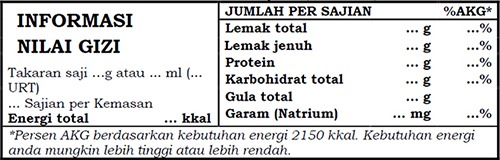
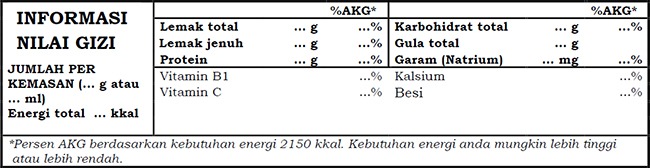
BPOM Regulation No. 10 of 2026 updates the standardized formats for the nutritional value information (ING) table. The regulation continues to allow both vertical and horizontal formats and now provides clearer templates for use on product labels.

For horizontal presentation, businesses may use either a three-column tabular format, which provides more space for displaying nutrient information and additional vitamins or minerals, or a two-column tabular format, which offers a simplified layout suitable for products with limited label space.


Three-column per-serving tabular format
 

Two-column per-serving tabular format
 

Three-column per-package tabular format
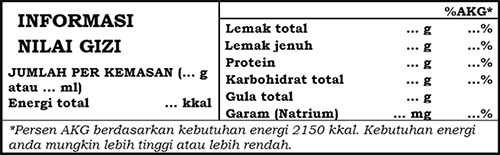
 

Two-column per-package tabular format


BPOM Regulation No. 10 of 2026 also introduces specific flexibility for micro-enterprises regarding the ING table. If analytical results are unavailable and the value of a processed food nutrient has not yet been established by the head of BPOM, the values in the ING table should be declared based on calculation results. The procedure for calculating the nutrient content for processed foods produced by micro-enterprises was established by the head of BPOM in 2026 and involves mostly traditional Indonesian food products.

Transition Period

BPOM Regulation No. 10 of 2026 provides a 24-month transition period to facilitate compliance with the new requirements, so processed foods that had already obtained distribution permits before the regulation entered into force, as well as products that were undergoing registration at that time, must be brought into compliance with the new regulation by June 17, 2028. Similar transitional provisions apply to the implementation of Nutri-Level labeling requirements for affected beverage products. As a result, food business operators are afforded additional time to review product portfolios, update nutritional information, and revise product labels where necessary.

Business Impact

The new regulation will require many food and beverage businesses to review their existing nutrition labeling practices in order to comply with the new requirements. In particular, companies should assess the impact of the revised nutrient reference values, updated serving-size requirements, and Nutri-Level labeling requirements on their products.

The Nutri-Level requirements will be especially relevant for beverage manufacturers. Businesses should therefore begin evaluating their product portfolios and preparing any necessary label updates to ensure compliance before the expiry of the 24-month transition period.


RELATED INSIGHTS​ 

October 3, 2025
On September 26, 2025, the Contract Committee under Thailand’s Consumer Protection Board issued a regulation that aims to standardize contracts and enhance consumer protection within the beauty and wellness industry. The Notification on Prescribing the Beauty Service Business as a Contract-Controlled Business B.E. 2568 (2025), which takes effect on January 24, 2026, requires business operators to use a prescribed standard contract in Thai and adhere to strict mandatory provisions and prohibitions. These regulations apply to operators across all in-person and online service channels, including via digital platforms. “Beauty services business” is defined as the provision of services under an agreement allowing consumers to receive a series of treatments, either over a set number of sessions or within a set period. This includes massage, spa, other methods for cleanliness, beauty, or care of facial or body skin, and weight control and body shaping—including services offered electronically. The law excludes surgery, liposuction, and medical treatments performed by licensed practitioners. The notification establishes the following key requirements: Mandatory contract and formatting. All contracts with consumers must use the standard contract form, in Thai, with clear, readable text (minimum font size of 2 millimeters, no more than 11 characters per inch), and include all essential terms from the annexed form. Contract execution. Contracts must be made in duplicate, with one copy given to the consumer at signing. For agreements concluded through electronic channels, the process must comply with the Electronic Transactions Act and use the same required terms. Digital platforms. Business operators who provide services facilitated through a digital platform as an intermediary are ultimately responsible for ensuring the consumer receives a compliant contract. Prohibited clauses. The law prohibits clauses that limit or exclude liability for damages to life, body, health, mind, or property resulting from breach of contract or a wrongful act;
September 16, 2025
Since Thailand formally removed Mitragyna speciosa (kratom) from the list of narcotic drugs, the country has progressed from outright prohibition to a structured, license-based regime. While the Ministry of Public Health oversees cannabis plant regulation, the Ministry of Justice (MOJ) is the regulatory authority overseeing kratom plants. For the avoidance of doubt, separate Ministry of Public Health notifications prohibit the use of kratom as a food ingredient unless a food safety evaluation has been conducted; however, this restriction does not affect trade in unprocessed leaves per se. For businesses in Thailand dealing exclusively in kratom leaves, the most consequential development is the Ministerial Regulation on the Application for Permits and Notifications for the Importation and Exportation of Kratom Leaves B.E. 2568 (2025), a bylaw of the Kratom Plant Act 2022. The ministerial regulation establishes the following notable definitions: “Kratom leaves”: Fresh or dried leaves in their natural, unprocessed state (no extracts, concentrates, or infused products). “Import/Export”: Any act of bringing kratom leaves into or out of Thailand, whether for commercial sale, industrial processing abroad, or research. Import/Export Licensing Under the Kratom Plant Act, a license is mandatory for importing or exporting kratom leaves. Individuals, juristic persons, community enterprises, and state agencies in Thailand are eligible to obtain a license to import (or a license to export) kratom leaves. Licenses are available to qualified individuals and juristic persons. Individuals must satisfy the following qualifications to be eligible for a license: Thai nationality, ≥ 20 years old, resident in Thailand. Not incompetent, quasi-incompetent, or under legal guardianship. No license suspension currently in force under the Kratom Act or Narcotics Code. No license revocation in the previous two years. No conviction under the Kratom Act or Narcotics Code within the previous two years (unless fully released from punishment). Juristic persons must satisfy
September 4, 2025
With advancements in health technology, telemedicine has taken on a wider online presence in Thailand. Under the Medical Facility Act, licensed clinics and hospitals may now diagnose, prescribe, and issue electronic prescriptions during a video call, provided they maintain patient confidentiality and proper recordkeeping. As a complementary concept, a telepharmacy allows a pharmacist to verify prescriptions, counsel patients, and dispense medication from a remote site. Hospitals, clinic chains, and some retail pharmacy groups have adopted “drive-thru” or “locker” pick-up points where drugs are bagged only after a real-time video consultation with a registered pharmacist. The clear benefits of telehealth include shorter waiting times and broader access to specialists, which is in the public interest. Drug Distribution and Advertising in Thailand The online pharmacy ecosystem creates a legal bridge in that once a teleconsulting doctor issues an e-prescription, a licensed pharmacy can lawfully dispense and deliver the medicine prescribed to the patient’s door. Nonetheless, the critical compliance component remains the advertising of medicinal drugs. It is still not allowed to advertise prescription/pharmacy-dispensed drugs to the public in Thailand. Although Thailand’s Drug Act of 1967 was written more than half a century ago, it still governs the trading of every medicinal drug that makes its way to consumers in Thailand—whether bought at a pharmacy or delivered with a few taps on a smartphone. First and foremost, the pharmacy must hold a license to sell medicinal drugs as a retailer. It is also mandatory that arrangements be made for a pharmacist to be on duty during opening hours. Drugs are classified into three main categories: prescription drugs, pharmacy-dispensed drugs, and over-the-counter (OTC) drugs. The listing of OTC drugs with their prices via an online platform is allowed, as only OTC drugs may be advertised directly to the public. However, naming or showing
August 8, 2025
In response to persistent challenges in food safety management and recent high-profile incidents involving counterfeit supplemented foods, infant formula, and health supplements, the Ministry of Health of Vietnam is initiating comprehensive regulatory reforms. These reforms include proposed amendments to the Law on Food Safety and its implementing Decree No. 15/2018/ND-CP (Decree 15), introducing significant changes to the registration procedures for food products, especially supplemented food products and health supplements. While awaiting public consultation and approval of the amended Law on Food Safety, the Ministry of Health is developing an interim mechanism, which includes a draft decree to replace Decree 15 and a draft resolution to address urgent issues until the amended law becomes effective, expected in July 2026. To align with the new Law on Quality of Products and Goods, the draft resolution stipulates that the declaration and registration of food products will follow the following procedures: Declaration of applied standards for food products, which is currently known as the “self-declaration” procedure, applies to processed packaged foods, food additives, food processing aids, containers or utensils that come into direct contact with food, packaging materials in direct contact with food, and micronutrients. Granting of circulation numbers, which is the current “registration of product declaration” procedure, applies to specific categories of food including health supplements, medical nutrition foods, special dietary foods, nutritional products for children up to 36 months, and, especially, supplemented foods, which are currently subject to self-declaration but will be shifted to this registration procedure. In addition, the following new procedure is introduced in the draft decree: Registration of declaration of conformity, which applies to the same product category as in “declaration of applied standards” above, but is for products that are already subject to technical regulations covering both safety indicators and quality indicators. Changes to the Food Product