
You are using an outdated browser and your browsing experience will not be optimal. Please update to the latest version of Microsoft Edge, Google Chrome or Mozilla Firefox. Install Microsoft Edge

August 10, 2026

Changes in Nutrition Labeling Requirements in Indonesia

On June 17, 2026, Indonesia’s National Agency of Drug and Food Control (BPOM) issued BPOM Regulation No. 10 of 2026 on Nutritional Information on Processed Food Labels.

The new regulation, which revokes three previous nutrition labeling regulations, introduces several notable changes affecting food and beverage manufacturers, importers, and distributors. These changes range from updated nutrient reference values and serving-size requirements to the introduction of the Nutri-Level front-of-pack labeling system for certain beverage products. Businesses operating in Indonesia should carefully review these developments and assess their products’ compliance with the new requirements during the transition period.

Implementation of the Nutri-Level Labeling System

To implement the recently issued decree on Nutri-Level labeling, BPOM Regulation No. 10 of 2026 stipulates the requirements to implement the Nutri-Level labeling system on the front-of-pack. Under the new framework, ready-to-drink beverages, powdered beverages, and liquid or solid concentrates are required to display Nutri-Level labeling on the front label of their packaging.

The Nutri-Level labeling system classifies products into color-coded levels A through D based on their sugar, sodium, and total fat content. The applicable Nutri-Level is determined based on the lowest level measured in the assessment of sugar, sodium, and total fat content.

For products classified as level C or D, the Nutri-Level label must be accompanied by information on the relevant sugar, sodium, and total fat content per 100 ml of the ready-to-consume product. Products classified as level A or B may either display only the Nutri-Level designation or display the Nutri-Level together with the relevant nutritional information per 100 ml.

Minimum Vitamin and Mineral Content Required for Declaration

BPOM Regulation No. 10 of 2026 introduces a stricter threshold for the declaration of vitamins and minerals in the nutritional value information section (ING).

Vitamins or minerals may only be declared if they are present at a level of at least 5% of the recommended dietary allowance (RDA) per serving, per 100 g, per 100 ml, or per package, in accordance with the inclusion of the ING table, except for processed foods that declare vitamins or minerals claims in accordance with certain laws and regulations. This represents a significant change from the previous regime under the now-revoked BPOM Regulation No. 26 of 2021, under which vitamins and minerals could be declared when present at a level of at least 2% of the RDA per serving.

Revised Serving Size Requirements

While serving size declarations were already required under BPOM Regulation No. 26 of 2021, BPOM Regulation No. 10 of 2026 introduces additional technical guidance on serving-size determination and presentation. The new regulation expressly requires serving sizes to be rounded to the nearest half-unit, providing a standardized approach to serving-size calculations across product categories. An exception applies to products classified under food category 11.6 (sweeteners, including table-top sweeteners and high-intensity sweeteners), which may require businesses to review and, where necessary, update their existing nutrition labeling.

In addition, an appendix to Regulation No. 10 of 2026 sets out updated serving-size references for a wide range of food categories. As a result, food business operators should review the revised category-specific serving-size references to determine whether their existing nutrition information tables, nutrient calculations, and serving-size declarations remain compliant under the new framework. Although serving-size requirements were already regulated under BPOM Regulation No. 26 of 2021, the 2026 regulation provides greater technical detail and updated references that may necessitate label revisions for certain products.

Updated Nutrient Reference Values

BPOM Regulation No. 10 of 2026 updates the nutrient reference values previously set forth in BPOM Regulation No. 9 of 2016 to correspond with the current development of scientific knowledge in health. Several reference values have been revised from those in BPOM Regulation No. 9 of 2016 (e.g., for total fat, vitamin B1, vitamin B2, vitamin B12, magnesium, potassium, and various other vitamins and minerals). As these values are used to calculate the percentage of RDA displayed in nutrition information tables, the revisions may affect the nutrient percentage calculations currently appearing on product labels.

The regulation also introduces updated nutrient reference methodologies and conversion factors. In particular, vitamin B3 may now be expressed in niacin equivalents (NE), folate may be expressed in dietary folate equivalents (DFE), and revised conversion factors have been adopted for vitamins A, D, and E. These changes are intended to align nutrition labeling requirements with current nutritional science and may require food business operators to reassess existing nutrient declarations and label calculations.

Updated Nutritional Value Information Table Formats

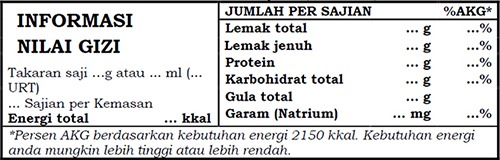
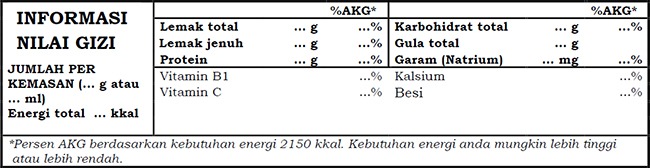
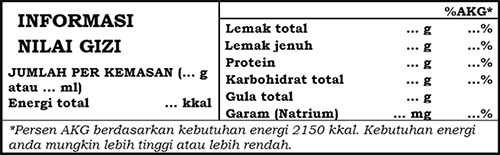
BPOM Regulation No. 10 of 2026 updates the standardized formats for the nutritional value information (ING) table. The regulation continues to allow both vertical and horizontal formats and now provides clearer templates for use on product labels.

For horizontal presentation, businesses may use either a three-column tabular format, which provides more space for displaying nutrient information and additional vitamins or minerals, or a two-column tabular format, which offers a simplified layout suitable for products with limited label space.


Three-column per-serving tabular format
 

Two-column per-serving tabular format
 

Three-column per-package tabular format
 

Two-column per-package tabular format


BPOM Regulation No. 10 of 2026 also introduces specific flexibility for micro-enterprises regarding the ING table. If analytical results are unavailable and the value of a processed food nutrient has not yet been established by the head of BPOM, the values in the ING table should be declared based on calculation results. The procedure for calculating the nutrient content for processed foods produced by micro-enterprises was established by the head of BPOM in 2026 and involves mostly traditional Indonesian food products.

Transition Period

BPOM Regulation No. 10 of 2026 provides a 24-month transition period to facilitate compliance with the new requirements, so processed foods that had already obtained distribution permits before the regulation entered into force, as well as products that were undergoing registration at that time, must be brought into compliance with the new regulation by June 17, 2028. Similar transitional provisions apply to the implementation of Nutri-Level labeling requirements for affected beverage products. As a result, food business operators are afforded additional time to review product portfolios, update nutritional information, and revise product labels where necessary.

Business Impact

The new regulation will require many food and beverage businesses to review their existing nutrition labeling practices in order to comply with the new requirements. In particular, companies should assess the impact of the revised nutrient reference values, updated serving-size requirements, and Nutri-Level labeling requirements on their products.

The Nutri-Level requirements will be especially relevant for beverage manufacturers. Businesses should therefore begin evaluating their product portfolios and preparing any necessary label updates to ensure compliance before the expiry of the 24-month transition period.


RELATED INSIGHTS​ 

October 11, 2021
A registration process for plant variety protection (PVP) has been in effect in Myanmar since enactment of the New Plant Variety Protection Law 2016, which was later replaced by the New Plant Variety Protection Law 2019 (“PVP Law 2019”). In accordance with its implementation of this law, the government is encouraging private companies, associations, organizations, and individual plant breeders to apply for the protection of new plant varieties in order to increase crop production in the country. Despite the challenges of the COVID-19 pandemic in Myanmar, Tilleke & Gibbins successfully secured a plant breeder’s rights certificate for a client in June 2020, making the client the first certificate holder in Myanmar. This article summarizes the PVP application and registration process, and offers some practical insights into the authorities’ activities and approach. PVP Registration The Central Committee for National New Plant Variety Protection (PVP Committee) oversees PVP registration, which is administered by the PVP Section of the Department of Agricultural Research (DAR) in the Ministry of Agriculture, Livestock, and Irrigation. To apply for plant breeder’s rights in Myanmar, an application and a technical questionnaire on the new plant variety should be filed with the PVP Section, which reviews the technical questionnaire and determines whether the plant qualifies as a new variety. Four groups are eligible to apply for PVP registration in order to secure plant breeder’s rights under the current PVP legislation: Myanmar nationals; Foreign nationals and organizations whose permanent residence is in Myanmar; Persons or entities resident in a country that has a PVP agreement with Myanmar; and International organizations. An application can be examined in one of four ways (determined by the PVP Committee): Official field trial involving planting the new variety in Myanmar; On-site field inspection of the breeder’s field by the PVP Section; Examination of test
August 27, 2021
The process of registering pesticide products in Myanmar has been slowed significantly by regulatory challenges since the enactment of the Pesticide Law in 2016. In some cases, the whole process can take almost three years. Nonetheless, this stringent and time-consuming process has been functioning smoothly, and Tilleke & Gibbins has successfully received approvals from the Pesticide Registration Board (PRB) despite the ongoing COVID-19 pandemic and state of emergency in the country. Overview Since its enactment, the Pesticide Law of 2016 has governed the regulation of local and imported pesticides under the oversight of the Plant Protection Division (PPD) and the joint secretary of the PRB. All foreign and domestic companies (including subsidiaries and joint ventures) looking to have their agricultural or household pest control products imported into Myanmar must first provide the products’ complete formulas and lists of active ingredients to the PPD, and apply for a pesticide registration certificate. Applications should be supported by a letter of consent from the manufacturer and various other technical documents and requirements. Experts at the PRB will review the technical dossier and inform the applicant if any re-submissions are required. Key Considerations One common cause of delay in the registration process is the requirement to submit both English and Myanmar translations of proposed labels to the PRB. Because the PRB takes a restrictive view of these labels and their translations, having the labels initially reviewed by a local regulatory expert familiar with the requirements will streamline the process by flagging potential issues for correction before submission to the PRB. After document submission is complete, the next stage of the process is further lab testing according to requirements set out by the Myanmar Pesticide Law. Applicants will need to supply the formulated product in an amount sufficient for carrying out supervised trials and
August 26, 2021
The Ministry of Health of Vietnam recently issued Circular No. 10/2021/TT-BYT dated June 30, 2021, stipulating the list of substances prohibited from use in the production and trading of health supplements (“Circular 10”). Circular 10 will come into effect on September 1, 2021. Accordingly, substances found on the following lists will be prohibited from use in health supplements: The list of drugs and drug materials prohibited from importation and production found in Annex V of Decree No. 54/2017/ND-CP of the Government dated May 8, 2017, guiding the implementation of Law on Pharmacy (Decree 54). Lists promulgated with Decree No. 73/2018/ND-CP of the Government dated May 15, 2018, stipulating the list of narcotic substances and precursors, including: List I: Narcotic substances banned from use in healthcare and daily life, the use of which for analysis, testing, scientific research, and criminal investigation is subject to permission by competent authorities. List II: Narcotic substances restricted from analysis, testing, scientific research, criminal investigation, or healthcare as regulated by competent authorities. List III: Narcotic substances permitted in analysis, testing, scientific research, criminal investigation, healthcare, and veterinary medicine as regulated by competent authorities. List IVA: Essential precursors involved in forming the structure of narcotic substances. The list of narcotic active ingredients found in Annex I of Circular No. 20/2017/TT-BYT of the Ministry of Health, detailing articles of the Law on Pharmacy and Decree 54 related to drugs and drug materials under special control. The list of toxic drugs and toxic drug materials under Circular No. 06/2017/TT-BYT of the Ministry of Health dated May 3, 2017. Lists under Circular No. 42/2017/TT-BYT of the Ministry of Health dated November 13, 2017, stipulating the lists of toxic herbal materials, including: Annex I: List of toxic herbal materials of plant origin. Annex II: List of toxic herbal materials of
August 26, 2021
In April 2021, the Vietnamese government made public a draft decree to amend Decree No. 43/2017/ND-CP of the Government dated April 14, 2017, on goods labeling (“Decree 43”), which is the primary legislation in Vietnam on the labeling requirements for domestically circulating goods and imported goods. Some noteworthy differences between the draft and the current Decree 43 include the following: 1. Original labels for imported products For imported goods, the draft adds a requirement on compulsory information for original labels, which is not mentioned in Decree 43. In particular, the original product label for goods being imported to circulate on the Vietnam market must contain the following compulsory information in a foreign language or in Vietnamese before customs clearance: Product name; Name and address of the entities responsible for the products; Product origin or place where the final production stage to complete the product was conducted. (If this information is not presented on the original product label, it must be included in the import documents accompanying the product.) 2. Vietnamese labels for imported products Under the draft, if it is impossible to determine the product origin under rules/guidance on determining product origin in Vietnam, it is acceptable to instead indicate on the product label the place(s) where the final production stage to complete the product was conducted. 3. Nutritional information for food Instead of being optional information as mentioned in Decree 43, “nutritional value” is compulsory information on labels for some food products under the draft. The Ministry of Health will have a roadmap for carrying out nutritional labeling and will provide appropriate guidance to manufacturers and importers, as well as issue regulations on types of food that are partially or entirely exempt from declaration of nutritional value. The draft has not yet been finalized and is subject to