
You are using an outdated browser and your browsing experience will not be optimal. Please update to the latest version of Microsoft Edge, Google Chrome or Mozilla Firefox. Install Microsoft Edge

August 10, 2026

Changes in Nutrition Labeling Requirements in Indonesia

On June 17, 2026, Indonesia’s National Agency of Drug and Food Control (BPOM) issued BPOM Regulation No. 10 of 2026 on Nutritional Information on Processed Food Labels.

The new regulation, which revokes three previous nutrition labeling regulations, introduces several notable changes affecting food and beverage manufacturers, importers, and distributors. These changes range from updated nutrient reference values and serving-size requirements to the introduction of the Nutri-Level front-of-pack labeling system for certain beverage products. Businesses operating in Indonesia should carefully review these developments and assess their products’ compliance with the new requirements during the transition period.

Implementation of the Nutri-Level Labeling System

To implement the recently issued decree on Nutri-Level labeling, BPOM Regulation No. 10 of 2026 stipulates the requirements to implement the Nutri-Level labeling system on the front-of-pack. Under the new framework, ready-to-drink beverages, powdered beverages, and liquid or solid concentrates are required to display Nutri-Level labeling on the front label of their packaging.

The Nutri-Level labeling system classifies products into color-coded levels A through D based on their sugar, sodium, and total fat content. The applicable Nutri-Level is determined based on the lowest level measured in the assessment of sugar, sodium, and total fat content.

For products classified as level C or D, the Nutri-Level label must be accompanied by information on the relevant sugar, sodium, and total fat content per 100 ml of the ready-to-consume product. Products classified as level A or B may either display only the Nutri-Level designation or display the Nutri-Level together with the relevant nutritional information per 100 ml.

Minimum Vitamin and Mineral Content Required for Declaration

BPOM Regulation No. 10 of 2026 introduces a stricter threshold for the declaration of vitamins and minerals in the nutritional value information section (ING).

Vitamins or minerals may only be declared if they are present at a level of at least 5% of the recommended dietary allowance (RDA) per serving, per 100 g, per 100 ml, or per package, in accordance with the inclusion of the ING table, except for processed foods that declare vitamins or minerals claims in accordance with certain laws and regulations. This represents a significant change from the previous regime under the now-revoked BPOM Regulation No. 26 of 2021, under which vitamins and minerals could be declared when present at a level of at least 2% of the RDA per serving.

Revised Serving Size Requirements

While serving size declarations were already required under BPOM Regulation No. 26 of 2021, BPOM Regulation No. 10 of 2026 introduces additional technical guidance on serving-size determination and presentation. The new regulation expressly requires serving sizes to be rounded to the nearest half-unit, providing a standardized approach to serving-size calculations across product categories. An exception applies to products classified under food category 11.6 (sweeteners, including table-top sweeteners and high-intensity sweeteners), which may require businesses to review and, where necessary, update their existing nutrition labeling.

In addition, an appendix to Regulation No. 10 of 2026 sets out updated serving-size references for a wide range of food categories. As a result, food business operators should review the revised category-specific serving-size references to determine whether their existing nutrition information tables, nutrient calculations, and serving-size declarations remain compliant under the new framework. Although serving-size requirements were already regulated under BPOM Regulation No. 26 of 2021, the 2026 regulation provides greater technical detail and updated references that may necessitate label revisions for certain products.

Updated Nutrient Reference Values

BPOM Regulation No. 10 of 2026 updates the nutrient reference values previously set forth in BPOM Regulation No. 9 of 2016 to correspond with the current development of scientific knowledge in health. Several reference values have been revised from those in BPOM Regulation No. 9 of 2016 (e.g., for total fat, vitamin B1, vitamin B2, vitamin B12, magnesium, potassium, and various other vitamins and minerals). As these values are used to calculate the percentage of RDA displayed in nutrition information tables, the revisions may affect the nutrient percentage calculations currently appearing on product labels.

The regulation also introduces updated nutrient reference methodologies and conversion factors. In particular, vitamin B3 may now be expressed in niacin equivalents (NE), folate may be expressed in dietary folate equivalents (DFE), and revised conversion factors have been adopted for vitamins A, D, and E. These changes are intended to align nutrition labeling requirements with current nutritional science and may require food business operators to reassess existing nutrient declarations and label calculations.

Updated Nutritional Value Information Table Formats

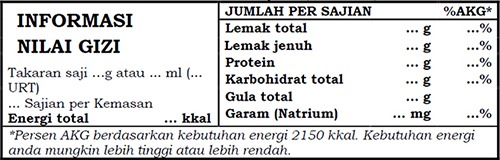
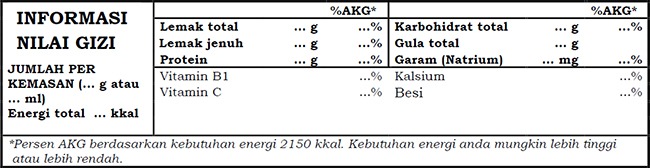
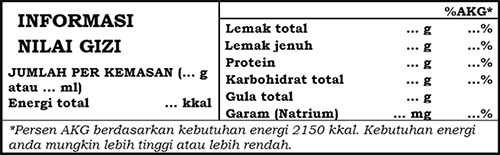
BPOM Regulation No. 10 of 2026 updates the standardized formats for the nutritional value information (ING) table. The regulation continues to allow both vertical and horizontal formats and now provides clearer templates for use on product labels.

For horizontal presentation, businesses may use either a three-column tabular format, which provides more space for displaying nutrient information and additional vitamins or minerals, or a two-column tabular format, which offers a simplified layout suitable for products with limited label space.


Three-column per-serving tabular format
 

Two-column per-serving tabular format
 

Three-column per-package tabular format
 

Two-column per-package tabular format


BPOM Regulation No. 10 of 2026 also introduces specific flexibility for micro-enterprises regarding the ING table. If analytical results are unavailable and the value of a processed food nutrient has not yet been established by the head of BPOM, the values in the ING table should be declared based on calculation results. The procedure for calculating the nutrient content for processed foods produced by micro-enterprises was established by the head of BPOM in 2026 and involves mostly traditional Indonesian food products.

Transition Period

BPOM Regulation No. 10 of 2026 provides a 24-month transition period to facilitate compliance with the new requirements, so processed foods that had already obtained distribution permits before the regulation entered into force, as well as products that were undergoing registration at that time, must be brought into compliance with the new regulation by June 17, 2028. Similar transitional provisions apply to the implementation of Nutri-Level labeling requirements for affected beverage products. As a result, food business operators are afforded additional time to review product portfolios, update nutritional information, and revise product labels where necessary.

Business Impact

The new regulation will require many food and beverage businesses to review their existing nutrition labeling practices in order to comply with the new requirements. In particular, companies should assess the impact of the revised nutrient reference values, updated serving-size requirements, and Nutri-Level labeling requirements on their products.

The Nutri-Level requirements will be especially relevant for beverage manufacturers. Businesses should therefore begin evaluating their product portfolios and preparing any necessary label updates to ensure compliance before the expiry of the 24-month transition period.


RELATED INSIGHTS​ 

March 24, 2023
Tilleke & Gibbins’ life sciences specialists in Indonesia have contributed a new “Life Sciences Commercialization in Indonesia” chapter to the Life Sciences Global Guide from Practical Law. This Q&A guide to commercializing life sciences innovations in Indonesia provides important information that companies can use to shape their strategies for life sciences products and activities in the jurisdiction. Specifically, the chapter covers: Overview of the life sciences sector Pricing, government funding, and reimbursement: National health care system, price regulation and reimbursement Distribution and sale Cross-border trade and parallel imports Advertising and engagement with patient organizations Patents: Conditions for patentability, registration, length of protection, infringement, international treaties Trademarks: Requirements, registration Competition law issues: Authorities and legislation, commercial contracts and competition law, licensing approvals and formalities Product liability: Regulators, medicinal product liability law, liable partners, defenses, product liability claims, remedies Practical Law, produced by Thomson Reuters, is the world’s leading legal know-how resource for business lawyers, publishing a huge range of guides covering hundreds of jurisdictions and practice areas. The full “Life Sciences Commercialization in Indonesia” section can be found on the Practical Law website.
March 7, 2023
On March 3, 2023, the government of Vietnam issued Decree No. 07/2023/ND-CP (Decree 07) amending Decree 98/2021/ND-CP on medical device management (Decree 98) to resolve many urgent problems in the healthcare sector in Vietnam. Decree 07 took effect on the same day and amends and supplements several articles in its predecessor, Decree 98, which originally took effect on January 1, 2022. Some outstanding points of Decree 07 are summarized below. 1. Registration of Medical Devices The compulsory implementation of the ASEAN Common Submission Dossier Template (CSDT) in registration applications for medical devices will be delayed until January 1, 2024, instead of the deadline of January 1, 2023 under Decree 98. In addition, if after three rounds of amendment/supplementation as requested by the authority, the registration dossiers still have not been approved, the applicants must submit new registration dossiers. 2. Withdrawal of Registration Number Decree 98 adds one case for withdrawing the registration number of a medical device, which is when the documents in the registration dossier are concluded by the authority to be noncompliant with the provisions of law. 3. Listing Price of Medical Devices It is required for establishments manufacturing or trading medical devices to list their prices in locations stipulated under Article 17 of Decree No. 177/2013/ND-CP implementing the Law on Prices (such as at transaction or selling locations of the trading establishments) or on the online portal of the Department of Medical Equipment and Construction’s (DMEC). 4. Price Declaration It is no longer required to declare prices of all medical devices circulating on the Vietnam market. Instead, the Ministry of Health will issue and adjust the list of medical devices subject to price declaration, depending on management requirements and the actual situation, especially when there are abnormal fluctuations in prices affecting the supply of medical devices,
March 7, 2023
According to the Ministry of Health of Vietnam, many healthcare facilities in the country are facing a shortage of drugs, medical devices, and materials/chemicals. To address the urgent needs of medical examination and treatment in public healthcare facilities, on March 4, 2023, the government of Vietnam promulgated Resolution No. 30/NQ-CP on continuing to implement solutions to ensure the availability of drugs, medical equipment, and healthcare supplies (“Resolution 30”). Resolution 30 amends item 4 of Resolution No. 144/NQ-CP dated November 5, 2022, allowing medical examination and treatment expenses to continue to be covered by health insurance for technical services carried out with medical devices supplied by contractors after winning tenders to supply materials and chemicals. The new mechanism brings more benefit to patients by removing the previous ending date of November 5, 2023, and will be applicable until there is further guidance from the government. Resolution 30 also allows the use of medical devices that were donated or gifted by domestic and foreign entities (including those that were provided under now-expired joint ventures or cooperation contracts) regardless of whether those entities have fulfilled the procedures for ownership establishment. Technical services that are performed by such devices will be covered by health insurance. This provision will help address the shortage of medical devices used in public hospitals. The determination of bid price is also a highlight of Resolution 30, which pilots a simpler price determination procedure for the purchase of drugs and medical devices. Instead of requiring purchasers to obtain quotations from three suppliers, Resolution 30 allows them to compare prices based on the quotations actually received, even from only one or two suppliers. Alternatively, price determination can be based on the winning bid price for a similar medical device procurement package that was awarded within the last 120 days. This
February 21, 2023
On December 28, 2022, the Ministry of Health of Laos issued Decision No. 3789/MOH on the Control of Hemp for Medication and Products (the “Decision”). The Decision approves the regulated cultivation, extraction, production, processing, storage, distribution, utilization, import-export, and transport of hemp. The Decision also authorizes the use of hemp and hemp-related products by the general population, although use of certain products is limited to those with medical prescriptions. Background In 2019, the Lao government established an ad hoc committee to consider the legalization of cannabis, as reported previously. The government permitted certain local companies to grow cannabis in specific zones under pilot programs, although it continued to strictly prohibit the use and commercialization, as well as consumption, of cannabis-related products, regardless of the level of psychoactive tetrahydrocannabinol (THC) in the products. Overview of the Decision The Decision was issued by the Ministry of Health (which led the ad hoc committee) and permits authorized companies to engage in certain activities involving the use of hemp and the consumption of hemp and hemp-related products. The Decision defines hemp (“porkeo” in Lao) as a “plant that belongs to the same family as ganja and bears the scientific name Cannabis Sativa L. (Cannabis sativa L. subsp. sativa var. sativa) which is a subspecies of ganja (Cannabis Sativa L.).” This definition aims at differentiating hemp from the general definition of ganja or marijuana, which continues to be listed as a prohibited narcotic in Laos. The Law on Narcotics (2007) and the Penal Code (2017) still prohibit the production, trade and use of all types of cannabis. These laws will need to be amended to ensure that they are aligned with changes set out in the Decision.  Authorized Hemp Activities The Decision allows approved companies to engage in the cultivation, extraction, production, processing, storage,