
You are using an outdated browser and your browsing experience will not be optimal. Please update to the latest version of Microsoft Edge, Google Chrome or Mozilla Firefox. Install Microsoft Edge

August 10, 2026

Changes in Nutrition Labeling Requirements in Indonesia

On June 17, 2026, Indonesia’s National Agency of Drug and Food Control (BPOM) issued BPOM Regulation No. 10 of 2026 on Nutritional Information on Processed Food Labels.

The new regulation, which revokes three previous nutrition labeling regulations, introduces several notable changes affecting food and beverage manufacturers, importers, and distributors. These changes range from updated nutrient reference values and serving-size requirements to the introduction of the Nutri-Level front-of-pack labeling system for certain beverage products. Businesses operating in Indonesia should carefully review these developments and assess their products’ compliance with the new requirements during the transition period.

Implementation of the Nutri-Level Labeling System

To implement the recently issued decree on Nutri-Level labeling, BPOM Regulation No. 10 of 2026 stipulates the requirements to implement the Nutri-Level labeling system on the front-of-pack. Under the new framework, ready-to-drink beverages, powdered beverages, and liquid or solid concentrates are required to display Nutri-Level labeling on the front label of their packaging.

The Nutri-Level labeling system classifies products into color-coded levels A through D based on their sugar, sodium, and total fat content. The applicable Nutri-Level is determined based on the lowest level measured in the assessment of sugar, sodium, and total fat content.

For products classified as level C or D, the Nutri-Level label must be accompanied by information on the relevant sugar, sodium, and total fat content per 100 ml of the ready-to-consume product. Products classified as level A or B may either display only the Nutri-Level designation or display the Nutri-Level together with the relevant nutritional information per 100 ml.

Minimum Vitamin and Mineral Content Required for Declaration

BPOM Regulation No. 10 of 2026 introduces a stricter threshold for the declaration of vitamins and minerals in the nutritional value information section (ING).

Vitamins or minerals may only be declared if they are present at a level of at least 5% of the recommended dietary allowance (RDA) per serving, per 100 g, per 100 ml, or per package, in accordance with the inclusion of the ING table, except for processed foods that declare vitamins or minerals claims in accordance with certain laws and regulations. This represents a significant change from the previous regime under the now-revoked BPOM Regulation No. 26 of 2021, under which vitamins and minerals could be declared when present at a level of at least 2% of the RDA per serving.

Revised Serving Size Requirements

While serving size declarations were already required under BPOM Regulation No. 26 of 2021, BPOM Regulation No. 10 of 2026 introduces additional technical guidance on serving-size determination and presentation. The new regulation expressly requires serving sizes to be rounded to the nearest half-unit, providing a standardized approach to serving-size calculations across product categories. An exception applies to products classified under food category 11.6 (sweeteners, including table-top sweeteners and high-intensity sweeteners), which may require businesses to review and, where necessary, update their existing nutrition labeling.

In addition, an appendix to Regulation No. 10 of 2026 sets out updated serving-size references for a wide range of food categories. As a result, food business operators should review the revised category-specific serving-size references to determine whether their existing nutrition information tables, nutrient calculations, and serving-size declarations remain compliant under the new framework. Although serving-size requirements were already regulated under BPOM Regulation No. 26 of 2021, the 2026 regulation provides greater technical detail and updated references that may necessitate label revisions for certain products.

Updated Nutrient Reference Values

BPOM Regulation No. 10 of 2026 updates the nutrient reference values previously set forth in BPOM Regulation No. 9 of 2016 to correspond with the current development of scientific knowledge in health. Several reference values have been revised from those in BPOM Regulation No. 9 of 2016 (e.g., for total fat, vitamin B1, vitamin B2, vitamin B12, magnesium, potassium, and various other vitamins and minerals). As these values are used to calculate the percentage of RDA displayed in nutrition information tables, the revisions may affect the nutrient percentage calculations currently appearing on product labels.

The regulation also introduces updated nutrient reference methodologies and conversion factors. In particular, vitamin B3 may now be expressed in niacin equivalents (NE), folate may be expressed in dietary folate equivalents (DFE), and revised conversion factors have been adopted for vitamins A, D, and E. These changes are intended to align nutrition labeling requirements with current nutritional science and may require food business operators to reassess existing nutrient declarations and label calculations.

Updated Nutritional Value Information Table Formats

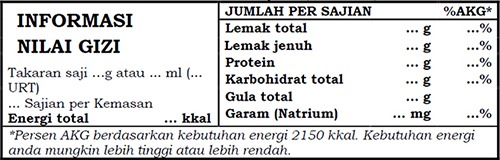
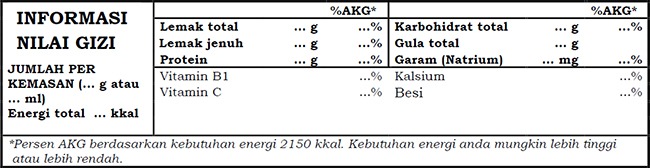
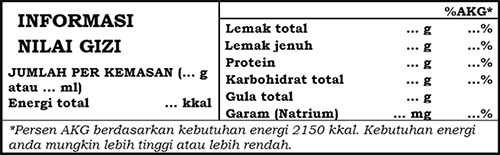
BPOM Regulation No. 10 of 2026 updates the standardized formats for the nutritional value information (ING) table. The regulation continues to allow both vertical and horizontal formats and now provides clearer templates for use on product labels.

For horizontal presentation, businesses may use either a three-column tabular format, which provides more space for displaying nutrient information and additional vitamins or minerals, or a two-column tabular format, which offers a simplified layout suitable for products with limited label space.


Three-column per-serving tabular format
 

Two-column per-serving tabular format
 

Three-column per-package tabular format
 

Two-column per-package tabular format


BPOM Regulation No. 10 of 2026 also introduces specific flexibility for micro-enterprises regarding the ING table. If analytical results are unavailable and the value of a processed food nutrient has not yet been established by the head of BPOM, the values in the ING table should be declared based on calculation results. The procedure for calculating the nutrient content for processed foods produced by micro-enterprises was established by the head of BPOM in 2026 and involves mostly traditional Indonesian food products.

Transition Period

BPOM Regulation No. 10 of 2026 provides a 24-month transition period to facilitate compliance with the new requirements, so processed foods that had already obtained distribution permits before the regulation entered into force, as well as products that were undergoing registration at that time, must be brought into compliance with the new regulation by June 17, 2028. Similar transitional provisions apply to the implementation of Nutri-Level labeling requirements for affected beverage products. As a result, food business operators are afforded additional time to review product portfolios, update nutritional information, and revise product labels where necessary.

Business Impact

The new regulation will require many food and beverage businesses to review their existing nutrition labeling practices in order to comply with the new requirements. In particular, companies should assess the impact of the revised nutrient reference values, updated serving-size requirements, and Nutri-Level labeling requirements on their products.

The Nutri-Level requirements will be especially relevant for beverage manufacturers. Businesses should therefore begin evaluating their product portfolios and preparing any necessary label updates to ensure compliance before the expiry of the 24-month transition period.


RELATED INSIGHTS​ 

October 25, 2023
Cambodia’s Ministry of Health (MOH) continues to increase awareness among the public and private sector of the need for strict healthcare regulations and strict enforcement to advance the quality of the country’s healthcare sector. In April 2023, the MOH issued a notification letter reminding advertisers of health products that they need to obtain a permit before advertising their products in Cambodia. On October 12, 2023, the MOH issued two press releases on continued noncompliance in the healthcare sector. The two press releases address the illegal advertising of both healthcare products and private healthcare services. The releases also address unlicensed healthcare professionals and general noncompliance by private healthcare services. These releases indicate that the MOH, in cooperation with local authorities, will substantially increase its enforcement efforts across Cambodia. Since October 12, several private healthcare clinics have had their operations closed and licenses suspended or revoked, signaling the ministry’s intent to enforce the legal framework. Noncompliant Advertising of Health Products The first press release focuses on the continued illegal advertising of health products and the advertising of unregistered health products. Health products include modern medicines, traditional medicines, health supplements, medical devices, cosmetics, and other products that prevent or treat diseases. The release highlights that the MOH has noticed ongoing unauthorized and illegal advertising, commenting that these are often found online and on social media. The noncompliant advertising referenced in the release includes advertising of health products without the required advertising permit, advertising products that are not properly registered with the MOH, and advertising by unlicensed companies and individuals. The MOH also states in the release that some advertisements are using inappropriate and noncompliant content that is not based on medical science and exaggerates the qualities of the health products—specifically mentioning skin-whitening cosmetics. The ministry’s press release also informs the public of
October 25, 2023
One significant development in the health sector in Indonesia is the use of information technology and communication in the implementation of health efforts—particularly digital health services such as telehealth and telemedicine integrated into the country’s National Health Information System. This development was addressed in a major new piece of legislation for the healthcare sector in Indonesia. Enacted in August 2023, Law No. 17 of 2023 concerning Health (the “Health Law”) provides the updates needed to support the development of healthcare services in Indonesia. Under the Health Law, health information system (HIS) providers must: Carry out processing of data and health information in the territory of Indonesia, except for certain limited and specific processing activities that may be conducted outside Indonesia when permitted by the relevant authorities and in compliance with relevant regulations. Ensure the reliability of its HIS, including availability, security, maintenance, and integration with Indonesia’s National Health Information System. Provide quality health data and information. Process data and health information, which includes planning, collection, storage, inspection, transfer, utilization, and destruction. Record its data- and information-processing history. Protect every person’s data and health information. Obtain approval from the relevant personal data subject or comply with relevant regulations if the processing of data and health information involves an individual’s health data. Inform the data owner if there is a failure to protect data and individual health information. The Health Law’s personal data protection requirements listed above appear to be aligned with the provisions in Law No. 27 of 2022 concerning Personal Data Protection (the “PDP Law”). Under this law, data and information relating to health are identified as “specific personal data,” the processing of which carries a high potential risk of impacting the relevant personal data subject. In the implementation of digital health services, patients’ personal data or medical records
October 19, 2023
Cambodia’s Law on Food Safety came into force on June 8, 2022. This law has been widely regarded as a major legal development of the food safety framework in Cambodia, providing new rules, clarifying existing rules, and setting a clear framework for its implementation and enforcement. In addressing some of the key features of this new law shortly after it was passed in 2022, we remarked that we eagerly await implementing regulations. Since then, various regulations have been adopted, such as two regulations (Sub-Decree No. 13 and Prakas No. 80) on food surveillance, recalls, and seizure. These implementing rules are essential in ensuring that enforcement officers can remove noncompliant and unsafe foods from the market. Another key aspect of the Law on Food Safety is that it requires Khmer-language labeling on prepackaged food products. There has been a notable increase in the inclusion of Khmer labeling on food products in the market since June 2022, but noncompliance is still considerable, especially for imported foods. Further interesting labeling rules set by the Law on Food Safety include a requirement to provide nutrition information. This requirement has not yet been widely adopted, with many in the industry highlighting that the details of this labeling requirement are not clear. Indeed, the relevant article of the Law on Food Safety itself only sets the requirement for food products to bear nutrition labeling and does not spell out what detailed information should be provided or in what manner. However, a prakas (ministerial regulation) adopted months prior to the Law on Food Safety does set out clear guidance on nutrition labeling. As long as this earlier regulation is not replaced or abrogated, and as far as it does not conflict with later laws or regulations, it can be relied upon for guidance. What are the
September 20, 2023
Thailand is preparing to open its first renewal period for drug marketing authorizations (MAs) since the passage of the Drug Act (No. 6) B.E. 2562 (2019). Before 2019, MAs for pharmaceuticals and vaccines in Thailand had lifelong validity. The 2019 Drug Act stipulated that all new MAs would be valid for seven years and could be renewed. The 2019 law also set out expiration dates for existing pharmaceutical products registered and approved prior to the implementation of the law (i.e., before October 13, 2019): Drug MAs issued before January 1, 1997, expire on October 13, 2024. Drug MAs approved between January 1, 1997, and December 31, 2007, expire on October 13, 2026. Drug MAs approved between January 1, 2008, and October 13, 2019, expire on October 13, 2028. Based on these dates, the first renewal period for drug MAs will commence in the fourth quarter of 2023. To facilitate the renewal process, the Thai Food and Drug Administration (FDA) has publicized draft regulations and notifications on the required application form and documents, the rules and conditions, and the process for renewing an MA. In May 2023, the Thai FDA issued Ministerial Regulation Re: Renewal of Drug MA Licenses B.E. 2566 (2023) to prescribe the essential requirements for filing a renewal application: To renew a drug MA, holders must submit their renewal application to the Thai FDA within the one-year period before the MA’s expiration date. Renewal applications can only be submitted online via the Thai FDA’s electronic system. The Thai FDA will grant approval for an MA renewal if the following conditions are satisfied: The documents in relation to efficacy and safety are up-to-date, accurate, and in accordance with academic principles. The specification and analytical method comply with the official pharmacopeias as prescribed in the Drug Act, as amended.