
You are using an outdated browser and your browsing experience will not be optimal. Please update to the latest version of Microsoft Edge, Google Chrome or Mozilla Firefox. Install Microsoft Edge

August 10, 2026

Changes in Nutrition Labeling Requirements in Indonesia

On June 17, 2026, Indonesia’s National Agency of Drug and Food Control (BPOM) issued BPOM Regulation No. 10 of 2026 on Nutritional Information on Processed Food Labels.

The new regulation, which revokes three previous nutrition labeling regulations, introduces several notable changes affecting food and beverage manufacturers, importers, and distributors. These changes range from updated nutrient reference values and serving-size requirements to the introduction of the Nutri-Level front-of-pack labeling system for certain beverage products. Businesses operating in Indonesia should carefully review these developments and assess their products’ compliance with the new requirements during the transition period.

Implementation of the Nutri-Level Labeling System

To implement the recently issued decree on Nutri-Level labeling, BPOM Regulation No. 10 of 2026 stipulates the requirements to implement the Nutri-Level labeling system on the front-of-pack. Under the new framework, ready-to-drink beverages, powdered beverages, and liquid or solid concentrates are required to display Nutri-Level labeling on the front label of their packaging.

The Nutri-Level labeling system classifies products into color-coded levels A through D based on their sugar, sodium, and total fat content. The applicable Nutri-Level is determined based on the lowest level measured in the assessment of sugar, sodium, and total fat content.

For products classified as level C or D, the Nutri-Level label must be accompanied by information on the relevant sugar, sodium, and total fat content per 100 ml of the ready-to-consume product. Products classified as level A or B may either display only the Nutri-Level designation or display the Nutri-Level together with the relevant nutritional information per 100 ml.

Minimum Vitamin and Mineral Content Required for Declaration

BPOM Regulation No. 10 of 2026 introduces a stricter threshold for the declaration of vitamins and minerals in the nutritional value information section (ING).

Vitamins or minerals may only be declared if they are present at a level of at least 5% of the recommended dietary allowance (RDA) per serving, per 100 g, per 100 ml, or per package, in accordance with the inclusion of the ING table, except for processed foods that declare vitamins or minerals claims in accordance with certain laws and regulations. This represents a significant change from the previous regime under the now-revoked BPOM Regulation No. 26 of 2021, under which vitamins and minerals could be declared when present at a level of at least 2% of the RDA per serving.

Revised Serving Size Requirements

While serving size declarations were already required under BPOM Regulation No. 26 of 2021, BPOM Regulation No. 10 of 2026 introduces additional technical guidance on serving-size determination and presentation. The new regulation expressly requires serving sizes to be rounded to the nearest half-unit, providing a standardized approach to serving-size calculations across product categories. An exception applies to products classified under food category 11.6 (sweeteners, including table-top sweeteners and high-intensity sweeteners), which may require businesses to review and, where necessary, update their existing nutrition labeling.

In addition, an appendix to Regulation No. 10 of 2026 sets out updated serving-size references for a wide range of food categories. As a result, food business operators should review the revised category-specific serving-size references to determine whether their existing nutrition information tables, nutrient calculations, and serving-size declarations remain compliant under the new framework. Although serving-size requirements were already regulated under BPOM Regulation No. 26 of 2021, the 2026 regulation provides greater technical detail and updated references that may necessitate label revisions for certain products.

Updated Nutrient Reference Values

BPOM Regulation No. 10 of 2026 updates the nutrient reference values previously set forth in BPOM Regulation No. 9 of 2016 to correspond with the current development of scientific knowledge in health. Several reference values have been revised from those in BPOM Regulation No. 9 of 2016 (e.g., for total fat, vitamin B1, vitamin B2, vitamin B12, magnesium, potassium, and various other vitamins and minerals). As these values are used to calculate the percentage of RDA displayed in nutrition information tables, the revisions may affect the nutrient percentage calculations currently appearing on product labels.

The regulation also introduces updated nutrient reference methodologies and conversion factors. In particular, vitamin B3 may now be expressed in niacin equivalents (NE), folate may be expressed in dietary folate equivalents (DFE), and revised conversion factors have been adopted for vitamins A, D, and E. These changes are intended to align nutrition labeling requirements with current nutritional science and may require food business operators to reassess existing nutrient declarations and label calculations.

Updated Nutritional Value Information Table Formats

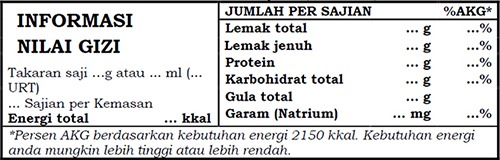
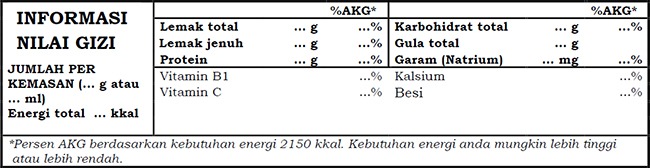
BPOM Regulation No. 10 of 2026 updates the standardized formats for the nutritional value information (ING) table. The regulation continues to allow both vertical and horizontal formats and now provides clearer templates for use on product labels.

For horizontal presentation, businesses may use either a three-column tabular format, which provides more space for displaying nutrient information and additional vitamins or minerals, or a two-column tabular format, which offers a simplified layout suitable for products with limited label space.


Three-column per-serving tabular format
 

Two-column per-serving tabular format
 

Three-column per-package tabular format
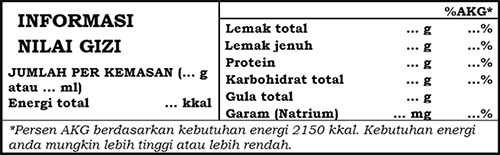
 

Two-column per-package tabular format


BPOM Regulation No. 10 of 2026 also introduces specific flexibility for micro-enterprises regarding the ING table. If analytical results are unavailable and the value of a processed food nutrient has not yet been established by the head of BPOM, the values in the ING table should be declared based on calculation results. The procedure for calculating the nutrient content for processed foods produced by micro-enterprises was established by the head of BPOM in 2026 and involves mostly traditional Indonesian food products.

Transition Period

BPOM Regulation No. 10 of 2026 provides a 24-month transition period to facilitate compliance with the new requirements, so processed foods that had already obtained distribution permits before the regulation entered into force, as well as products that were undergoing registration at that time, must be brought into compliance with the new regulation by June 17, 2028. Similar transitional provisions apply to the implementation of Nutri-Level labeling requirements for affected beverage products. As a result, food business operators are afforded additional time to review product portfolios, update nutritional information, and revise product labels where necessary.

Business Impact

The new regulation will require many food and beverage businesses to review their existing nutrition labeling practices in order to comply with the new requirements. In particular, companies should assess the impact of the revised nutrient reference values, updated serving-size requirements, and Nutri-Level labeling requirements on their products.

The Nutri-Level requirements will be especially relevant for beverage manufacturers. Businesses should therefore begin evaluating their product portfolios and preparing any necessary label updates to ensure compliance before the expiry of the 24-month transition period.


RELATED INSIGHTS​ 

January 21, 2026
Spurred by global geopolitics and Canada’s Indo-Pacific Strategy, which aims to forge deeper ties with ASEAN, Canadian companies have been showing growing interest in Thailand and Southeast Asia in recent years. To understand the opportunities offered by the region, we sat down with Andrew Stoutley, a Toronto native and the chief operating officer of Tilleke & Gibbins, a leading Southeast Asian regional law firm with over 130 years of history in Thailand. Q: Why are Canadian companies looking at Thailand and Southeast Asia right now? A: Two reasons stand out. First, diversification has moved up the agenda. Many Canadian companies want options outside North America due to tariff volatility and policy uncertainty in the United States, as well as questions around the next Canada–United States–Mexico Agreement mandatory joint review. At the same time, the shift of global production from China to Southeast Asia is accelerating, driven by rising costs, geopolitics, and the need to avoid overreliance on a single market. As a result, Canadian companies are looking for a second production base or a regional hub, and Thailand and its neighbors are natural choices given their manufacturing depth, location, and established supply chains. Second, Canada’s own efforts in the region are gaining traction. The Indo-Pacific Strategy has led to more on-the-ground support, including larger trade missions, upgraded diplomatic posts, and new financing options. Export Development Canada (EDC) now has a presence in Bangkok, giving Canadian companies a direct line to financing and insurance in Thailand. There’s also steady progress on trade frameworks like the recently signed Canada–Indonesia Comprehensive Economic Partnership Agreement (which will come into effect pending domestic procedures), ongoing negotiations of a Canada–ASEAN FTA, and the exciting announcement about the launch of negotiations of a Canada–Thailand FTA. Together, these developments have the potential to make it much easier
January 8, 2026
Thailand’s approach to cannabis regulation has moved quickly from broad access to a medical, prescription‑only system. The latest government regulation classifies the cannabis flower as a controlled herb under the Thai Traditional Medicine Wisdom Act. The latest rules ban advertising and recreational sales, allow sales only to patients with prescriptions (up to 30 days), and require flowers to come from GACP‑certified (Good Agricultural and Collection Practices) farms. More importantly, cannabis dispensaries can only sell to patients presenting valid prescriptions issued by one of seven professions—medical doctors, Thai traditional practitioners, applied Thai traditional practitioners, traditional Chinese medicine practitioners, pharmacists, dentists, and folk healers—consistent with approved clinical indications. Noncompliance risks license suspension or revocation, and criminal penalties of up to one year’s imprisonment or a THB 20,000 fine. The dispensary‑only model that proliferated in Thailand in recent years is expected to end soon, as the rules will push all cannabis dispensaries into medical settings or retail pharmacies. Dispensaries must convert into medical establishments—clinics, pharmacies, or traditional pharmacies—complete with on‑site licensed practitioners as well as budtenders; strong controls for storage, hygiene, odor, and smoke; and facilities for record-keeping. All flowers dispensed or exported must come from GACP‑certified farms. If the government ends dispensaries outright and forces a conversion to clinics or pharmacies, compensation will not be automatic at the outset. As a result, business operators should plan for compliance and repurposing under the Medical Facilities Act, Modern Drug Act, and Herbal Product Act, which regulate medical clinics, modern pharmacies, and traditional medicine pharmacies, respectively. The table below summarizes the required licenses for clinics, pharmacies, and traditional medicine pharmacies selling cannabis flowers in Thailand. Aside from the specific listed licenses, all three types of establishments must also obtain a license to sell a controlled herb (cannabis flowers) from the Department of Thai Traditional
January 6, 2026
On December 30, 2025, Thailand’s Electronic Transactions Development Agency (ETDA) notified digital marketplace operators of a consolidated list of “high‑risk products” that are subject to strict monitoring on digital platforms. The list was jointly prepared by the Thai Industrial Standards Institute (TISI) and the Food and Drug Administration (FDA) to guide platform compliance in the initial phase of implementation of the Electronic Transaction Committee’s Notification on Other Measures for Marketplace for Goods with Specific Characteristics under Section 18(2) of the 2022 Royal Decree on Digital Platform Businesses Requiring Notification B.E.2568 (2025). The notice is addressed to operators of digital platform services that function as product marketplaces with specific characteristics laid out in the notification. The ETDA states that the TISI and the FDA are closely monitoring the high‑risk product categories on digital platforms, and the published list serves as the baseline reference for platform screening during the initial phase of the notification’s implementation. High‑Risk Product List The list aggregates categories of products that are illegal to sell online or are otherwise tightly regulated under Thai law, with an emphasis on health-related products, controlled substances, medical devices, and a wide range of industrial products that require certification or compliance with specified Thai Industrial Standards, as detailed below. Prohibited and tightly controlled health products. This includes all categories of modern medicines subject to control other than general household remedies; all categories of controlled herbal products except for over-the-counter herbal products; narcotics; psychotropic substances; and medical devices requiring use in medical facilities or a physician’s prescription. Selected industrial products requiring heightened controls. The list highlights dozens of TISI-regulated items commonly sold online. Examples include pacifiers, rice cookers, electrical wire, food wrap film, crayons, washing machines and dryers, air conditioners, electric cookers and air fryers, water heaters, microwave ovens, LED luminaires, hair dryers
January 5, 2026
On December 31, 2025, Vietnam’s Ministry of Health (MOH) issued Circular No. 57/2025/TT-BYT providing guidance on the classification of medical devices according to technical standards and quality requirements (Circular 57), applicable to procurement activities for medical devices in Vietnam. According to the MOH, the purpose of the classification is to establish a principle-based legal framework and regulations that enable purchasers to easily identify groups of medical devices aligned with their professional requirements and financial capacity. Some of the key stipulations of Circular 57 are outlined below. Basis for Determining Technical Standards and Quality Under Circular 57, the technical standards of medical devices are determined in accordance with Vietnamese laws on standards and technical regulations, through the following means: Certification of conformity with standards in accordance with Vietnamese laws on standards and technical regulations; Results of conformity assessment conducted by an internationally recognized conformity assessment organization or a legally established domestic or foreign conformity assessment organization operating in Vietnam; and Documentation evidencing compliance provided by the medical device owner. The quality of medical devices is determined based on whether the device has been approved for circulation by the relevant marketing authority of one or more jurisdictions. Classification of Medical Devices Circular 57 classifies medical devices into six groups (from Group 1 to Group 6) based on technical standards and quality. Medical devices subject to classification must simultaneously meet technical standards and quality requirements in accordance with professional specifications and user needs, and must be lawfully marketed in Vietnam. Medical devices manufactured in Vietnam may participate in all corresponding groups, provided they meet the technical standards required by the user and are lawfully marketed in Vietnam. Outlook Circular No. 57 will take effect on February 15, 2026, while the classification requirements will become effective on January 1, 2027. Holders of medical