
You are using an outdated browser and your browsing experience will not be optimal. Please update to the latest version of Microsoft Edge, Google Chrome or Mozilla Firefox. Install Microsoft Edge

August 10, 2026

Changes in Nutrition Labeling Requirements in Indonesia

On June 17, 2026, Indonesia’s National Agency of Drug and Food Control (BPOM) issued BPOM Regulation No. 10 of 2026 on Nutritional Information on Processed Food Labels.

The new regulation, which revokes three previous nutrition labeling regulations, introduces several notable changes affecting food and beverage manufacturers, importers, and distributors. These changes range from updated nutrient reference values and serving-size requirements to the introduction of the Nutri-Level front-of-pack labeling system for certain beverage products. Businesses operating in Indonesia should carefully review these developments and assess their products’ compliance with the new requirements during the transition period.

Implementation of the Nutri-Level Labeling System

To implement the recently issued decree on Nutri-Level labeling, BPOM Regulation No. 10 of 2026 stipulates the requirements to implement the Nutri-Level labeling system on the front-of-pack. Under the new framework, ready-to-drink beverages, powdered beverages, and liquid or solid concentrates are required to display Nutri-Level labeling on the front label of their packaging.

The Nutri-Level labeling system classifies products into color-coded levels A through D based on their sugar, sodium, and total fat content. The applicable Nutri-Level is determined based on the lowest level measured in the assessment of sugar, sodium, and total fat content.

For products classified as level C or D, the Nutri-Level label must be accompanied by information on the relevant sugar, sodium, and total fat content per 100 ml of the ready-to-consume product. Products classified as level A or B may either display only the Nutri-Level designation or display the Nutri-Level together with the relevant nutritional information per 100 ml.

Minimum Vitamin and Mineral Content Required for Declaration

BPOM Regulation No. 10 of 2026 introduces a stricter threshold for the declaration of vitamins and minerals in the nutritional value information section (ING).

Vitamins or minerals may only be declared if they are present at a level of at least 5% of the recommended dietary allowance (RDA) per serving, per 100 g, per 100 ml, or per package, in accordance with the inclusion of the ING table, except for processed foods that declare vitamins or minerals claims in accordance with certain laws and regulations. This represents a significant change from the previous regime under the now-revoked BPOM Regulation No. 26 of 2021, under which vitamins and minerals could be declared when present at a level of at least 2% of the RDA per serving.

Revised Serving Size Requirements

While serving size declarations were already required under BPOM Regulation No. 26 of 2021, BPOM Regulation No. 10 of 2026 introduces additional technical guidance on serving-size determination and presentation. The new regulation expressly requires serving sizes to be rounded to the nearest half-unit, providing a standardized approach to serving-size calculations across product categories. An exception applies to products classified under food category 11.6 (sweeteners, including table-top sweeteners and high-intensity sweeteners), which may require businesses to review and, where necessary, update their existing nutrition labeling.

In addition, an appendix to Regulation No. 10 of 2026 sets out updated serving-size references for a wide range of food categories. As a result, food business operators should review the revised category-specific serving-size references to determine whether their existing nutrition information tables, nutrient calculations, and serving-size declarations remain compliant under the new framework. Although serving-size requirements were already regulated under BPOM Regulation No. 26 of 2021, the 2026 regulation provides greater technical detail and updated references that may necessitate label revisions for certain products.

Updated Nutrient Reference Values

BPOM Regulation No. 10 of 2026 updates the nutrient reference values previously set forth in BPOM Regulation No. 9 of 2016 to correspond with the current development of scientific knowledge in health. Several reference values have been revised from those in BPOM Regulation No. 9 of 2016 (e.g., for total fat, vitamin B1, vitamin B2, vitamin B12, magnesium, potassium, and various other vitamins and minerals). As these values are used to calculate the percentage of RDA displayed in nutrition information tables, the revisions may affect the nutrient percentage calculations currently appearing on product labels.

The regulation also introduces updated nutrient reference methodologies and conversion factors. In particular, vitamin B3 may now be expressed in niacin equivalents (NE), folate may be expressed in dietary folate equivalents (DFE), and revised conversion factors have been adopted for vitamins A, D, and E. These changes are intended to align nutrition labeling requirements with current nutritional science and may require food business operators to reassess existing nutrient declarations and label calculations.

Updated Nutritional Value Information Table Formats

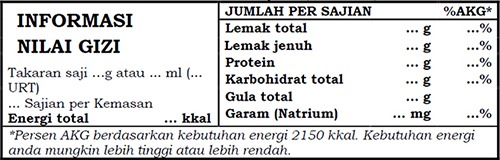
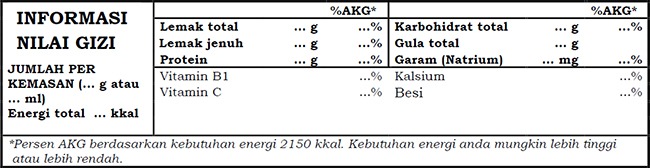
BPOM Regulation No. 10 of 2026 updates the standardized formats for the nutritional value information (ING) table. The regulation continues to allow both vertical and horizontal formats and now provides clearer templates for use on product labels.

For horizontal presentation, businesses may use either a three-column tabular format, which provides more space for displaying nutrient information and additional vitamins or minerals, or a two-column tabular format, which offers a simplified layout suitable for products with limited label space.


Three-column per-serving tabular format
 

Two-column per-serving tabular format
 

Three-column per-package tabular format
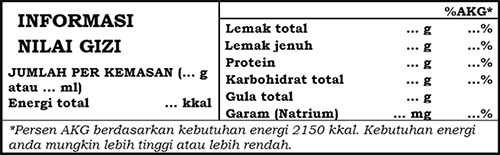
 

Two-column per-package tabular format


BPOM Regulation No. 10 of 2026 also introduces specific flexibility for micro-enterprises regarding the ING table. If analytical results are unavailable and the value of a processed food nutrient has not yet been established by the head of BPOM, the values in the ING table should be declared based on calculation results. The procedure for calculating the nutrient content for processed foods produced by micro-enterprises was established by the head of BPOM in 2026 and involves mostly traditional Indonesian food products.

Transition Period

BPOM Regulation No. 10 of 2026 provides a 24-month transition period to facilitate compliance with the new requirements, so processed foods that had already obtained distribution permits before the regulation entered into force, as well as products that were undergoing registration at that time, must be brought into compliance with the new regulation by June 17, 2028. Similar transitional provisions apply to the implementation of Nutri-Level labeling requirements for affected beverage products. As a result, food business operators are afforded additional time to review product portfolios, update nutritional information, and revise product labels where necessary.

Business Impact

The new regulation will require many food and beverage businesses to review their existing nutrition labeling practices in order to comply with the new requirements. In particular, companies should assess the impact of the revised nutrient reference values, updated serving-size requirements, and Nutri-Level labeling requirements on their products.

The Nutri-Level requirements will be especially relevant for beverage manufacturers. Businesses should therefore begin evaluating their product portfolios and preparing any necessary label updates to ensure compliance before the expiry of the 24-month transition period.


RELATED INSIGHTS​ 

April 29, 2026
Effective June 22, 2026, Thai Industrial Standards (TIS) for food contact paper and cooking paper will be enforced as mandatory for sale in the Thai market. This move has important implications for product licensing and tightens hygiene, labeling, and chemical-safety requirements for food-contact and cooking paper products. Thailand is strengthening its regulatory framework for paper-based culinary materials against a backdrop of accelerating global commitments to ESG and sustainability, as such materials—particularly those derived from natural or recycled fibers—have emerged as key alternatives to plastics in food preparation, cooking, and packaging applications. As a result, regulators worldwide are tightening controls to ensure that sustainability initiatives do not compromise consumer safety, particularly regarding the potential migration of chemical substances into food. Regulatory Framework: Voluntary vs. Mandatory Standards Standards under the TIS regime are generally classified into two categories. Voluntary standards allow manufacturers or importers to apply for a product license and affix the TIS mark to demonstrate product quality and build consumer confidence, but compliance is not legally required. Mandatory standards, by contrast, require manufacturers and importers to obtain a product license and affix the TIS mark before placing products on the Thai market, and noncompliant products cannot be legally sold. Previously, the TIS standards for food contact paper (TIS 2948-2562) and cooking paper (TIS 3438-2022) fell under the voluntary standard regime, meaning that obtaining a TIS license and displaying the TIS mark was optional. However, due to the increasing use of paper in food preparation and cooking, the Thai Industrial Standards Institute has determined that upgrading these standards to mandatory status is necessary to enhance consumer safety. As a result, all paper intended for food contact or cooking purposes must now obtain a TIS product license prior to sale in Thailand. Scope of the Standards The primary distinction between the
April 22, 2026
A new decree in Vietnam brings significant implementation clarity to the country’s existing extended producer responsibility (EPR) legal framework. An EPR mechanism was first codified in Vietnam in the 2020 Law on Environmental Protection amid ongoing challenges surrounding the collection and treatment of product and packaging waste. The mechanism was progressively detailed through Decree No. 08/2022/ND‑CP and its successive amendments, but the regulatory framework remained insufficiently developed, notably in terms of support mechanisms for waste collection, recycling, and treatment. The newly launched regulations in Decree No. 110/2026/ND-CP (Decree 110), issued on April 1, 2026, and taking effect on May 25, 2026, stipulate fully and clearly the responsibility of manufacturers and importers to recycle products and packaging and to treat waste. Some key provisions of Decree 110 for manufacturers, importers, and related stakeholders are presented below. Subjects of EPR The Law on Environmental Protection assigns responsibility to manufacturers and importers for product and packaging recycling (under Article 54) or waste collection and treatment (under Article 55), depending on the type of products and packaging they produce or import. Decree 110 elaborates on these EPR provisions by specifying the responsible entities and listing out the types of products and packaging subject to recycling and waste treatment responsibilities. Decree 110 clarifies the responsible entities in special cases, such as when products under the same brand are made by multiple manufacturers, when there is a contract manufacturing or entrusted import relationship, and when the manufacturer or importer is part of a corporate group. Notably, exemptions may be applied in some scenarios, such as for manufacturers and importers of products and packaging exclusively for export, temporary import and re-export, or research and testing purposes, as well as for entities with annual revenue from related products not exceeding VND 30 billion. Recycling Responsibilities Decree 110
March 30, 2026
In response to an emerging crisis on food safety, the government of Vietnam promulgated Decree No. 46/2026/ND-CP (Decree 46) on January 26, 2026, and Resolution No. 66.13/2026/NQ-CP (Resolution 66.13) on January 27, 2026, setting out a number of substantive changes to the procedure and strict requirements for the declaration, registration, and importation of food products. Both instruments took effect upon issuance. However, shortly after they entered into force, food businesses encountered significant implementation challenges, particularly with respect to state inspection procedures at the customs clearance stage for imported products. In response, the government issued Resolution No. 09/2026/NQ-CP (Resolution 09) on February 4, 2026, temporarily suspending Decree 46 and Resolution 66.13 until a new effective date of April 16, 2026. Continued Suspension of Implementation of Decree 46 and Resolution 66.13 After considering feedback gathered by the Ministry of Health from food businesses and other stakeholders during the suspension period, the Vietnam Government Office issued a notice on March 20, 2026, agreeing to extend the suspension until the issuance of an amended Law on Food Safety and its guiding decree. Following this notice, on March 22, 2026, the Ministry of Health prepared a draft resolution to implement the notice and replace Resolution 09. Under the draft resolution, the effectiveness of Decree 46 and Resolution No. 66.13 would continue to be suspended until the amended Law on Food Safety takes effect, except for the provisions under Resolution 66.13 allowing flexibility in documents evidencing product efficacy, which would take effect on April 16, 2026, and remain effective until the Law on Food Safety is replaced (but not later than February 28, 2027). Accordingly, for products subject to the registration declaration procedure, such as health supplements, efficacy may be substantiated by either (i) scientific evidence supporting the declared function and effects of the product
February 26, 2026
Laos’ Food and Drug Department (FDD) has been using a new online registration system for drugs since the beginning of the year. The system, which was implemented following the November 2025 issuance of Notice No. 5960/FDD, became the official pathway for submissions on January 1, 2026. Since that date, paper-based registrations have no longer been accepted. This marks a significant advancement in the digitalization of regulatory processes in Laos. As the online system is now the exclusive platform for registration, renewal, and amendments, companies that have not yet aligned their processes to the new system should act promptly to ensure a smooth transition. To assist with this, the FDD will conduct periodic training sessions on the use of the online registration system, which will be delivered either in person or remotely, depending on operator demand. To start using the system, drug and medical device manufacturers, as well as import-export companies, that have not yet registered must submit a formal request identifying the authorized personnel who will access the platform, after which they will be issued user accounts and access codes. Each request must be accompanied by the company’s enterprise registration certificate (incorporation certificate), a copy of the identity card or passport of each designated user, and a scanned copy of their signature. There is no restriction on the number of users per company, allowing flexibility to meet operational needs. Companies that already hold accounts and access codes from the trial phase may continue using them and may apply for additional accounts if needed. Additional Requirements The new system also introduces a standardized format for drug registration numbers. For example, an import drug registration number such as 06 I 4040/15 will be changed to 06-IM-04040-15, and a domestic drug registration number such as 06 L 4040/15 will be changed to