
You are using an outdated browser and your browsing experience will not be optimal. Please update to the latest version of Microsoft Edge, Google Chrome or Mozilla Firefox. Install Microsoft Edge

August 10, 2026

Changes in Nutrition Labeling Requirements in Indonesia

On June 17, 2026, Indonesia’s National Agency of Drug and Food Control (BPOM) issued BPOM Regulation No. 10 of 2026 on Nutritional Information on Processed Food Labels.

The new regulation, which revokes three previous nutrition labeling regulations, introduces several notable changes affecting food and beverage manufacturers, importers, and distributors. These changes range from updated nutrient reference values and serving-size requirements to the introduction of the Nutri-Level front-of-pack labeling system for certain beverage products. Businesses operating in Indonesia should carefully review these developments and assess their products’ compliance with the new requirements during the transition period.

Implementation of the Nutri-Level Labeling System

To implement the recently issued decree on Nutri-Level labeling, BPOM Regulation No. 10 of 2026 stipulates the requirements to implement the Nutri-Level labeling system on the front-of-pack. Under the new framework, ready-to-drink beverages, powdered beverages, and liquid or solid concentrates are required to display Nutri-Level labeling on the front label of their packaging.

The Nutri-Level labeling system classifies products into color-coded levels A through D based on their sugar, sodium, and total fat content. The applicable Nutri-Level is determined based on the lowest level measured in the assessment of sugar, sodium, and total fat content.

For products classified as level C or D, the Nutri-Level label must be accompanied by information on the relevant sugar, sodium, and total fat content per 100 ml of the ready-to-consume product. Products classified as level A or B may either display only the Nutri-Level designation or display the Nutri-Level together with the relevant nutritional information per 100 ml.

Minimum Vitamin and Mineral Content Required for Declaration

BPOM Regulation No. 10 of 2026 introduces a stricter threshold for the declaration of vitamins and minerals in the nutritional value information section (ING).

Vitamins or minerals may only be declared if they are present at a level of at least 5% of the recommended dietary allowance (RDA) per serving, per 100 g, per 100 ml, or per package, in accordance with the inclusion of the ING table, except for processed foods that declare vitamins or minerals claims in accordance with certain laws and regulations. This represents a significant change from the previous regime under the now-revoked BPOM Regulation No. 26 of 2021, under which vitamins and minerals could be declared when present at a level of at least 2% of the RDA per serving.

Revised Serving Size Requirements

While serving size declarations were already required under BPOM Regulation No. 26 of 2021, BPOM Regulation No. 10 of 2026 introduces additional technical guidance on serving-size determination and presentation. The new regulation expressly requires serving sizes to be rounded to the nearest half-unit, providing a standardized approach to serving-size calculations across product categories. An exception applies to products classified under food category 11.6 (sweeteners, including table-top sweeteners and high-intensity sweeteners), which may require businesses to review and, where necessary, update their existing nutrition labeling.

In addition, an appendix to Regulation No. 10 of 2026 sets out updated serving-size references for a wide range of food categories. As a result, food business operators should review the revised category-specific serving-size references to determine whether their existing nutrition information tables, nutrient calculations, and serving-size declarations remain compliant under the new framework. Although serving-size requirements were already regulated under BPOM Regulation No. 26 of 2021, the 2026 regulation provides greater technical detail and updated references that may necessitate label revisions for certain products.

Updated Nutrient Reference Values

BPOM Regulation No. 10 of 2026 updates the nutrient reference values previously set forth in BPOM Regulation No. 9 of 2016 to correspond with the current development of scientific knowledge in health. Several reference values have been revised from those in BPOM Regulation No. 9 of 2016 (e.g., for total fat, vitamin B1, vitamin B2, vitamin B12, magnesium, potassium, and various other vitamins and minerals). As these values are used to calculate the percentage of RDA displayed in nutrition information tables, the revisions may affect the nutrient percentage calculations currently appearing on product labels.

The regulation also introduces updated nutrient reference methodologies and conversion factors. In particular, vitamin B3 may now be expressed in niacin equivalents (NE), folate may be expressed in dietary folate equivalents (DFE), and revised conversion factors have been adopted for vitamins A, D, and E. These changes are intended to align nutrition labeling requirements with current nutritional science and may require food business operators to reassess existing nutrient declarations and label calculations.

Updated Nutritional Value Information Table Formats

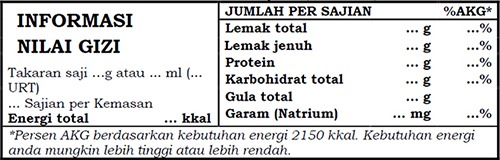
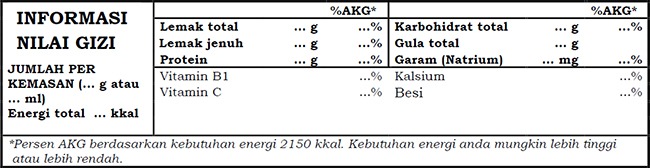
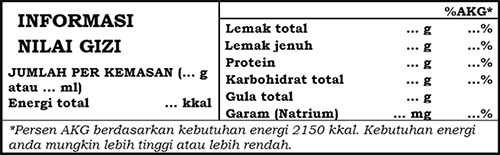
BPOM Regulation No. 10 of 2026 updates the standardized formats for the nutritional value information (ING) table. The regulation continues to allow both vertical and horizontal formats and now provides clearer templates for use on product labels.

For horizontal presentation, businesses may use either a three-column tabular format, which provides more space for displaying nutrient information and additional vitamins or minerals, or a two-column tabular format, which offers a simplified layout suitable for products with limited label space.


Three-column per-serving tabular format
 

Two-column per-serving tabular format
 

Three-column per-package tabular format
 

Two-column per-package tabular format


BPOM Regulation No. 10 of 2026 also introduces specific flexibility for micro-enterprises regarding the ING table. If analytical results are unavailable and the value of a processed food nutrient has not yet been established by the head of BPOM, the values in the ING table should be declared based on calculation results. The procedure for calculating the nutrient content for processed foods produced by micro-enterprises was established by the head of BPOM in 2026 and involves mostly traditional Indonesian food products.

Transition Period

BPOM Regulation No. 10 of 2026 provides a 24-month transition period to facilitate compliance with the new requirements, so processed foods that had already obtained distribution permits before the regulation entered into force, as well as products that were undergoing registration at that time, must be brought into compliance with the new regulation by June 17, 2028. Similar transitional provisions apply to the implementation of Nutri-Level labeling requirements for affected beverage products. As a result, food business operators are afforded additional time to review product portfolios, update nutritional information, and revise product labels where necessary.

Business Impact

The new regulation will require many food and beverage businesses to review their existing nutrition labeling practices in order to comply with the new requirements. In particular, companies should assess the impact of the revised nutrient reference values, updated serving-size requirements, and Nutri-Level labeling requirements on their products.

The Nutri-Level requirements will be especially relevant for beverage manufacturers. Businesses should therefore begin evaluating their product portfolios and preparing any necessary label updates to ensure compliance before the expiry of the 24-month transition period.


RELATED INSIGHTS​ 

February 9, 2023
Vietnam’s Ministry of Finance is drafting a circular on determining the origin of imported and exported goods. This circular, a draft version of which has been released for public comment (“Draft Circular”), consolidates prevailing regulations and guidelines on determining the origin of imported and exported goods that are stipulated in the following legal documents, which the Draft Circular would replace when it comes into effect: Circular No. 38/2018/TT-BTC dated April 20, 2018, of the Ministry of Finance regulating the determination of origin of imported and exported goods, as amended by Circular No. 62/2019/TT-BTC dated September 5, 2019, of the Ministry of Finance; Circular No. 47/2020/TT-BTC dated May 27, 2020, regulating the time to submit documents proving the origin of goods and form of the documents proving the origin of imported goods applied during the Covid-19 pandemic; and Circular No. 07/2021/TT-BTC dated January 25, 2021, regulating the time to submit documents proving the origin of imported goods under the EU-Vietnam Free Trade Agreement (EVFTA). Generally speaking, the Draft Circular does not increase the administrative procedures for importers and exporters, but rather seeks to codify the recent practices implemented by the customs authorities. The Draft Circular focuses on providing comprehensive guidance for importing/exporting companies when carrying out administrative procedures to certify the origins of imported and exported goods to be in line with current trade practices and international commitments under new-generation free trade agreements. In particular, the Draft Circular supplements guidelines on declaring origins and submitting Certificates of Origin (C/Os) of imported goods under the EVFTA and the Regional Comprehensive Economic Partnership Agreement (RCEP). The Draft Circular also provides some new guidelines to facilitate exports (and imports) and overcome some obstacles and issues when implementing the prevailing regulations. For example, the submission of C/Os online, which was only applicable during the
January 27, 2023
The opening weeks of 2023 have already seen a sharp increase in enforcement against violations of product labeling and advertising rules in Cambodia, in line with a notice issued by the country’s Directorate-General for Consumer Protection, Competition, and Fraud Repression (CCF) last year. Since the Law on Consumer Protection was adopted in 2019, a major legislative push has been seen, with general rules coming out focusing on providing consumers with sufficient information on products and services, for example via product labeling or advertising rules. Then, more detailed regulations were adopted for specific product categories, for example for food products and cosmetics. Khmer language requirements have been a key feature of the recently adopted rules on advertising and labeling. Despite the Khmer language mandates in consumer protection laws and regulations, enforcement and compliance was low. Most products on the market—especially imports—did not comply with the language requirement. In line with the revamped regulatory framework, the CCF has increased its enforcement, enabled by recent substantial budget increases. They have adopted clear implementing regulations for their officers to enforce in a practical yet effective manner, and they have been issuing notices reminding companies to comply with the new rules. A September 2022 notice announced that increased CCF enforcement of product labeling rules would start on January 1, 2023. As noted above, this has already proven to be true, and enforcement is now proceeding in earnest. Companies should take heed of this notice and ensure compliance with the Khmer language requirements (detailed below), as the CCF has shown that it readily acts against violators, from small retailers to large conglomerates. Khmer Language Requirement A sub-decree issued November 4, 2022 requires all commercial advertising of products and services—by any channel—to use Khmer as the primary language. If foreign-language text is used in advertisements, it
January 10, 2023
On January 9, 2023, Vietnam’s National Assembly voted to approve a draft resolution on the continued implementation of policies for the prevention and control of the Covid-19 pandemic. Under this resolution, marketing authorizations (MAs) for the following drugs and medicinal ingredients will be extended to December 31, 2024, allowing continued use in Vietnam: Drugs and medicinal ingredients whose MAs expire from January 1, 2023, to December 12, 2024, and whose extension dossiers have been submitted but have not yet been approved in accordance with the Law on Pharmacy; and Drugs and medicinal ingredients whose MAs have been extended as per Resolution No. 12/2021/UBTVQH15 and have not been extended in accordance with the Law on Pharmacy. The extension does not apply to the following cases: Drugs and medicinal ingredients that have been recalled by the Law on Pharmacy; Drugs with signs of being unsafe for users that have been suspended from circulation/use and sealed for preservation in accordance with the Law on Pharmacy; and Drugs with MAs having a validity term of three years in accordance with the Law on Pharmacy. The Ministry of Health will announce the list of drugs and medicinal ingredients whose MAs are subject to be extended as described above.
November 23, 2022
The delisting of cannabis as a controlled narcotic in Thailand on June 9, 2022, was a breakthrough moment for the industry.  Not only are farmers and others in the industry elated that such a step was taken, it has triggered the establishment of an abundance of cannabis dispensaries in Bangkok and other popular domestic and international tourist destinations in Thailand, including Chiang Mai, Pattaya, Phuket, and many islands. Vulnerable populations, such as children, accessing cannabis has also become a hot-button issue. Thailand’s Ministry of Public Health (MOPH) was initially criticized by some for its policy of allowing cannabis to be sold with few restrictions. On June 17, 2022, the MOPH followed up with the Announcement Re: Controlled Herbs (Cannabis) under the Thai Traditional Medical Knowledge Act, which seemed to implement a viable mechanism to regulate cannabis dispensaries. This announcement contained prohibitions on selling cannabis to vulnerable populations (minors, expectant women, and breastfeeding mothers) and on smoking cannabis in public. Furthermore, the draft Cannabis and Hemp Act includes provisions related to sales and distribution channels and advertisements for particular dispensaries. However, the draft act has been delayed due to disagreements among some political parties during the reading of the legislation, and is unlikely to be implemented in 2022 as had been widely expected.  The tug-of-war among the political parties has caused concerns about whether the country’s recent liberalized cannabis policy will be revisited and cannabis relisted as a narcotic. With this uncertainty over when the draft Cannabis and Hemp Act will be implemented, the MOPH has focused on identifying gaps in current regulation that might allow the misuse of cannabis. The minister of the MOPH has announced that the MOPH announcement of June 17, 2022, will be repealed and replaced by the November 11, 2022, Announcement Re: Controlled Herbs (Cannabis).