
You are using an outdated browser and your browsing experience will not be optimal. Please update to the latest version of Microsoft Edge, Google Chrome or Mozilla Firefox. Install Microsoft Edge

August 10, 2026

Changes in Nutrition Labeling Requirements in Indonesia

On June 17, 2026, Indonesia’s National Agency of Drug and Food Control (BPOM) issued BPOM Regulation No. 10 of 2026 on Nutritional Information on Processed Food Labels.

The new regulation, which revokes three previous nutrition labeling regulations, introduces several notable changes affecting food and beverage manufacturers, importers, and distributors. These changes range from updated nutrient reference values and serving-size requirements to the introduction of the Nutri-Level front-of-pack labeling system for certain beverage products. Businesses operating in Indonesia should carefully review these developments and assess their products’ compliance with the new requirements during the transition period.

Implementation of the Nutri-Level Labeling System

To implement the recently issued decree on Nutri-Level labeling, BPOM Regulation No. 10 of 2026 stipulates the requirements to implement the Nutri-Level labeling system on the front-of-pack. Under the new framework, ready-to-drink beverages, powdered beverages, and liquid or solid concentrates are required to display Nutri-Level labeling on the front label of their packaging.

The Nutri-Level labeling system classifies products into color-coded levels A through D based on their sugar, sodium, and total fat content. The applicable Nutri-Level is determined based on the lowest level measured in the assessment of sugar, sodium, and total fat content.

For products classified as level C or D, the Nutri-Level label must be accompanied by information on the relevant sugar, sodium, and total fat content per 100 ml of the ready-to-consume product. Products classified as level A or B may either display only the Nutri-Level designation or display the Nutri-Level together with the relevant nutritional information per 100 ml.

Minimum Vitamin and Mineral Content Required for Declaration

BPOM Regulation No. 10 of 2026 introduces a stricter threshold for the declaration of vitamins and minerals in the nutritional value information section (ING).

Vitamins or minerals may only be declared if they are present at a level of at least 5% of the recommended dietary allowance (RDA) per serving, per 100 g, per 100 ml, or per package, in accordance with the inclusion of the ING table, except for processed foods that declare vitamins or minerals claims in accordance with certain laws and regulations. This represents a significant change from the previous regime under the now-revoked BPOM Regulation No. 26 of 2021, under which vitamins and minerals could be declared when present at a level of at least 2% of the RDA per serving.

Revised Serving Size Requirements

While serving size declarations were already required under BPOM Regulation No. 26 of 2021, BPOM Regulation No. 10 of 2026 introduces additional technical guidance on serving-size determination and presentation. The new regulation expressly requires serving sizes to be rounded to the nearest half-unit, providing a standardized approach to serving-size calculations across product categories. An exception applies to products classified under food category 11.6 (sweeteners, including table-top sweeteners and high-intensity sweeteners), which may require businesses to review and, where necessary, update their existing nutrition labeling.

In addition, an appendix to Regulation No. 10 of 2026 sets out updated serving-size references for a wide range of food categories. As a result, food business operators should review the revised category-specific serving-size references to determine whether their existing nutrition information tables, nutrient calculations, and serving-size declarations remain compliant under the new framework. Although serving-size requirements were already regulated under BPOM Regulation No. 26 of 2021, the 2026 regulation provides greater technical detail and updated references that may necessitate label revisions for certain products.

Updated Nutrient Reference Values

BPOM Regulation No. 10 of 2026 updates the nutrient reference values previously set forth in BPOM Regulation No. 9 of 2016 to correspond with the current development of scientific knowledge in health. Several reference values have been revised from those in BPOM Regulation No. 9 of 2016 (e.g., for total fat, vitamin B1, vitamin B2, vitamin B12, magnesium, potassium, and various other vitamins and minerals). As these values are used to calculate the percentage of RDA displayed in nutrition information tables, the revisions may affect the nutrient percentage calculations currently appearing on product labels.

The regulation also introduces updated nutrient reference methodologies and conversion factors. In particular, vitamin B3 may now be expressed in niacin equivalents (NE), folate may be expressed in dietary folate equivalents (DFE), and revised conversion factors have been adopted for vitamins A, D, and E. These changes are intended to align nutrition labeling requirements with current nutritional science and may require food business operators to reassess existing nutrient declarations and label calculations.

Updated Nutritional Value Information Table Formats

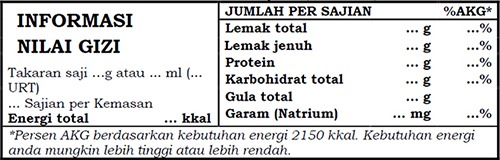
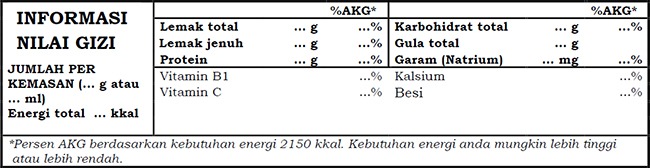
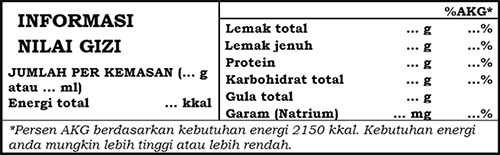
BPOM Regulation No. 10 of 2026 updates the standardized formats for the nutritional value information (ING) table. The regulation continues to allow both vertical and horizontal formats and now provides clearer templates for use on product labels.

For horizontal presentation, businesses may use either a three-column tabular format, which provides more space for displaying nutrient information and additional vitamins or minerals, or a two-column tabular format, which offers a simplified layout suitable for products with limited label space.


Three-column per-serving tabular format
 

Two-column per-serving tabular format
 

Three-column per-package tabular format
 

Two-column per-package tabular format


BPOM Regulation No. 10 of 2026 also introduces specific flexibility for micro-enterprises regarding the ING table. If analytical results are unavailable and the value of a processed food nutrient has not yet been established by the head of BPOM, the values in the ING table should be declared based on calculation results. The procedure for calculating the nutrient content for processed foods produced by micro-enterprises was established by the head of BPOM in 2026 and involves mostly traditional Indonesian food products.

Transition Period

BPOM Regulation No. 10 of 2026 provides a 24-month transition period to facilitate compliance with the new requirements, so processed foods that had already obtained distribution permits before the regulation entered into force, as well as products that were undergoing registration at that time, must be brought into compliance with the new regulation by June 17, 2028. Similar transitional provisions apply to the implementation of Nutri-Level labeling requirements for affected beverage products. As a result, food business operators are afforded additional time to review product portfolios, update nutritional information, and revise product labels where necessary.

Business Impact

The new regulation will require many food and beverage businesses to review their existing nutrition labeling practices in order to comply with the new requirements. In particular, companies should assess the impact of the revised nutrient reference values, updated serving-size requirements, and Nutri-Level labeling requirements on their products.

The Nutri-Level requirements will be especially relevant for beverage manufacturers. Businesses should therefore begin evaluating their product portfolios and preparing any necessary label updates to ensure compliance before the expiry of the 24-month transition period.


RELATED INSIGHTS​ 

September 15, 2023
In May 2023, Thailand issued a regulation on conditional approval for emergency use of medicinal products, replacing a series of similar notifications that had been issued to aid mitigation efforts during the COVID-19 pandemic. During the pandemic, regulatory authorities worldwide—including the Thai Food and Drug Administration (FDA)—reshaped the approval pathway for emergency drugs intended for the treatment of COVID-19. The Thai FDA published five Notifications Re: Conditional Approval for the Emergency Use of Medicinal Products to outline the registration requirements and channels of distribution for drugs intended for the diagnosis, treatment, or prevention of COVID-19. As the threat from COVID-19 was receding, the Thai FDA saw fit to prepare for the potential emergence of other serious communicable diseases by enabling the supply of timely medications for disease diagnosis, treatment, and prevention. The Thai FDA therefore cancelled the five COVID-19-related emergency use notifications, which were published in 2020 and 2022, and replaced them with the Notification Re: Conditional Approval for Emergency Use of Medicinal Products published in May 2023. Under the May 2023 FDA notification on emergency use, conditional approval can be applied to drugs supported by empirical scientific evidence demonstrating their capacity to diagnose, treat, alleviate, cure, or prevent a serious communicable disease. The drugs eligible for approval under this new emergency pathway include novel drugs that are not yet approved in Thailand, as well as existing drugs approved in Thailand but recently discovered to have additional potential indications for the diagnosis, treatment, alleviation, cure, or prevention of a serious communicable disease. Distribution The 2023 FDA notification also clearly defines permissible distribution channels based on the dosage form of drug products: Vaccines can be distributed to governmental organizations that have a duty to prevent or treat diseases, such as the Thai Red Cross Society (TRCS), the Government Pharmaceutical Organization
September 7, 2023
Thailand is a member state of the ASEAN Economic Community, and next year, it is expected that the ASEAN Harmonization of Traditional Medicines and Health Supplements will be signed by the economic minister of each ASEAN country. Following ratification, the ASEAN Guidelines on Claims and Claims Substantiation for Traditional Medicines and Health Supplements will become the standard guidelines in the region, and various implementation efforts and instruments will follow. These guidelines cover a wide range of medicines and supplements; however, it is not possible to cover all herbal products. There are three types of health supplement claims: nutritional claims, functional claims, and disease risk reduction claims. Examples of the three types of claims include the following: Nutritional claims: supplements nutrition, nourishes the body, supports healthy growth and development, etc. Functional claims: maintains healthy joints, supports immunity, maintains liver function, etc. Disease risk reduction claims: helps to reduce risk of dyslipidemia, helps to reduce risk of osteoporosis, etc. The degree of evidence required for substantiating disease risk reduction claims is higher than for functional claims and nutritional claims. Functional claims and disease risk reduction claims must be substantiated by efficacy studies and the relevant toxicity data. It is the responsibility of the health supplement company to provide the required evidence in order to comply with the criteria for making such claims. Tips on Health Claims for Health Supplements 1. Nutritional Claims For essential nutrients such as vitamins and minerals, as listed by the Thai Food and Drug Administration (FDA), the amount included in a supplement must be between 15% and 100% of the Thai Recommended Daily Intake (RDI) values. Rules for specific kinds of nutritional claims are provided in the Notification of the Thai FDA RE: Nutrient Function Claims. For example, the nutrients that can be claimed as boosting the
August 29, 2023
Laos’ Ministry of Health (MOH) has promulgated a regulation detailing registration and notification protocols for medical devices. Decision on the Registration and Notification of Medical Devices No. 1470/MOH will come into force 60 days after both the signing of the regulation (which already occurred in July) and publication in the Official Gazette, which has not yet been specified by the government. Registration of medical devices in Laos is mentioned in the country’s Law on Drugs and Medical Products No. 07/NA, dated December 21, 2011, but a registration procedure has not been put in place. There was only a separate requirement to furnish certain required documents when importing medical devices. Now, the decision outlines the registration and notification process for medical devices through the Ministry of Health’s Food and Drug Department (FDD), in line with the regulatory principles in the ASEAN Medical Device Directive of 2015, which Laos has ratified. Medical Devices in Laos The decision defines medical devices as any instrument, apparatus, implement, machine, appliance, implant, in vitro reagent or calibrator, software, material, or other similar or related article intended for any of the following uses in humans: Diagnosis, prevention, monitoring, recovery from, or alleviation or treatment of a disease; Diagnosis, monitoring, recovery from, or alleviation of or compensation for an injury; Replacement, modification, or support of anatomy or a physiological process; Supporting and sustaining life; Controlling or assisting in conception; or Disinfection and sterilization of tools and medical devices. Medical devices in Laos are given one of four classifications based on their level of risk: Class A – Low risk (e.g., rubber belts, cotton for medical purposes, nonwoven swabs, adhesive bandages) Class B – Low-moderate risk (e.g., neonatal suction equipment, surgical gloves, gastro-catheters) Class C – Moderate-high risk (e.g., endoscopic surgical equipment, anesthesia equipment, peritoneal dialysis equipment) Class
August 29, 2023
Since the June 9, 2022, delisting of all parts of the cannabis plant according to the Narcotics Code, there has been an explosion of cannabis dispensaries operating in Thailand. The Department of Thai Traditional and Alternative Medicine (DTTAM) has issued more than 12,000 cannabis dispensary licenses to businesses in Thailand. A license allows a dispensary to sell cannabis flowers legally. In addition, the DTTAM requests the cooperation of dispensaries in submitting monthly reports about the sourcing, selling, and inventory of cannabis flowers. The DTTAM may suspend the selling license of dispensaries that fail to submit these reports. Apart from the enforcement duties and administrative acts of the DTTAM, the enactment of the laws and regulations pertaining to cannabis seemed to be drastically winding down. One of the reasons was that Thailand had delays in the process of forming a new government following the general election of May 14, 2023. These delays dampened Thailand’s thriving cannabis industry. In particular, the industry has concerns about the uncertainty of the nascent cannabis law. On August 11, 2023, the Narcotics Control Division of the Thai Food and Drug Administration (FDA) posted the Draft Regulation Re: Application for Approval and Approval for Manufacture, Importation, Exportation, Distribution or Possession of Narcotics under Category 5 (Extracts from Cannabis or Hemp Plants Only). This may be the first regulation that the newly formed government implements with regard to cannabis extracts. Unlike the DTTAM’s enforcement activities, the Thai FDA requests that a domestic manufacturer, importer, exporter, or seller of cannabis extracts apply for a license. The Thai FDA, as the authority, will consider granting a license only in the following cases: For medical benefits; For commercial or industrial benefits; For the benefit of medical or scientific analysis or research; and For use by the government for preventing and