
You are using an outdated browser and your browsing experience will not be optimal. Please update to the latest version of Microsoft Edge, Google Chrome or Mozilla Firefox. Install Microsoft Edge

December 6, 2018

Case Studies on Board of Patents’ Decisions Relating to Product Design Novelty

Informed Counsel

To be eligible for a design patent under Thai law, a product design must be novel and industrially applicable. A product design is considered to be novel if, before the application is filed, the design:

  • is not widely known or used in Thailand;
  • is not disclosed or described in Thailand or another country;
  • is not published; and
  • does not sufficiently resemble any previous designs to be considered an imitation.

These criteria, stipulated by law, are deliberately straightforward so that unpatentable product designs can be easily weeded out. However, when a design patent application is filed for a design that is similar in appearance to a publicly available product, it can be challenging to assess whether the new application will be granted. This article takes an in-depth look at two cases that fall under this scenario, the reasoning that the Board of Patents (BOP) adopted in addressing them, and the ultimate decisions that it reached.

Case Studies

On June 27, 2018, the BOP ruled that a design for roofing plates was novel, compared to four prior art designs for existing patents.
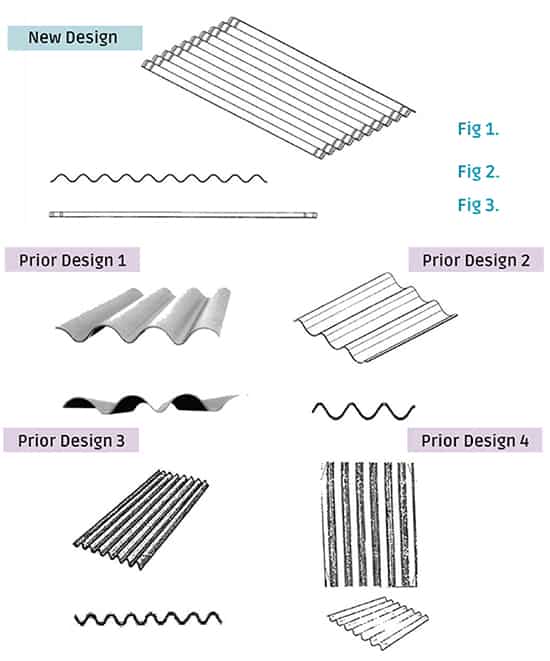
The BOP compared the new design to the four existing designs in order to determine whether the new design was recognizably different. In deliberating the case, the BOP found that the new design featured a roof tile with a wave pattern in which the upper and lower waves were the same size and appearance. Additionally, the two-stripe patterns, oriented in a perpendicular direction to the waves and located at both ends of the roof tile, were held to be a unique feature. These combined characteristics passed the novelty test and led the BOP to render the design as novel compared to the existing patents.

Approximately one month after the decision in the roofing plates case was rendered, the BOP dismissed a design patent application for a screw cap for a jar on the grounds that it was substantially similar to a prior art design for an existing patent. 


According to the BOP, the new product design comprised a round cap with a flat top and bottom and convex vertical strips along the outer edge. In addition, a vertical cross-section of the cap featured a flat surface with a groove. Ultimately, these elements were found to be substantially similar to the prior art design. Although the grooves of the new design were wider and deeper than those of the prior art, these differences were insufficient for the design to be considered novel.

Conclusion   

In the deliberation of both cases, the BOP considered each element of the new product design, and the overall appearance, and compared them to prior designs. If they found that the combined elements created an overall appearance that was sufficiently different from the previous design, then the new product design was deemed to be novel.   

The BOP’s decisions on these two cases make it clear that, when comparing prior art designs to the design in a new application, the focus goes beyond merely identifying unique parts. The BOP also pays considerable attention to the cohesiveness of the overall appearance of the product. As shown in the second case, a design will not be considered as novel if it is substantially similar to existing designs in overall appearance. However, individual elements can help to distinguish the overall appearance of a design from other existing designs, and thus make it patentable.    

One practical upshot of this is that it is prudent to point out all unique and unifying elements of a design when filing a response to an office action or appeal to the BOP regarding the novelty of a product design. This strategy can be very useful in successfully registering a challenged application.

RELATED INSIGHTS​

May 25, 2021
When a U.S. cosmetics startup discovered that a trademark application for its brand name had been filed in Vietnam by a likely trademark squatter, they opted to use a “straw man” – another company with no visible connection to the startup – to directly negotiate with the squatter.
May 21, 2021
Under current law, the term of protection for photographic works is 50 years from the work’s creation or first publication. The draft amendment of the Copyright Act extends this to be the lifetime of the author plus an additional 50 years. This change would put Thailand’s protection for photographic works in line with the WIPO Copyright Treaty, of which Thailand is getting ready to be a member. Online infringement: safe harbours and takedowns While the current Copyright Act provides injunctive relief against online infringement for copyright owners, together with an exemption from infringement liability for ISPs, the mechanism for doing so has proved ineffective. The new draft therefore replaces this mechanism with safe harbour provisions that exempt ISPs from liability for copyright infringement committed by users, as long as the ISPs comply properly – including by implementing the notice-and-takedown system. The draft provides a detailed definition of ‘service providers’ and divides ISPs into intermediary ISPs, caching ISPs, hosting ISPs, and search engine ISPs. The draft’s definition of ‘users’ of ISPs includes anyone who uses an ISP’s service (paying or otherwise). In order to be exempted from liability for copyright infringement for their provided services, an ISP must have explicitly announced (and complied with) a policy to terminate services to repeated infringers. ISPs must also adopt the notice-and-takedown system – a new addition by the draft. Under this system, which can be compared to the Digital Millennium Copyright Act in the US, copyright owners can send a notice of infringement (backed by evidence) to caching, hosting or search engine ISPs, informing them of any allegedly infringing data. An ISP that has been notified is required to immediately take down the allegedly infringing data, its references, and access points from their system – or block access. The ISP must then notify the user
May 5, 2021
With the latest COVID-19 outbreak in Thailand becoming more severe and widespread, travel restrictions and social distancing measures may prevent applicants for patents, petty patents, and design patents from submitting documents or amendments by the required deadline. In order to ease the burden on applicants, the Director-General of the Department of Intellectual Property (DIP) has issued a notification, effective on April 16, 2021, extending the deadline for submission of documents and amendments in response to office actions with the DIP. According to the notification, any office action deadline which was due to fall from April 16 to May 31, 2021 will now automatically be postponed to May 31, 2021. Applicants may submit their responses to office actions from June 1 – June 30, 2021. The extended deadlines apply to the following procedures: Amendments in response to office actions; Submission of documents per an office action or examiner’s instructions; and, Requests for extensions of time for amendments or document submission in response to office actions. Applicants who are able to do so may still choose to submit any documentation, amendments, and requests for extensions within the original deadline stipulated in an office action.