
You are using an outdated browser and your browsing experience will not be optimal. Please update to the latest version of Microsoft Edge, Google Chrome or Mozilla Firefox. Install Microsoft Edge

April 10, 2020

Cambodia Issues Tax Relief Measures for Textile and Garment Enterprises to Mitigate EBA Suspension

On March 24, 2020, Cambodia’s Ministry of Economy and Finance issued Prakas No. 319 MoEF.Br.K on Tax Measures to Mitigate the Effect of Challenges on Textile and Garment Enterprises.

This prakas provides income tax exemptions to factories and enterprises in the textile, garment, footwear, bag, handbag, and hat sectors that are affected by the partial suspension of the European Union’s Everything but Arms (EBA) preferential tariff scheme.

Companies will receive an income tax exemption for the 2020 tax year based on how the partial suspension of EBA has affected their business. The formula for determining the level of the effect is set out below:
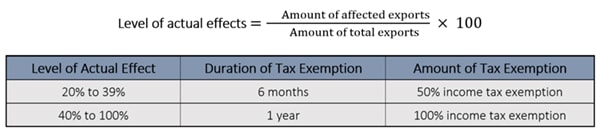
In order to qualify for the above income tax exemptions, companies must submit documentary evidence to quantify the effect of the partial EBA suspension to the General Department of Taxation when submitting their annual income tax returns.

For more details on this tax relief measure, or on any aspect of conducting business in Cambodia, to Tilleke & Gibbins at [email protected].

RELATED INSIGHTS​ 

December 2, 2022
On November 11, 2022, Myanmar’s Ministry of Commerce (MOC) announced a pilot period for importing electric vehicles into Myanmar, which came into force with MOC Order No. 62/2022, issued under the Import and Export Law. A separate order (No. 61/2022) issued on the same day specifies rules for importation of motorcycles by companies that do not have a certificate to open a showroom, as well as rules for opening motorcycle showrooms. Electric Vehicle Importation According to the order, which takes effect January 1, 2023, “electric vehicles” includes only battery electric vehicles (BEVs) for both personal use and passenger use. In order to import electric vehicles into Myanmar without having a certificate to open a showroom, companies must: Be registered as a company, either wholly owned by nationals or a joint venture, at the Directorate of Investment and Company Administration (DICA); Be able to present the purchase and sales agreement for each brand of imported electric vehicles; Receive approval from the National Steering Committee for Development of Electric Vehicles and Associated Businesses, and import according to the quality and quantity of electric vehicles permitted by the committee; Arrange the necessary warranty, spare parts availability, and after-sales service for the imported electric vehicles; Deposit a bank guarantee of MMK 50 million at a bank recognized by the Central Bank of Myanmar; and Apply for a purchase permit at the MOC, for the purpose of registering the imported vehicles with the Road Transport Administration Department. BEV Tax Exemption Following MOC Order No. 62/2022, BEVs and their batteries are now exempted from commercial tax and special goods tax, which came into force with the Law Amending the Union Tax Law 2022 (State Administrative Council Law No. 48/2022) dated November 17, 2022. These tax exemptions will be effective from October 1, 2022, to March
August 26, 2022
Thailand’s Board of Investment (BOI) has extended its previously announced period for reduction of import duty on imported raw and essential materials for battery manufacturing for electric vehicles and other applications. The BOI’s announcement No. 5/2565 dated August 8, 2022, extended the reduction period to a maximum of five years. The BOI’s promoted activities list includes two battery-manufacturing business activities: Activity 4.8.3.1 – Battery manufacturing Activity 5.2.6.1 – High energy density battery manufacturing Qualifying battery manufacturers who have cell or module manufacturing processes are eligible for 90% import duty reductions on raw and essential materials that cannot be produced in Thailand. These reductions will be available on an annual basis, and are renewable for five years in total—up from the original two years. Existing projects (i.e., those which have the original two-year duration in their BOI certificate) can also benefit from the extension by preparing a project amendment form, along with a clarification letter and supporting documents, for submission to the BOI office. For more details on these customs duty reductions, or on any aspect of investment promotion in Thailand, please contact Charuwan Charoonchitsathian at [email protected] or +66 2056 5657, or Napassorn Lertussavavivat at [email protected] or +66 2056 5662.
July 12, 2022
On June 21, 2022, Thailand’s cabinet updated and approved in principle a five-year personal income tax exemption for foreign filmmaking companies and actors working on motion pictures in Thailand. The tax measure, which is intended to promote the use of Thailand as a filming location, is similar to a 2012 law that authorized a temporary personal income tax exemption for nonresidents shooting movies for foreign filmmaking companies. Normally, nonresident artists are subject to tax on income from filmmaking in Thailand. These artists have to declare their income and submit personal tax returns to the local tax authorities for both midyear and annual tax submission deadlines. Depending on the amount of income (including remuneration, per diem, travel expense allowance, etc.), personal income tax rates can be up to 35%. With the exemption, however, nonresident actors will in effect be able to bypass these taxation requirements. This incentive will not grant a tax exemption to foreign directors, producers, film crews, or other filmmaking staff. However, based on current Thai Revenue Department guidelines, a filmmaking company will have no tax liability in Thailand if no income is earned during the filmmaking itself. The incentive scheme is expected to pass into law soon after the cabinet’s approval. While this incentive provides strong incentives for foreign companies to film in Thailand, a number of other considerations will remain—for instance, customs duty liability on equipment temporarily brought into Thailand, personal income tax implications, and film crew members’ compliance with legal and regulatory requirements. For more information on the exemption for foreign filmmaking companies and actors, or on any aspect of risk mitigation and legal compliance relating to filming operations in Thailand, please contact Auaychai Sukawong at [email protected] or +66 2056 5537.
April 29, 2022
A recent notification (No. 20/2022) from Myanmar’s Ministry of Planning and Finance requires all companies and organizations in Myanmar, including nonprofits, to apply for a taxpayer identification number (TIN) by June 30, 2022, or within 90 days of establishment. TINs were stipulated in the Tax Administration Law 2019, but up until this notification there had been no clear mandatory implementation. The notification, which took effect on April 1, 2022, signals the government’s intention to improve tax management tasks in the country, offer more efficient tax services, and streamline taxpayer registration procedures in Myanmar. The section of the Tax Administration Law about TINs states that the Internal Revenue Department is responsible for determining and issuing each TIN. In accordance with this, the notification requires that any entity that was formed and registered (i.e., at the Directorate of Investment and Company Administration, or—for nonprofits—at any government department or organization) before April 1, 2022, must apply for a TIN by June 30, 2022. Those established or registered on or after April 1, 2022, are to apply for a TIN within 90 days of registration. After registering for a TIN, taxpayers must use the number for all tax-related purposes—including income tax, commercial tax, and special excise tax—as well as for liaising with the Internal Revenue Department (e.g., to submit tax returns), making payments, importing goods, applying for exporter and importer licenses, and conducting business transactions (e.g., tenders). For more details on these TIN requirements or any aspect of taxation regulations in Myanmar, please contact Tilleke & Gibbins at [email protected].