
You are using an outdated browser and your browsing experience will not be optimal. Please update to the latest version of Microsoft Edge, Google Chrome or Mozilla Firefox. Install Microsoft Edge

April 10, 2020

Cambodia Issues Tax Relief Measures for Textile and Garment Enterprises to Mitigate EBA Suspension

On March 24, 2020, Cambodia’s Ministry of Economy and Finance issued Prakas No. 319 MoEF.Br.K on Tax Measures to Mitigate the Effect of Challenges on Textile and Garment Enterprises.

This prakas provides income tax exemptions to factories and enterprises in the textile, garment, footwear, bag, handbag, and hat sectors that are affected by the partial suspension of the European Union’s Everything but Arms (EBA) preferential tariff scheme.

Companies will receive an income tax exemption for the 2020 tax year based on how the partial suspension of EBA has affected their business. The formula for determining the level of the effect is set out below:
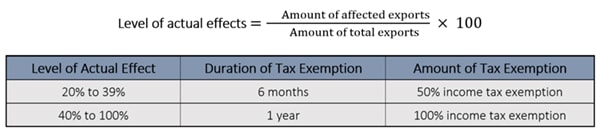
In order to qualify for the above income tax exemptions, companies must submit documentary evidence to quantify the effect of the partial EBA suspension to the General Department of Taxation when submitting their annual income tax returns.

For more details on this tax relief measure, or on any aspect of conducting business in Cambodia, to Tilleke & Gibbins at [email protected].

RELATED INSIGHTS​ 

March 6, 2025
On February 18, 2025, the Thai Senate approved an amendment to the Act on the Establishment of and Procedures for the Tax Court. This follows the July 2024 approval by the Thai cabinet and subsequent preparation of supporting secondary legislation. This important amendment to procedural law, once it takes effect, will extend the exclusive jurisdictional powers of the Tax Court to all criminal tax, customs, and excise tax claims in addition to the court’s existing jurisdiction over all such civil claims. The amendment, while now formally approved by the legislature, is awaiting the king’s signature and will take effect 180 days after its publication in the Government Gazette. Based upon its projected publication date, the amendment will likely take effect by the end of the third quarter of this year. This development is set to offer a more sophisticated Tax Court litigation process for highly specialized and often complex criminal tax and customs claims, something with which Thailand’s traditional criminal courts have struggled. It also ensures that all tax and customs matters are adjudicated before the same court, saving time, party costs, and judicial resources. This appears likely to result in more consistent adjudication of criminal tax and customs disputes, a benefit for the Thai government and party litigants alike. Any ongoing criminal tax and customs claims already commenced with the respective criminal courts on the date on which the amendment becomes effective will remain under the exclusive jurisdiction of those criminal courts. The Tax Court will have exclusive jurisdiction over all other claims. This important legislative change offers those managing or otherwise facing civil and/or criminal Thai tax or customs disputes the opportunity to more effectively plan and execute a uniform defense strategy before a single, qualified forum.
January 3, 2025
Thailand has adopted the OECD’s global minimum tax framework through the Emergency Decree on Top-Up Tax B.E. 2567 (2024). Published in the Government Gazette on December 26, 2024, this legislation implements a 15% global minimum effective tax rate for large multinational enterprise (MNE) groups. The emergency decree took effect on January 1, 2025. The emergency decree was enacted through expedited procedures to implement “pillar two” of the OECD’s Base Erosion and Profit Shifting (BEPS) 2.0 project’s Global Anti-Base Erosion (GloBE) Rules. This swift implementation ensures Thailand can collect relevant tax revenues and prevents potential revenue losses from MNEs that might otherwise shift profits to jurisdictions with lower tax rates or to countries that have already implemented similar top-up tax legislation. Key aspects of Thailand’s implementation of the global minimum tax through the emergency decree are described below. Top-Up Tax The emergency decree introduces a dual mechanism for collecting additional top-up tax from MNEs whose effective tax rate falls below 15%. The first mechanism is a domestic top-up tax that targets MNEs operating within Thailand when their local effective tax rate is lower than 15%. The second mechanism is the income inclusion rule, which determines when a company’s foreign income should be included in the parent (main) company’s taxable income. This rule applies to Thai-based entities—including ultimate parent entities (UPE), intermediate parent entities, and partially owned parent entities—that hold ownership stakes in low-tax foreign jurisdictions. Scope MNEs subject to Thailand’s implementation of the global minimum tax framework are defined in the emergency decree as those whose UPEs report consolidated revenue of at least EUR 750 million (approximately THB 28 billion) in at least two of the four accounting periods preceding the relevant fiscal year. Reporting and Payment In-scope MNEs must comply with specific reporting obligations to the Thai Revenue Department. The filing deadline is set
December 4, 2024
Thailand Legal Basics, a valuable primer for foreign investors, explores all aspects of living and doing business in Thailand. Written by specialists at Tilleke & Gibbins in Bangkok, it is the only comprehensive English-language guide to the Thai legal system with a focus on the concerns of foreign business and investment.
August 20, 2024
Following the enactment of the Tax Administration Law (TAL), Myanmar’s Ministry of Planning and Finance has issued Notification No. 44/2024, which outlines directives and procedures for addressing violations of tax law provisions. These procedures, which came into force on June 13, 2024, primarily focus on three key areas: tax evasion, impeding tax administration, and failure to preserve secrecy. The notification primarily aims to address tax evasion, impeding tax administration, and failure to preserve secrecy, classifying these offenses as either subject to arrest without warrant or not. Notably, tax evasion is classified as an offense subject to arrest without warrant, while impeding tax administration and failure to preserve secrecy are not. The notification also prescribed the forms for notifying taxpayers before taking any action. Tax Evasion Tax evasion refers to a taxpayer who willfully evades the assessment, payment, or collection of tax. Penalties for such offenses include fines of MMK 250,000 (approx. USD 120) or 100% of the evaded tax (whichever is greater), imprisonment for up to seven years, or both. The enforcement process for tax evasion requires the chief officer of the township revenue department or an officer in charge (the tax authority) to assess the relevant documents and information provided by the taxpayer. If a taxpayer is found to be evading tax, the tax authority must send a notice in the prescribed form for verification within 15 days. Taxpayers may apply for a one-time extension of 15 days to submit requested documents and make disclosures. If the taxpayer cannot fulfill the requirements as instructed, the tax authority will seek approval from the director general of the Internal Revenue Department (IRD) for criminal proceedings as cognizable offences. Impeding Tax Administration and Failure to Preserve Secrecy Impeding tax administration refers to obstruction or attempted obstruction of taxation staff or officers