
You are using an outdated browser and your browsing experience will not be optimal. Please update to the latest version of Microsoft Edge, Google Chrome or Mozilla Firefox. Install Microsoft Edge

April 10, 2020

Cambodia Issues Tax Relief Measures for Textile and Garment Enterprises to Mitigate EBA Suspension

On March 24, 2020, Cambodia’s Ministry of Economy and Finance issued Prakas No. 319 MoEF.Br.K on Tax Measures to Mitigate the Effect of Challenges on Textile and Garment Enterprises.

This prakas provides income tax exemptions to factories and enterprises in the textile, garment, footwear, bag, handbag, and hat sectors that are affected by the partial suspension of the European Union’s Everything but Arms (EBA) preferential tariff scheme.

Companies will receive an income tax exemption for the 2020 tax year based on how the partial suspension of EBA has affected their business. The formula for determining the level of the effect is set out below:
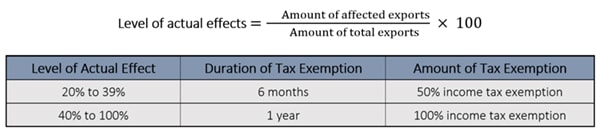
In order to qualify for the above income tax exemptions, companies must submit documentary evidence to quantify the effect of the partial EBA suspension to the General Department of Taxation when submitting their annual income tax returns.

For more details on this tax relief measure, or on any aspect of conducting business in Cambodia, to Tilleke & Gibbins at [email protected].

RELATED INSIGHTS​ 

September 5, 2011
Trademarks, tax, and termination are the terms in a franchise agreement most likely to cause trouble for a franchisor in Asia. In Thailand, many of the world’s most successful franchise models have established themselves to cater to the sophisticated Thai consumer. Well-known examples include Zara and Gap (for clothing and accessories); KFC, Pizza Hut, and Krispy Kreme (food); Ikea (home accessories); and 7-Eleven and Family Mart (convenience stores).
August 11, 2011
This Japanese-language Guide to Doing Business in Thailand was prepared by Tilleke & Gibbins in collaboration with Nishimura & Asahi, the Lex Mundi member firm for Japan. Written for potential Japanese investors in Thailand, the guide provides an overview of the Thai legal system, structures for doing business, and foreign investment regulations. It introduces other aspects of Thai law relevant to investment activities, including the following:
August 4, 2011
Recognizing the importance of foreign investment for its economic growth, Thailand has through the years relaxed restrictive investment laws and regulations, thus favorably positioning itself as a prime market for cross-border M&A activity. Continuing the trend toward investment liberalization, the Bank of Thailand and the Ministry of Finance will implement the second phase of the Financial Sector Master Plan over the course of 2010-2014, which will grant waivers on income tax, specific business tax, and stamp duty for earnings on merger and acquisition activities.
August 3, 2011
One question that is frequently asked by individual shareholders concerns the utilization of tax credit on dividends granted under Section 47 bis of the Thai Revenue Code. This article will discuss the conditions for using tax credit and explain how the tax credit can benefit a shareholder.