
You are using an outdated browser and your browsing experience will not be optimal. Please update to the latest version of Microsoft Edge, Google Chrome or Mozilla Firefox. Install Microsoft Edge

April 10, 2020

Cambodia Issues Tax Relief Measures for Textile and Garment Enterprises to Mitigate EBA Suspension

On March 24, 2020, Cambodia’s Ministry of Economy and Finance issued Prakas No. 319 MoEF.Br.K on Tax Measures to Mitigate the Effect of Challenges on Textile and Garment Enterprises.

This prakas provides income tax exemptions to factories and enterprises in the textile, garment, footwear, bag, handbag, and hat sectors that are affected by the partial suspension of the European Union’s Everything but Arms (EBA) preferential tariff scheme.

Companies will receive an income tax exemption for the 2020 tax year based on how the partial suspension of EBA has affected their business. The formula for determining the level of the effect is set out below:
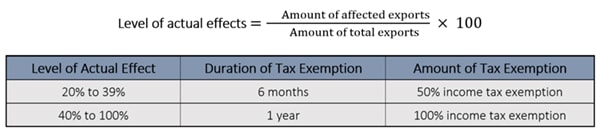
In order to qualify for the above income tax exemptions, companies must submit documentary evidence to quantify the effect of the partial EBA suspension to the General Department of Taxation when submitting their annual income tax returns.

For more details on this tax relief measure, or on any aspect of conducting business in Cambodia, to Tilleke & Gibbins at [email protected].

RELATED INSIGHTS​ 

December 22, 2014
Practical Law Company, in association with Lex Mundi, has published the latest edition of its Q&A guides to doing business worldwide. The Thailand chapter, authored by Tilleke & Gibbins attorneys, presents an overview of the country’s legal system and the key laws applicable to foreign companies doing business in the Kingdom. In particular, the chapter examines the following main subjects:
October 28, 2014
International Franchising, Second Edition (Release 3, 2014) has been published through Juris Publishing and edited by the Center for International Legal Studies. The guide provides expert analysis of franchising law and practice in 34 countries worldwide.The Thailand chapter of the guide, written by Sriwan Puapondh and Alan Adcock of Tilleke & Gibbins, delves into the following main topics:
January 10, 2014
Generally speaking, Specific Business Tax (SBT) is an alternative tax that is levied on certain types of businesses—particularly those in the financial services sectors. It was first introduced in tandem with the value-added tax (VAT) regime in 1992. The method for collecting SBT can be likened to that of sales tax, which was used in Thailand in the previous incarnation of indirect tax collection, before VAT.