You are using an outdated browser and your browsing experience will not be optimal. Please update to the latest version of Microsoft Edge, Google Chrome or Mozilla Firefox. Install Microsoft Edge

March 29, 2023

Cambodia Issues Decision on Thresholds for Merger Filings

On March 14, 2023, the Competition Commission of Cambodia (CCC) set out its merger filing thresholds in Decision No. 095 on Thresholds for Prior Notification of Business Mergers. This was a follow-up to the recent issuance of a regulation outlining the requirements and procedures for merger and acquisition filings. Decision No. 095 applies to all business combinations subject to premerger notification requirements under this prior regulation.

The thresholds for when the CCC must be notified of a merger are laid out in the table below.
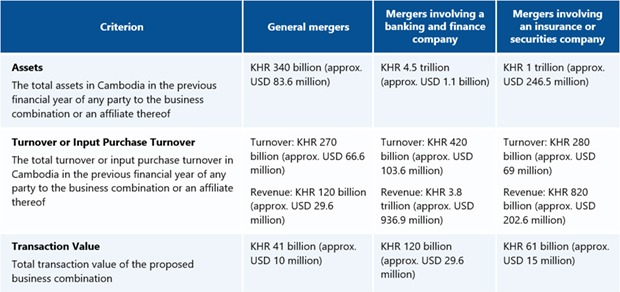
In current practice, the term “turnover” typically refers to a company’s total sales revenue, while “input purchase turnover” denotes the value of materials or equipment acquired for production purposes. Although this reflects the initial interpretation of these terms, it is advisable to seek confirmation or clarification from the CCC before the filing to ensure accuracy and alignment with their current definitions, as it is conceivable that the interpretation may change.

Decision No. 095 leaves room for the Ministry of Commerce to amend these thresholds as deemed necessary.

Outlook

In the last two years, Cambodia has steadily issued regulations to strengthen its legal framework for competition. Although gaps remain, especially with regard to enforcement of fines and certain unclear terms, more regulations are likely in 2025 and 2026.


RELATED INSIGHTS​ 

September 12, 2022
Throughout 2022, the Central Bank of Myanmar (CBM) has implemented a series of rules surrounding the compulsory conversion of foreign currency balances in the country. This began on April 3, when the CBM issued a notification directing foreign currency holders in Myanmar to convert their foreign earnings into Myanmar kyat (MMK), within one day, at the official exchange rate. Since then, the CBM has issued further clarifications and instructions for banks authorized to handle foreign currency, responded to some concerns from foreign investors by exempting certain foreign investment projects from the conversion requirement, and relaxed the currency conversion requirements for trade at the Chinese and Thai borders. The process has not been without some trial-and-error as well, with the CBM walking back some exemptions after they were enacted. Foreign investors and business owners, both in the country and abroad, have raised concerns about this centralized control of foreign currency flow and the depletion of foreign currency in Myanmar’s business community. To help readers understand the sometimes-surprising moves by the CBM over the past months, this article will summarize the key developments in the CBM’s efforts relating to foreign currency conversion. Establishment of Compulsory Exchange Requirement On April 3, 2022, the CBM issued Notification No. 12/2022 and Directive No. 4/2022 requiring nearly all individuals, companies, and other organizations in Myanmar to convert foreign-currency income received from abroad to MMK within one working day of receipt. These requirements took immediate effect for all transfers and applied retroactively to foreign currency balances already in the country. All authorized dealer (AD) banks (i.e., those licensed to exchange foreign currency) were instructed to convert foreign currency held in the foreign currency accounts of “internal residents”—which included locally registered companies, organizations, and offices; Myanmar branches of foreign companies; and individuals residing or established in Myanmar
September 8, 2022
Thailand’s Trade Competition Commission has amended the guidelines prohibiting large purchasers from setting unfair credit terms for small and medium-sized enterprises (SMEs). The new guidelines, which were published in the Government Gazette on August 17, 2022, revise the definition of SMEs and clarify the duties of concerned parties. The original guidelines, which took effect in December 2021, set a favorable maximum period for credit terms for SMEs selling products or services to a third-party purchaser. Prescribing longer credit terms than the mandatory period would constitute an unfair trade practice in violation of the Trade Competition Act B.E. 2560 (2017). In defining what businesses are considered SMEs, the guidelines set thresholds for the number of employees and amount of annual turnover. The amended guidelines maintain these thresholds, but the new guidelines require that both employee-number and turnover thresholds be met in order for a business to be considered an SME. In contrast, the original guidelines only required either the employee-number threshold or the turnover threshold to be met. This amendment will likely mean that fewer business operators qualify as SMEs. Accordingly, two types of businesses are defined as SMEs under the guidelines: Manufacturers of goods with up to 200 employees and an annual turnover of no more than THB 500 million (approximately USD 13.5 million); or Service providers or wholesale or retail businesses with up to 100 employees and an annual turnover of no more than THB 300 million (approximately USD 8.1 million). To benefit from protection under the new guidelines against unfair credit terms, SMEs must provide documents proving the number of employees and the amount of annual turnover to trade partners that purchase goods or services from them. The new guidelines come into force on September 16, 2022. For more information on the unfair credit term guidelines, or
August 26, 2022
Thailand’s Board of Investment (BOI) has extended its previously announced period for reduction of import duty on imported raw and essential materials for battery manufacturing for electric vehicles and other applications. The BOI’s announcement No. 5/2565 dated August 8, 2022, extended the reduction period to a maximum of five years. The BOI’s promoted activities list includes two battery-manufacturing business activities: Activity 4.8.3.1 – Battery manufacturing Activity 5.2.6.1 – High energy density battery manufacturing Qualifying battery manufacturers who have cell or module manufacturing processes are eligible for 90% import duty reductions on raw and essential materials that cannot be produced in Thailand. These reductions will be available on an annual basis, and are renewable for five years in total—up from the original two years. Existing projects (i.e., those which have the original two-year duration in their BOI certificate) can also benefit from the extension by preparing a project amendment form, along with a clarification letter and supporting documents, for submission to the BOI office. For more details on these customs duty reductions, or on any aspect of investment promotion in Thailand, please contact Charuwan Charoonchitsathian at [email protected] or +66 2056 5657, or Napassorn Lertussavavivat at [email protected] or +66 2056 5662.
August 23, 2022
Indemnification clauses are common contractual provisions in many jurisdictions including Thailand, but enforcing them can be challenging in the eyes of Thai law. In general, to “indemnify” means to hold another party free of responsibility for a potential risk or loss. When one party (i.e., the “indemnitor”) indemnifies another party (i.e., the “indemnitee”), the indemnitor is obligated to pay or compensate the indemnitee for any liabilities or losses (within the scope agreed in the contract). In this way, an indemnification clause can be a useful provision to shift responsibility for potential risks from one party to another. In some jurisdictions, “indemnity” includes the recovery of attorneys’ fees incurred by the indemnitee. It may even carry with it the duty to defend or fund the defense of any claim brought against the indemnitee. If that is the case, even though the contract does not say so, the indemnitor would have to hire an attorney and pay the legal fees for the indemnitee. In contracts that contain an indemnification clause, the indemnity would typically include the duty to defend. Let’s use a case example to elaborate this point. In this hypothetical case, a supplier of machinery agrees to indemnify and defend a retailer against claims from the retailer’s customer in the event that a purchased machine becomes defective. As a result, besides being responsible for the damages that the retailer may suffer based on contract law or negligence, the supplier must also pay for the lawyers to defend the retailer if the customer decides to sue. In Thailand, this kind of indemnification clause may not be enforceable. Unlike contract rules in many jurisdictions, Thai contract law is silent on “contractual indemnity.” It is commonly understood in Thailand (and confirmed by Supreme Court decision 7943/2542) that “indemnity” means “compensation” under section 222