You are using an outdated browser and your browsing experience will not be optimal. Please update to the latest version of Microsoft Edge, Google Chrome or Mozilla Firefox. Install Microsoft Edge

March 29, 2023

Cambodia Issues Decision on Thresholds for Merger Filings

On March 14, 2023, the Competition Commission of Cambodia (CCC) set out its merger filing thresholds in Decision No. 095 on Thresholds for Prior Notification of Business Mergers. This was a follow-up to the recent issuance of a regulation outlining the requirements and procedures for merger and acquisition filings. Decision No. 095 applies to all business combinations subject to premerger notification requirements under this prior regulation.

The thresholds for when the CCC must be notified of a merger are laid out in the table below.
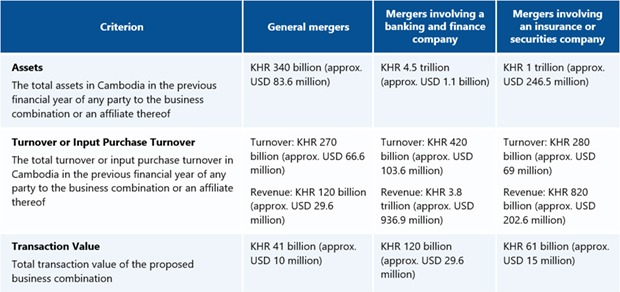
In current practice, the term “turnover” typically refers to a company’s total sales revenue, while “input purchase turnover” denotes the value of materials or equipment acquired for production purposes. Although this reflects the initial interpretation of these terms, it is advisable to seek confirmation or clarification from the CCC before the filing to ensure accuracy and alignment with their current definitions, as it is conceivable that the interpretation may change.

Decision No. 095 leaves room for the Ministry of Commerce to amend these thresholds as deemed necessary.

Outlook

In the last two years, Cambodia has steadily issued regulations to strengthen its legal framework for competition. Although gaps remain, especially with regard to enforcement of fines and certain unclear terms, more regulations are likely in 2025 and 2026.


RELATED INSIGHTS​ 

May 23, 2023
Life sciences specialists at Tilleke & Gibbins’ office in Bangkok have contributed a new “Life Sciences Commercialization in Thailand” chapter to the Life Sciences Global Guide from Practical Law. The Q&A-style guide provides strategic information for companies active in the life sciences sector in Thailand. The chapter covers a number of key areas: Overview of the life sciences sector Pricing, government funding, and reimbursement: National health care system, price regulation and reimbursement Distribution and sale Cross-border trade and parallel imports Advertising and engagement with patient organizations Patents: Conditions for patentability, registration, length of protection, infringement, international treaties Trademarks: Requirements, registration Competition law issues: Authorities and legislation, commercial contracts and competition law, licensing approvals and formalities Product liability: Regulators, medicinal product liability law, liable partners, defenses, product liability claims, remedies Practical Law, produced by Thomson Reuters, is the world’s leading legal know-how resource for business lawyers, publishing a huge range of guides covering hundreds of jurisdictions and practice areas. The full “Life Sciences Commercialization in Thailand” section can be found on the Practical Law website.
May 19, 2023
On May 15, 2023, Vietnam’s Deputy Prime Minister Tran Hong Ha signed Decision No. 500 of the Prime Minister approving the National Power Development Plan for the period 2021-2030, with a vision to 2050 (“PDP VIII”), following extensive public consultations and multiple rounds of review since the first draft version was circulated in 2021. The plan was approved in the context that in the past few years, a number of large power projects have been behind schedule for operation, while new projects have not been able to be implemented due to waiting for additional planning. PDP VIII is the master plan for the development of the power source and transmission grid at 220kV or higher; services in renewable energy and new energy in Vietnam; and works connecting the power grids of Vietnam and neighboring countries. We set out below some quick updates regarding PDP VIII. 1. Development Targets Key development targets are summarized in the table below: Investors in coal, domestic gas, and LNG projects may need to have a conversion plan ready given the 2050 targets to convert to other sources of energy. 2. Solar Projects A list of 27 solar power projects that were planned for the period of 2021-2030 but which have not been assigned to investors are not allowed to be deployed but can be considered after 2030, except in the case of deployment in the form of self-production and self-consumption (Appendix IV). These projects represent 4,136.25 MW of capacity that will be left on the sidelines until 2030. 3. Hydropower Projects A list of 14 potential hydropower projects can be considered if economic and technical conditions allow for more hydropower development (Appendix III). These projects represent 1,244 MW of capacity that can be added to the hydropower targets for 2030. 4. Projects Prioritized for
May 18, 2023
Thailand’s Office of the Securities and Exchange Commission (the “SEC Office”) has revamped various rules relating to private placements by listed companies with a view to streamlining the offering process and reducing the documentation required for submission to the SEC Office. Most of these rules were revised by the Capital Market Supervisory Board on December 28, 2022, and will come into effect on July 1, 2023. The key amendments in the new rules are summarized below. Elimination of Application Requirement Issuers are no longer required to apply to the SEC Office prior to offering their shares via private placement, according to new rules laid out in the Notification of the Capital Market Supervisory Board No. TorChor 28/2565 Re: Permission for Listed Companies to Offer Newly Issued Ordinary Shares via Private Placement (the “TorChor 28/2565 Notification”). The rules detailed in this notification will replace the current private placement rules under the Notification of the Capital Market Supervisory Board No. TorChor 72/2558 Re: Permission for Listed Companies to Offer Newly Issued Ordinary Shares via Private Placement. Under the TorChor 28/2565 Notification, issuers may offer their shares via private placements that are share offerings to no more than 50 high-net-worth or ultra-high-net-worth investors within 12 months, share offerings valued at no more than THB 20 million within 12 months, or share offerings to institutional investors (excluding share offerings to the issuer’s directors or employees), so long as the issuer complies with its information disclosure and corporate approval requirements, which remain mostly unchanged under the new notification. To fulfill these requirements, notice of a shareholders’ meeting must be submitted to all shareholders at least 14 days in advance, and the offering must be approved by a supermajority vote of the shareholders, which means approval by at least three-fourths of the shareholders present and
May 16, 2023
On April 25, 2023, Myanmar’s Ministry of Planning and Finance issued a standard operating procedure (SOP) requiring entities and individuals remitting foreign currency equivalent to more than USD 10,000 out of Myanmar to clear their tax payments prior to the remittance. The SOP took effect on May 1, 2023. This is the latest development since Myanmar began imposing restrictions in April 2022 on the remittance of foreign currency out of the country, implemented by the Central Bank of Myanmar and the Foreign Currency Supervisory Committee. The SOP requires the remitters described above to obtain certain documents evidencing payment of all requisite taxes and duties, and to submit them to their licensed authorized dealer (AD) bank as part of the remittance process. The documents required as evidence differ depending on the purpose of the remittance. The SOP details three main categories, as summarized below. Payments for Interest, Royalties, Trademarks, Copyrights, or Services A remitter of foreign currency for payment of interest, royalties, trademarks, copyrights, or services, must first apply to the Internal Revenue Department (IRD) for evidence that all applicable withholding tax has been paid. In addition, if the country to which the payments are being remitted is party to an avoidance of double taxation agreement with Myanmar, evidence of the recipient’s tax residency must also be submitted to the AD bank. Payments for Goods A remitter of foreign currency to pay for goods must submit the necessary IRD forms along with evidence that corporate income tax and other applicable taxes have been paid. Evidence may include a tax clearance certificate for the fiscal year, the company name, the taxpayer name, and the taxpayer identification number (TIN). Salary Payments A person remitting, in foreign currency, salary earned in Myanmar must submit the required form showing that they paid income tax