You are using an outdated browser and your browsing experience will not be optimal. Please update to the latest version of Microsoft Edge, Google Chrome or Mozilla Firefox. Install Microsoft Edge

March 29, 2023

Cambodia Issues Decision on Thresholds for Merger Filings

On March 14, 2023, the Competition Commission of Cambodia (CCC) set out its merger filing thresholds in Decision No. 095 on Thresholds for Prior Notification of Business Mergers. This was a follow-up to the recent issuance of a regulation outlining the requirements and procedures for merger and acquisition filings. Decision No. 095 applies to all business combinations subject to premerger notification requirements under this prior regulation.

The thresholds for when the CCC must be notified of a merger are laid out in the table below.
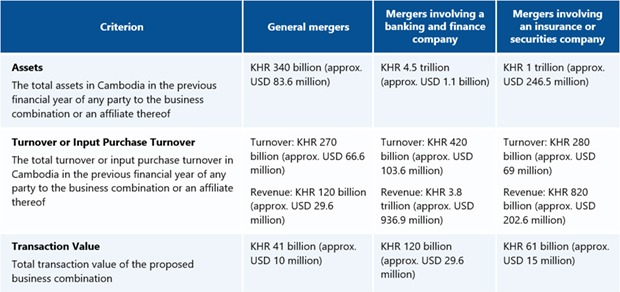
In current practice, the term “turnover” typically refers to a company’s total sales revenue, while “input purchase turnover” denotes the value of materials or equipment acquired for production purposes. Although this reflects the initial interpretation of these terms, it is advisable to seek confirmation or clarification from the CCC before the filing to ensure accuracy and alignment with their current definitions, as it is conceivable that the interpretation may change.

Decision No. 095 leaves room for the Ministry of Commerce to amend these thresholds as deemed necessary.

Outlook

In the last two years, Cambodia has steadily issued regulations to strengthen its legal framework for competition. Although gaps remain, especially with regard to enforcement of fines and certain unclear terms, more regulations are likely in 2025 and 2026.


RELATED INSIGHTS​ 

August 25, 2023
Michael Ramirez, a counsel in Tilleke & Gibbins’ dispute resolution department, has contributed an article to a series on contractual terms in Asia from the Asian Business Law Institute. Previous articles in the series have looked at administrative and tax requirements and contract breach and remedy under Thai law. The article gives an overview of how extracontractual liabilities are treated under Thai law. It addresses issues related to contract negotiations, no-reliance clauses, entire agreement clauses, and concurrent liability. ABLI, which is based in Singapore, conducts legal research and dissemination in order to provide knowledge, guidance, and recommendations surrounding development of legal systems in Asia. The full article on extracontractual liabilities is available as a PDF through the button below.
August 23, 2023
Introduction The idea of the metaverse rose to prominence in the public discourse in 2021, most notably when Facebook renamed itself Meta and announced a new focus on launching a virtual, immersive world. The initial excitement around the metaverse has since faded, with worsening economic conditions having a particularly acute effect on companies in the technology sector. When Meta CEO Mark Zuckerberg announced in March 2023 that artificial intelligence (AI) was the company’s “single largest investment,” many took this as a sign of the company shifting focus away from the metaverse. However, there remains significant interest in the metaverse from both businesses and consumers. Zuckerberg himself reaffirmed Meta’s focus on the metaverse, highlighting how developments in AI will improve virtual reality (VR) and augmented reality (AR) technology. Meanwhile, Roblox, a metaverse gaming platform, announced that in Q1 2023, its number of daily active users had increased to 66 million. Most recently, the announcement by Apple of its new ‘Vision Pro’ AR headset is reported to have renewed interest in the metaverse among developers. A particular area of interest in the developing metaverse is digital fashion and retail. In its Metaverse Fashion Trends Report 2022, Roblox found that nearly three in four users aged 14 to 24 spend money on digital fashion items. Roblox itself has partnered with fashion brands Burberry, Gucci, Tommy Hilfiger, and others, to offer experiences and items for use on the platform. In March 2023, Decentraland, a metaverse platform with a decentralized governance structure, hosted the Metaverse Fashion Week, featuring brands such as Adidas, Coach, and DKNY. As businesses continue to invest and look for opportunities to expand into the metaverse, whether through traditional e-commerce or more innovative digital asset offerings, it is important that they consider the ways in which new and existing laws apply
August 7, 2023
Foreign investment in Vietnam continues to be encouraging. The latest figures reported by the Foreign Investment Agency for 2023 note that nearly USD 5.45 billion in newly registered capital, adjusted and contributed capital for purchasing shares, and capital contributions from foreign investors was recorded from January 1 to March 20, with realized capital from foreign investment projects estimated to exceed USD 4.3 billion. These statistics highlight the increasing attractiveness of Vietnam as an investment destination and reflect its robust economic growth. Sectors such as technology, media and telecommunications are expected to experience increased deal-making due to rapid digitalization. The automotive and industrial manufacturing sectors are likely to see divestments related to sustainability. Since 2015, Vietnam has implemented various measures to strengthen its legal framework and enhance the efficiency of market governance. This has resulted in improved government management in taxation, investment, competition and e-commerce. Tax loopholes on indirect transfers have been closed, stronger rules on investment and competition are leveling the playing field, and clear frameworks for e-commerce have been established. Key Legal Issues Business activities are categorized according to the Vietnam Standard Industrial Classification. These classifications determine the necessary licenses, permits and regulations for operating businesses, as well as guidelines for foreign investors looking to invest in specific sectors. Foreign investment restrictions, which are based on business activities, include limitations on foreign ownership, and conditions imposed on foreign investors such as shareholding or operations requirements. These restrictions are governed by both international treaties that Vietnam has signed and domestic laws. Some examples of foreign investment restrictions include the following: Foreign investors can only own up to 99.99% of the capital of an advertising business; Foreign-invested enterprises may only purchase buildings for their own use and cannot sublease them to others; Foreign owners of 100% foreign-owned banks must have
August 7, 2023
M&A transactions for private and public limited companies in Thailand can be achieved in many ways, including acquiring shares from existing shareholders of a limited company, subscribing to new shares issued by a limited company, an amalgamation of limited companies, acquiring all or part of the assets or business of a limited company, and a merger of private limited companies. The Civil and Commercial Code is the key legislation governing private limited companies, while public limited companies are mainly governed by the Public Limited Company Act of 1992, as amended, unless listed on the Stock Exchange of Thailand (SET), in which case the Securities and Exchange Act of 1992, the Securities and Exchange Commission (SEC) Rules, the Capital Market Supervisory Board (CMSB) Rules, and the SET Rules also apply. The legal framework for most M&A transactions concerning Thai limited companies is also provided in both the code and the Public Limited Company Act. New Type of Combination On 7 February 2023, the Act Amending the Civil and Commercial Code came into effect, introducing a new merger scheme as another approach to business combination for private limited companies. A merger under the amended Civil and Commercial Code is a merger of two or more companies, resulting in either a new company with all merged juristic entities ceasing to exist or one of the companies continuing to exist with the other companies ceasing to exist as juristic entities. The merger replaces the “amalgamation” in the previous version of the code, which merely prescribed a legal framework and identified the implications of mergers but did not specify a concrete legal framework for the acquisition of assets or businesses. Arguably, the first type of merger described above is the same as an amalgamation under the previous version of the code, while the end