You are using an outdated browser and your browsing experience will not be optimal. Please update to the latest version of Microsoft Edge, Google Chrome or Mozilla Firefox. Install Microsoft Edge

March 29, 2023

Cambodia Issues Decision on Thresholds for Merger Filings

On March 14, 2023, the Competition Commission of Cambodia (CCC) set out its merger filing thresholds in Decision No. 095 on Thresholds for Prior Notification of Business Mergers. This was a follow-up to the recent issuance of a regulation outlining the requirements and procedures for merger and acquisition filings. Decision No. 095 applies to all business combinations subject to premerger notification requirements under this prior regulation.

The thresholds for when the CCC must be notified of a merger are laid out in the table below.
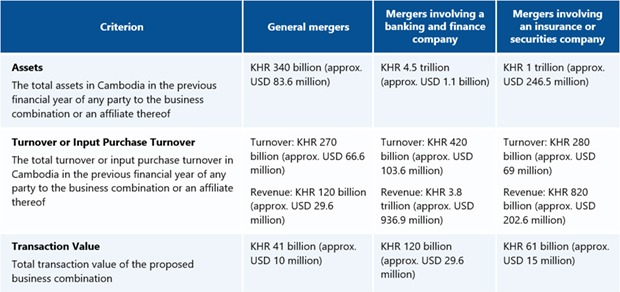
In current practice, the term “turnover” typically refers to a company’s total sales revenue, while “input purchase turnover” denotes the value of materials or equipment acquired for production purposes. Although this reflects the initial interpretation of these terms, it is advisable to seek confirmation or clarification from the CCC before the filing to ensure accuracy and alignment with their current definitions, as it is conceivable that the interpretation may change.

Decision No. 095 leaves room for the Ministry of Commerce to amend these thresholds as deemed necessary.

Outlook

In the last two years, Cambodia has steadily issued regulations to strengthen its legal framework for competition. Although gaps remain, especially with regard to enforcement of fines and certain unclear terms, more regulations are likely in 2025 and 2026.


RELATED INSIGHTS​ 

May 28, 2025
Tilleke & Gibbins attorneys in Vietnam have contributed the 2025 edition of Doing Business in Vietnam, a comprehensive Q&A-style resource from Thomson Reuters Practical Law that provides essential insights for companies navigating business operations in Vietnam. The guide presents a detailed overview of the country’s legal framework and regulatory environment, reflecting recent updates in Vietnamese legislation and practice. This annually updated guide offers key information on the following areas: Legal system: Structure of the Vietnamese judiciary and the role of codified law. Foreign investment: Conditions for market access, licensing requirements, foreign ownership restrictions, and investment incentives. Business vehicles: Formation and operation of legal entities, including limited liability companies, joint-stock companies, and representative offices. Employment: Employment contracts, social insurance, labor rights, and procedures for hiring foreign nationals. Tax: Overview of corporate income tax, personal income tax, value-added tax, and other tax obligations. Intellectual property: Procedures for protecting and enforcing patents, trademarks, copyrights, and other IP rights. Data protection: Compliance requirements under Vietnam’s data privacy laws, including the Personal Data Protection Decree. Competition law: Antitrust rules and regulatory oversight under the Law on Competition. Anti-bribery and corruption: Legal framework and enforcement practices aimed at curbing corrupt activities. E-commerce and digital business: Regulations governing online platforms, digital content, and cross-border services. Marketing and advertising: Laws and guidelines on advertising standards and consumer protection. Product regulation and liability: Safety requirements, product liability issues, and roles of relevant authorities. Doing Business in Vietnam is part of Practical Law’s global series of legal guides designed to support international practitioners and businesses. To access the most recent edition of the Vietnam guide, visit the Practical Law website and sign up for a free trial.
May 27, 2025
Thailand’s Department of Business Development (DBD) has issued a regulation mandating the closure of the legacy “e-Registration” system for registration of juristic persons, effective June 1, 2025. The e-Registration system will be formally discontinued as part of Thailand’s transition to the “DBD Biz Regist” digital platform, which aims to modernize and streamline online registration processes for corporate entities. Beginning July 1, 2025, the DBD will suspend all paper-based application submissions. All corporate registration applications for partnerships and private limited companies must be submitted online through the DBD Biz Regist system. The DBD introduced the DBD Biz Regist system in 2024 by a regulation of the Office of Central Company and Partnership Registration. While paper-based registration has remained available during the transition period, it has been limited to a reduced number of cases. DBD Biz Regist System The key principles of the DBD Biz Regist system include: Online submission and identity verification. The application process is fully digital throughout the entire registration procedure. Users can create accounts on the DBD Biz Regist website and complete identity verification online through ThaID, National Digital ID (NDID), or the DBD e-Service application—which is currently the only online option available to foreign nationals. In-person verification before a DBD registrar remains available as an alternative option. Electronic signatures. The system supports electronic signatures without requiring physical appearance for document signing. Users can sign documents electronically through ThaID, NDID, or the DBD e-Service application. Consent form process. After the DBD registrar approves an online application submission, the system will generate a consent form to be signed by the relevant parties. This form certifies the information presented in the online registration application. Applicants may either print and physically sign the consent form before uploading it to the system or sign it electronically through the DBD Biz Regist platform. Digital certified corporate documents. Upon completion of the
May 26, 2025
On September 6, 2024, Laos’ Ministry of Agriculture and Forestry (MOAF) issued Decision No. 4565/MAF on Forest Carbon Management. This decision, which took effect on October 29, 2024, enables Laos to participate in both domestic and international carbon markets. It outlines comprehensive guidelines for forest carbon activities, including investment procedures, carbon credit trading, and benefit allocation. The Department of Forestry (DOF), under the MOAF, oversees these activities and grants relevant permissions. Definitions The decision defines key terms related to forest carbon management: Forest carbon: Carbon dioxide (CO₂) absorbed by forests, calculated in tonnes per hectare. Forest carbon credit: Quantity of CO₂ reduction, absorption, and storage, measured in tonnes of carbon dioxide equivalent (tCO2e), achieved through various projects or activities. These credits are verified for the reduction, absorption, and storage of CO₂ to mitigate greenhouse gas emissions. They can be exchanged and traded in accordance with established standards for greenhouse gas emissions. Forest carbon trading: An agreement between a buyer (domestic or foreign legal entity or government) and a seller (the owner of a forest carbon project) to trade tCO2e . This trading allows the buyer to offset greenhouse gas emissions that exceed the emission allowances set out in the Paris Agreement on climate change. The forest carbon sold becomes the property of the buyer. Forest Carbon Business Operations According to the decision forest carbon business operations include: Cooperation between the government and development partners: This involves bilateral and multilateral cooperation based on international agreements and treaties. The use of carbon credits from this cooperation is not market-based but agreement-based, contributing to Laos’ national climate change goals. Forest carbon investment: This includes direct government investments and joint investments with the private sector, international organizations, or communities. These investments aim to create forest carbon credits without granting exclusive rights to forest
May 26, 2025
On May 21, 2025, the Trade Competition Commission of Thailand (TCCT) published a press release signaling heightened regulation of digital platforms in response to the influx of products from foreign countries being sold in Thailand via e-commerce platforms. In recent years, the rapid expansion of cross-border multi-sided e-commerce platforms has unlocked unprecedented growth, but it has also flooded Thailand’s digital marketplaces with low-cost imports sold by unregulated foreign vendors via these platforms, unfairly undercutting local merchants’ market share and exposing consumers to uneven product quality. According to the press release, the TCCT announced progress on drafting new guidelines on unfair trade practices, monopolistic conduct, and competition restraint by multi-sided e-commerce platforms at a recent meeting of the Management Committee for Addressing Issues of Foreign Goods and Businesses Violating Laws. This regulatory push is part of a broader governmental effort to tackle issues stemming from the foregoing that create uneven playing fields and undermine consumer welfare. The draft guidelines are designed to regulate platform operators and their complex and multidimensional trade relations that cause network effects and distort competition. The forthcoming guidelines, to be issued under the Trade Competition Act B.E. 2560 (2017), will undergo public consultation to ensure platform operators, the public, and other stakeholders will have an opportunity to provide input before they are finalized and enforced. The guidelines are seen as an important priority, with the minister of commerce urging swift implementation of the measures to achieve the government’s objectives. In addition to the legislative advancement, one of the TCCT commissioners has been appointed to advise a subcommittee on preventing nominee arrangements by foreign investors and a subcommittee dedicated to promoting Thai SMEs and eliminating poor-quality imports. The appointee will also support the nationwide task force against illegal foreign products in overseeing proactive field operations and comprehensive