You are using an outdated browser and your browsing experience will not be optimal. Please update to the latest version of Microsoft Edge, Google Chrome or Mozilla Firefox. Install Microsoft Edge

March 29, 2023

Cambodia Issues Decision on Thresholds for Merger Filings

On March 14, 2023, the Competition Commission of Cambodia (CCC) set out its merger filing thresholds in Decision No. 095 on Thresholds for Prior Notification of Business Mergers. This was a follow-up to the recent issuance of a regulation outlining the requirements and procedures for merger and acquisition filings. Decision No. 095 applies to all business combinations subject to premerger notification requirements under this prior regulation.

The thresholds for when the CCC must be notified of a merger are laid out in the table below.
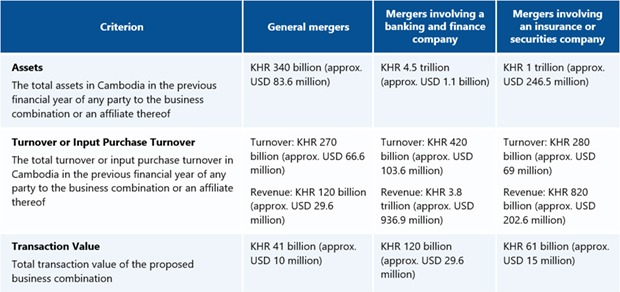
In current practice, the term “turnover” typically refers to a company’s total sales revenue, while “input purchase turnover” denotes the value of materials or equipment acquired for production purposes. Although this reflects the initial interpretation of these terms, it is advisable to seek confirmation or clarification from the CCC before the filing to ensure accuracy and alignment with their current definitions, as it is conceivable that the interpretation may change.

Decision No. 095 leaves room for the Ministry of Commerce to amend these thresholds as deemed necessary.

Outlook

In the last two years, Cambodia has steadily issued regulations to strengthen its legal framework for competition. Although gaps remain, especially with regard to enforcement of fines and certain unclear terms, more regulations are likely in 2025 and 2026.


RELATED INSIGHTS​ 

July 10, 2025
For companies and individuals doing business in Vietnam, a common question is whether electronic signatures (e-signatures) are legally recognized under Vietnamese law. This matter is governed by Law No. 20/2023/QH15 on Electronic Transactions issued on June 22, 2023 (ETL 2023) and its guiding legal documents such as Decree No. 23/2025/ND-CP dated February 21, 2025, and Circular 06/2024/TT-BTTTT dated July 1, 2024 (Circular 06). Recognition of Validity of E-signatures in Vietnam As a general principle, the ETL 2023 confirms that an e-signature cannot be denied legal validity solely due to its electronic form. The law categorizes e-signatures into three types: Type 1: Specialized e-signatures for organizations Type 2: Public digital signatures for individuals and organizations Type 3: Specialized digital signatures for government agencies Among these types, only secure specialized e-signatures (a secure e-signature of type 1) and digital signatures (type 2) are explicitly granted the same legal validity as handwritten (wet) signatures. This distinction is particularly important in legal disputes and for transactions with government agencies. (For more details, please refer to our previous article.) Domestic e-signatures A domestic organization can choose to use secure specialized e-signatures (type 1) and/or digital signatures (type 2) while a Vietnam-based individual can choose digital signatures (type 2) for their transactions—particularly for those involving government agencies and transactions of high value and complexity which require stronger legal protection. Specialized e-signatures (type 1) can be created by the organizations themselves, and additionally must be “secure” to be explicitly recognized as having the same legal validity as handwritten signatures. For clarity, “secure” specialized e-signatures are those certified (granted a safety certificate) by the Ministry of Science and Technology (MST). (This was formerly the responsibility of the Ministry of Information and Communications, which was merged with MST under Vietnam’s 2025 administrative restructuring.) Digital signatures (type 2) are
July 9, 2025
On June 16, 2025, the National Assembly of Vietnam adopted Law No. 75/2025/QH15 amending and supplementing a number of articles of the 2012 Advertising Law, with an effective date of January 1, 2026. The amended Advertising Law was enacted to further refine the legal framework for advertising activities in the modern era. Online Advertising Under the amended Advertising Law, “online advertising” is defined to encompass not only advertising on electronic newspapers and electronic information pages (as provided under the 2012 Advertising Law) but also advertising on other electronic venues, including social media, online applications, and digital platforms with internet connection. The amended Advertising Law also imposes new requirements for online advertising, including: Identification signs: Advertisements must have clear identifiable signs in numbers, letters, symbols, images, or sounds to distinguish them from non-advertising content. Control features: For advertisements not in fixed areas, there must be easily recognizable features and icons that allow recipients to turn off the advertisement, notify the service provider of violating advertising content, and refuse to view inappropriate advertising content. Linked content: Content in the links embedded in advertisements must comply with the law. Advertising service providers and publishers must have measures to check and monitor the linked content. Advertising on social media: Organizations and enterprises providing social media services must offer users features to distinguish advertising content from other content. Signage for sponsored content: When advertising, users of social media services must use signs to differentiate advertising or sponsored content from other content they provide. In response to the above requirements for online advertising, the amended Advertising Law sets out obligations of advertisers, advertising service providers, advertising publishers, and advertising conveyors in relation to online advertising. Among these, it is notably the responsibility of individuals and organizations engaging in online advertising to prevent and remove violating
July 7, 2025
On June 20, 2025, Cambodia’s Ministry of Economy and Finance issued Instruction No. 19116 to clarify when board members and company directors must receive salaries and pay payroll taxes. Board members and company directors who are not considered employees are subject to a withholding tax. This category consists of people who complete services for a nonresident individual and people who perform independent work for a company in Cambodia. Board members and company directors who are considered employees, including those appointed by a foreign head office to temporarily manage a company in Cambodia, must pay payroll taxes on any salary they receive, regardless of whether they are paid by a local or foreign branch of the company. The above obligations apply regardless of whether the person has a work permit. Board members and company directors are exempt from paying payroll tax if they: Are not present and not performing a regular management role at the company despite being registered on the company’s statutes or patent tax card; Participate only in board meetings and occasional shareholder meetings; and Do not receive a salary from a company in Cambodia. Overall, this instruction provides an important clarification regarding the tax obligations of board members and company directors. Companies should pay attention to the classification of their board members and directors and be mindful of the exemption.   This article was written with the assistance of Tilleke & Gibbins interns Amelia Gemma Erickson and Amrin Keat.
July 4, 2025
On July 3, 2025, the Trade Competition Commission of Thailand (TCCT) officially announced an invitation for stakeholders to participate in a public survey to gather feedback on the flexibility and appropriateness of credit terms across different business sectors for goods and services. The TCCT initially introduced guidelines on unfair trade practices related to credit terms applicable to small and medium-sized enterprises (SMEs) in 2021, with amendments following in 2022. The guidelines have had a wide impact, as businesses have had to adapt their payment procedures and practices, particularly those for dealing with SMEs, to comply with the guidelines. The TCCT is now seeking comprehensive feedback from businesses and other stakeholders to evaluate the effectiveness and practicality of these guidelines. The collected responses may potentially lead to future amendments aimed at enhancing fairness and efficiency in business transactions. To summarize the core principles, the guidelines aim to improve the liquidity and cash flow of SMEs, stipulating payment terms of: Within 30 days for agricultural products or primary agricultural processing involving non-complex production. Within 45 days for trade, manufacturing, and service sectors. The guidelines also identify practices deemed unfair, including: Unjustified delays in payment beyond agreed credit terms. Changes to credit terms or contractual conditions without at least 60 days’ advance notice. Other unfair conduct or credit term conditions that impose excessive burdens on an SME. Interested stakeholders are encouraged to submit their feedback through the TCCT’s online survey form available via their official public media channels. The survey is open for responses until July 20, 2025.