You are using an outdated browser and your browsing experience will not be optimal. Please update to the latest version of Microsoft Edge, Google Chrome or Mozilla Firefox. Install Microsoft Edge

March 29, 2023

Cambodia Issues Decision on Thresholds for Merger Filings

On March 14, 2023, the Competition Commission of Cambodia (CCC) set out its merger filing thresholds in Decision No. 095 on Thresholds for Prior Notification of Business Mergers. This was a follow-up to the recent issuance of a regulation outlining the requirements and procedures for merger and acquisition filings. Decision No. 095 applies to all business combinations subject to premerger notification requirements under this prior regulation.

The thresholds for when the CCC must be notified of a merger are laid out in the table below.
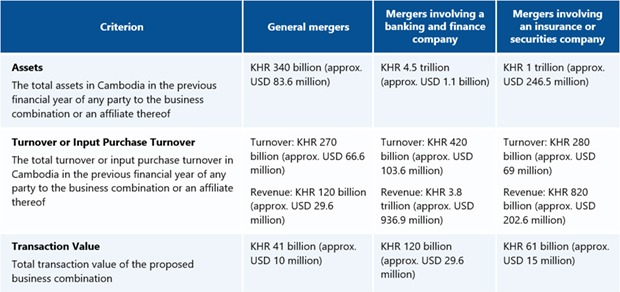
In current practice, the term “turnover” typically refers to a company’s total sales revenue, while “input purchase turnover” denotes the value of materials or equipment acquired for production purposes. Although this reflects the initial interpretation of these terms, it is advisable to seek confirmation or clarification from the CCC before the filing to ensure accuracy and alignment with their current definitions, as it is conceivable that the interpretation may change.

Decision No. 095 leaves room for the Ministry of Commerce to amend these thresholds as deemed necessary.

Outlook

In the last two years, Cambodia has steadily issued regulations to strengthen its legal framework for competition. Although gaps remain, especially with regard to enforcement of fines and certain unclear terms, more regulations are likely in 2025 and 2026.


RELATED INSIGHTS​ 

September 19, 2025
Over the past two years—particularly since Thailand announced incentives for EVs, including tax exemptions and reductions—there has been a clear trend of manufacturers relocating their facilities to Thailand. This shift is reshaping the country’s industrial landscape and creating significant opportunities in the real estate sector for companies looking to establish or expand EV manufacturing operations in Southeast Asia. Incentive-Driven Market Transformation The government’s tax exemptions and reductions have proven effective in attracting foreign investment, with Chinese manufacturers currently dominating the market. Most EV parts and car manufacturers operating in Thailand are from China, reflecting the prominence of Chinese EV brands that have already established a presence in the country. The sector encompasses manufacturers of electrical equipment as well as companies seeking to establish facilities for producing electric vehicle components, parts, and accessories. The surge in activity is evident across Thailand’s EV manufacturing sector, with legal practices handling these transactions experiencing unprecedented demand. Industrial Real Estate Framework and Market Dynamics Thailand’s industrial real estate framework provides compelling advantages for foreign manufacturers, who typically face restrictions on foreign land ownership under the Land Code. However, foreign investors can benefit from exemptions to these restrictions if the land is located within industrial real estate zones designated by the Industrial Estate Authority of Thailand (IEAT) or they obtain investment promotion from the Board of Investment (BOI) if the land is located outside an industrial estate area governed by the IEAT. Both the IEAT and BOI provide special tax and nontax incentives, including foreign land ownership, with even greater incentives available for land situated within the country’s Eastern Economic Corridor (EEC). This regulatory advantage has sparked a parallel trend in land development. Industrial real estate developers in the EEC are actively consolidating land into large plots to develop new industrial estate projects, recognizing that
September 17, 2025
M&A specialists at Tilleke & Gibbins have contributed the Vietnam chapter to Private M&A 2025, a newly released guide from Lexology Panoramic. The publication provides practical insights into private mergers and acquisitions frameworks in jurisdictions worldwide. The Vietnam chapter addresses key aspects of private M&A transactions, including: Structure and process, legal regulation, and required consents Advisers, negotiation, and documentation Due diligence and disclosure obligations Pricing, consideration, and financing Conditions, preclosing covenants, and termination rights Representations, warranties, indemnities, and postclosing covenants Taxation of transfers Employees, pensions, and benefits Recent legal, regulatory, and market practice developments The chapter highlights how Vietnam’s legal framework governs private acquisitions and disposals, outlines typical transaction processes and structures, and provides guidance on common regulatory and practical considerations. It also notes recent trends, including increased scrutiny of merger control filings by the Vietnam Competition Commission and regulatory changes affecting M&A approvals. The full Vietnam chapter is available as a PDF through the button below. Readers can also gain 30 days of complimentary access to Private M&A 2025 and Lexology Panoramic’s full library of resources through this link.
September 10, 2025
Under Thai law, authorized directors stand as a company’s mind and will and, as such, may incur personal criminal liability for acts or omissions committed in the course of company business. When allegations surface, directors must be prepared for the practical reality that, before guilt or innocence is ever adjudicated, they could be deprived of liberty unless bail release is promptly achieved through the competent legal authority. When Bail Can Be Granted Two procedural moments trigger the need to consider bail. The first arises during the investigative phase, when a claim is lodged against a director with the competent law enforcement authorities. Upon receipt of a complaint, the assigned inquiry officer summons the director for questioning, compiles evidence, and ultimately forwards a prosecution or nonprosecution recommendation to the public prosecutor. Although the public prosecutor retains ultimate discretion to indict an accused director, the police or prosecutor may conclude that pretrial detention is necessary and may therefore apply to the court for an order to hold the director in court custody. The second moment occurs after a criminal case is filed directly with the court. This occurs once a court accepts a criminal case filed by a prosecutor against a director or, alternatively, when the court accepts a case filed by an individual for trial. For cases filed by individuals, the plaintiff presents prima facie evidence at the preliminary hearing, and the court will accept the complaint if it finds sufficient grounds, thereby conferring upon the director the status of a criminal defendant. Upon acceptance of the criminal case, the court then has the inherent authority to order custody pending trial unless the defendant secures bail release. Procedural Considerations Experienced litigants typically prepare bail security in advance and submit a bail petition at the earliest possible time. While there are
September 8, 2025
On September 1, 2025, Myanmar’s Directorate of Investment and Company Administration (DICA) issued Directive No. 106/2025 to remind all companies and organizations registered under the Myanmar Companies Law of their obligation to strictly comply with the DICA registrar’s orders, directives, and procedures. This directive highlights the importance of legal and procedural compliance in corporate filings, governance changes, and operational conduct. It also signals increased scrutiny over documentation submitted during annual returns, share transfers, and director appointments or resignations. Public companies will be subject to closer regulatory attention, and new company registrations will involve vetting of proposed directors to ensure prior compliance with applicable laws. Compliance The directive emphasizes the following points: Companies must ensure full compliance with the Myanmar Companies Law and all directives issued by the registrar. This includes the proper submission of annual returns and adherence to updated requirements for share transfers and changes in directors. Companies and organizations must comply with all applicable laws, rules, directives, and procedures issued by relevant ministries and departments. If any authority takes action due to noncompliance, the registrar may also take appropriate measures. Noncompliance may result in regulatory sanctions, including restrictions on future company participation and vetting under anti–money laundering and counter–terrorism financing protocols. Prospective directors of newly registered companies will be vetted to confirm no prior violations of applicable laws. Entities must respond promptly and accurately to document requests from the registrar, both during initial registration and in subsequent filings. Companies are strongly advised to review their internal compliance frameworks and ensure readiness to meet DICA’s documentation and procedural expectations. In particular, companies must respond promptly and accurately to document requests from the registrar, whether during initial registration or in subsequent filings. For more information on this DICA announcement, or on any aspect of corporate registration, or assistance with