You are using an outdated browser and your browsing experience will not be optimal. Please update to the latest version of Microsoft Edge, Google Chrome or Mozilla Firefox. Install Microsoft Edge

March 29, 2023

Cambodia Issues Decision on Thresholds for Merger Filings

On March 14, 2023, the Competition Commission of Cambodia (CCC) set out its merger filing thresholds in Decision No. 095 on Thresholds for Prior Notification of Business Mergers. This was a follow-up to the recent issuance of a regulation outlining the requirements and procedures for merger and acquisition filings. Decision No. 095 applies to all business combinations subject to premerger notification requirements under this prior regulation.

The thresholds for when the CCC must be notified of a merger are laid out in the table below.
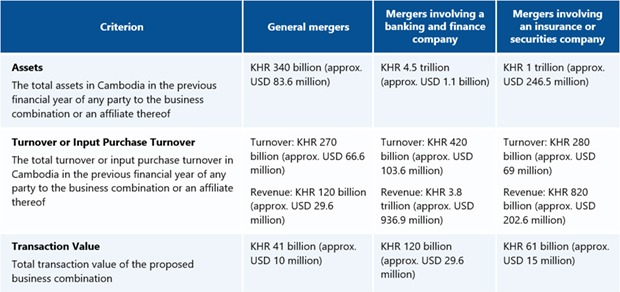
In current practice, the term “turnover” typically refers to a company’s total sales revenue, while “input purchase turnover” denotes the value of materials or equipment acquired for production purposes. Although this reflects the initial interpretation of these terms, it is advisable to seek confirmation or clarification from the CCC before the filing to ensure accuracy and alignment with their current definitions, as it is conceivable that the interpretation may change.

Decision No. 095 leaves room for the Ministry of Commerce to amend these thresholds as deemed necessary.

Outlook

In the last two years, Cambodia has steadily issued regulations to strengthen its legal framework for competition. Although gaps remain, especially with regard to enforcement of fines and certain unclear terms, more regulations are likely in 2025 and 2026.


RELATED INSIGHTS​ 

January 6, 2026
Thailand is developing new legislation on responsible business conduct that would impose statutory obligations on large enterprises to manage human rights and environmental risks throughout their operations and supply chains. The Draft Act on the Promotion of Responsible Business Conduct, commonly referred to as the Human Rights and Environmental Due Diligence (HRDD) Bill, has been developed through extensive consultation involving a wide range of stakeholders, with the Ministry of Justice playing a leading role. If enacted, the HRDD bill would reshape how certain large businesses operate and manage their supply chains, reflecting a recognition of international standards and global concerns regarding human rights and environmental protection. By introducing legally binding due diligence obligations, the draft aims to ensure that businesses operating in Thailand are held accountable for adverse impacts throughout their operations and supply chains, in line with emerging global legal frameworks. Who Will Have to Comply? The HRDD bill primarily targets large enterprises based on their annual revenue thresholds: Manufacturing businesses with annual revenue exceeding THB 500 million Wholesale, retail, or service businesses with annual revenue exceeding THB 300 million The draft would also cover state-owned enterprises and foreign businesses operating in Thailand if their operations meet the applicable revenue thresholds. What Does Human Rights and Environmental Due Diligence Involve? Under the HRDD bill, due diligence is not a one-time checklist but an ongoing process with several key requirements: Adopt and publicly disclose a sustainability policy. Businesses must commit publicly to respecting human rights and protecting the environment, and must integrate this policy into corporate governance and risk management systems. Identify and assess risks. Companies must identify and assess risks of human rights violations and environmental harm across their operations and value chains. Prevent or reduce risks. Businesses must implement effective and proportionate measures to prevent or mitigate
December 30, 2025
On December 17, 2025, Laos’ Ministry of Industry and Commerce (MOIC) issued a notice introducing a new digital system that allows e-commerce businesses to obtain required certificates and licenses through an online, application-based platform. Notice No. 3988, which will take effect on February 1, 2026, introduces the E-Trust platform, a downloadable application that allows e-commerce businesses to remotely obtain acknowledgement certificates and business operating licenses. New Digital Registration Options Under the previous framework established by the Decree on E-commerce (2021), businesses were required to complete registration exclusively through paper-based submissions. The new system now offers businesses two registration options: Traditional paper-based process at the Division of E-commerce Management within the MOIC; or Electronic registration and renewal through the E-Trust platform. This change is expected to streamline procedures, reduce administrative burdens, and enhance accessibility for businesses operating outside Vientiane. The E-Trust platform facilitates compliance for both individuals and legal entities required to submit applications and renewals for required certificates and licenses. The development is particularly beneficial for businesses located in remote provinces, as it eliminates the need for physical travel and significantly accelerates processing times. Compliance Requirements and Penalties Businesses must obtain or renew the required certificates and licenses to avoid sanctions under the Decision on Fines and Other Measures for Violation of the Decree and Regulations on E-commerce (No. 2828/MOIC, dated November 11, 2025). Penalties for noncompliance may include monetary fines and other enforcement measures.
December 19, 2025
Prior to the dissolution of the House of Representatives, Thailand’s cabinet approved a draft amendment to the Administrative Procedure Act, following review by the Council of State. If enacted, this reform will fundamentally change how state agencies process business applications and appeals by imposing enforceable timelines and legal consequences for inaction. The draft directly targets a longstanding commercial frustration: applications and appeals that vanish into administrative silence, stalling investment and foreclosing judicial review across sectors ranging from real estate and manufacturing to healthcare and finance. The “Silence Means Yes” Rule for Applications At the core of the reform is a new automatic “approval by implication” for applications subject to statutory processing deadlines. If an official fails to notify an applicant of a decision within the legally prescribed period, the application will be deemed approved as a matter of law. This presumption shifts the costs of delay from businesses to the bureaucracy and gives applicants a definitive legal position once time expires. The mechanism applies to routine licensing and registration matters governed by explicit consideration periods in existing statutes or ministerial regulations. Officials may extend the decision period by up to thirty days, but only if they notify the applicant before the original deadline and substantiate that the delay arises from genuinely exceptional circumstances beyond their control. Certain sensitive applications are expressly excluded from automatic approval, including those that may significantly affect national security or defense, public safety and health, the environment or natural resources, or national cultural heritage. Once the deadline passes without a decision, businesses can proceed with deployment of capital and operations—construction, hiring, procurement, and market entry—without waiting for formal permission that may never arrive. For time-sensitive projects, this materially reduces regulatory timing risk. The “Deemed Rejection” Rule for Appeals The draft introduces a parallel “deemed rejection”
December 15, 2025
Thailand is taking steps to energize its startup scene by drafting the Startup Promotion Law. This draft law aims to remove obstacles, open new funding opportunities, and provide coordinated government support. The goal is to make it easier for Thailand-based startups to grow and compete on a global stage. Why Is This Law Needed? For many years, Thai startups have operated under traditional company law frameworks that were not designed with high-growth businesses or with fundraising opportunities in mind. Restrictions on issuing bonds, offering shares to outside investors, and repurchasing shares for employee incentive programs made it challenging for emerging companies to access capital and accelerate their growth. The draft Startup Promotion Act seeks to remove these obstacles and foster a more competitive, entrepreneur-friendly environment in Thailand. Who’s in Charge? Two main organizations will oversee the startup ecosystem: Startup Promotion Committee: This group, to be appointed by the National Science, Research, and Innovation Policy Council, will set national strategies, policies, and budget; design promotional campaign and incentives; and propose further legislative amendments to promote startups. National Innovation Agency (NIA): Under the draft act, the NIA will be the main contact for startups and will serve as the secretariat office of the Startup Promotion Committee, coordinating data, advising startups, maintaining the public registry, and providing funding and investment (grants, repayable grants, loans, and equity) under committee criteria and, where applicable, cabinet approval. What Startups Are Eligible for Benefits? To be officially recognized and access benefits, a company must: Be a private limited company less than 10 years old at the time of application. Existing companies that already exceed the 10-year threshold may still apply for startup statues within one year of the law’s enactment, as long as they otherwise still qualify for the new regime. Have average annual revenue not