You are using an outdated browser and your browsing experience will not be optimal. Please update to the latest version of Microsoft Edge, Google Chrome or Mozilla Firefox. Install Microsoft Edge

March 29, 2023

Cambodia Issues Decision on Thresholds for Merger Filings

On March 14, 2023, the Competition Commission of Cambodia (CCC) set out its merger filing thresholds in Decision No. 095 on Thresholds for Prior Notification of Business Mergers. This was a follow-up to the recent issuance of a regulation outlining the requirements and procedures for merger and acquisition filings. Decision No. 095 applies to all business combinations subject to premerger notification requirements under this prior regulation.

The thresholds for when the CCC must be notified of a merger are laid out in the table below.
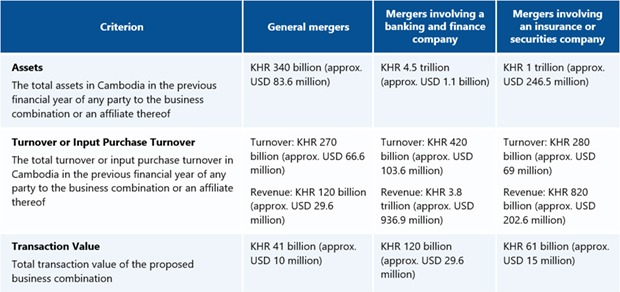
In current practice, the term “turnover” typically refers to a company’s total sales revenue, while “input purchase turnover” denotes the value of materials or equipment acquired for production purposes. Although this reflects the initial interpretation of these terms, it is advisable to seek confirmation or clarification from the CCC before the filing to ensure accuracy and alignment with their current definitions, as it is conceivable that the interpretation may change.

Decision No. 095 leaves room for the Ministry of Commerce to amend these thresholds as deemed necessary.

Outlook

In the last two years, Cambodia has steadily issued regulations to strengthen its legal framework for competition. Although gaps remain, especially with regard to enforcement of fines and certain unclear terms, more regulations are likely in 2025 and 2026.


RELATED INSIGHTS​ 

March 23, 2026
In March 2026, the Myanmar Investment Commission (MIC) introduced two regulatory updates affecting investors planning new investments or implementing MIC-approved projects. Minimum Investment Conditions for Tax Incentives MIC Notification No. 1/202 clarifies the minimum conditions for investments in promoted sectors to qualify for tax exemptions or relief under the Myanmar Investment Law. The notification establishes the following requirements: Investors must contribute at least 35% of the total investment amount in cash, as reflected in the relevant proposal or endorsement application. Where an investment involves a foreign loan, the investor must obtain approval from the Central Bank of Myanmar, together with a loan repayment schedule, and provide evidence that both the foreign loan proceeds and the capital contribution have been remitted in cash through an authorized dealer bank. Chinese Yuan Accepted for Investment Capital The MIC also issued Investment News Bulletin No. 1/2026, confirming that Chinese yuan (CNY) is now accepted as foreign investment capital for applications for MIC permits and endorsements, in addition to US dollars (USD). Investment funds contributed in CNY may be remitted through banks authorized to deal in foreign currency in CNY, following the same process currently applied to investments made in USD. These developments may affect how foreign investment capital is structured and remitted, as well as the availability of tax incentives for investments under the MIC framework.
March 20, 2026
Thailand’s Board of Investment (BOI) now requires data center projects to demonstrate measurable benefits for local workforce development, R&D, SME capability, and domestic supply chains to qualify for corporate income tax (CIT) exemptions. BOI Notification No. Por. 3/2569, issued on February 6, 2026, updates the requirements for projects seeking promotion under BOI category 8.2.1 (data centers). All data center projects must now submit and implement plans covering development of Thai human resources and domestic supply chain support before benefiting from any CIT exemption. Human Resources Development Plan The BOI seeks to promote local talent development beyond basic training. Plans must include the following elements: Training for data center design, construction, and operations targeting vocational students, engineering and ICT undergraduates and postgraduates, and energy and building personnel in Thailand. Joint curricula with Thai universities and technical institutes. Collaborative R&D with Thai nationals or institutions in areas including AI, resource allocation, high-performance computing, and data center hardware and systems. Thai SME upskilling in electrical and energy systems and IT services. Domestic Supply Chain Support Plan Plans must demonstrate knowledge transfer in design, construction, cooling, security, and power and water management. Projects must also include usage or installation of domestically manufactured equipment or engage specialist domestic entities. Criteria for BOI Evaluation The BOI will assess data center operators’ eligibility for CIT incentives based on two criteria: Scale requirement: Training and joint-curriculum initiatives must reach a total participants equal to at least 10 times the project headcount and run for the duration of the CIT incentive. If this threshold is not met, the applicant must also implement continuous R&D or SME skills-development plans throughout the incentive period. Substantiality test: Supply-chain plans must be substantive, meet industry standards, and show measurable development of the domestic digital and data center supply base. To ensure compliance,
February 25, 2026
Tilleke & Gibbins has updated the Vietnam chapter in the newly released Licensing 2026 guide, published by Lexology Panoramic. The comparative guide provides companies and other interested readers with information on licensing law and practice in various countries around the world. Licensing 2026 provides detailed information on the following topics: Restrictions, laws and licensing arrangements Intellectual property issues: Paris Convention for the Protection of Industrial Property, contesting the validity of licensor’s IP rights, invalidity and expiry of IP rights, security interests, proceedings against third parties, sublicensing, jointly owned IP, first to file, scope of patent protection, trade secrets, copyright Software licensing: Perpetual licensing, legal requirements, user restrictions Royalties and payments, currency conversion, and taxes: Relevant legislation, restrictions, taxation of foreign licensors Competition law issues: Restrictions on trade, legal restrictions, and IP-related court rulings Indemnification, disclaimers, and damages: Prevalence and enforceability of indemnity provisions and contractual waivers of damages Termination: Right to terminate, impact of termination Bankruptcy: Impact of licensee or licensor bankruptcy Dispute resolution: Governing law, arbitration, enforceability, injunctive relief, contractual waivers The Vietnam chapter is available below as a PDF. Readers can gain 30 days of complementary access to the full Licensing 2026 guide and the rest of Lexology Panoramic’s varied offerings through this link.
February 20, 2026
The past year has been an important one for the Trade Competition Commission of Thailand (TCCT). With a right combination of commissioners bringing expertise in competition law, investigations, administrative procedures, court processes, and sector-focused industries, the regulator has pushed forward with stronger enforcement efforts and closer cooperation with both domestic and international stakeholders. In 2025 the TCCT participated in major international initiatives—including peer reviews conducted by the OECD and ASEAN. These efforts reflect Thailand’s ongoing ambition to elevate its competition law framework to meet international expectations and build trust among global communities. There was also significant momentum around potential amendments to the Trade Competition Act (TCA). Political parties, the TCCT, the private sector, and civil society all agreed that the 2017 law could benefit from clearer rules and more effective enforcement tools. Although a draft amendment passed an initial reading and moved to a subcommittee for revision, the process stalled following the dissolution of Parliament. At the same time, the TCCT invested heavily in strengthening its own internal capabilities. It expanded collaborations with organizations such as the OECD, ASEAN authorities, the EU, and counterparts in Japan and Australia. The TCCT also published sector-specific market studies, including on digital platforms and e‑marketplaces and on cold‑rolled steel. The regulator also shared draft guidelines aimed at regulating online platforms—although these have not yet been finalized. What’s Next for the TCCT? Looking ahead, the TCCT is set to keep building on the momentum it has created and be a more active, transparent, and practical regulator. It is likely to become even more visible in the public sphere as it steps up efforts to raise awareness about competition law, especially among businesses that may not traditionally follow or be familiar with such regulatory developments. Digital markets, including e‑commerce and online marketplaces, will remain a