You are using an outdated browser and your browsing experience will not be optimal. Please update to the latest version of Microsoft Edge, Google Chrome or Mozilla Firefox. Install Microsoft Edge

March 29, 2023

Cambodia Issues Decision on Thresholds for Merger Filings

On March 14, 2023, the Competition Commission of Cambodia (CCC) set out its merger filing thresholds in Decision No. 095 on Thresholds for Prior Notification of Business Mergers. This was a follow-up to the recent issuance of a regulation outlining the requirements and procedures for merger and acquisition filings. Decision No. 095 applies to all business combinations subject to premerger notification requirements under this prior regulation.

The thresholds for when the CCC must be notified of a merger are laid out in the table below.
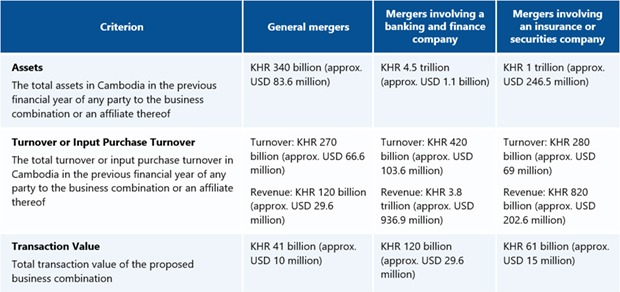
In current practice, the term “turnover” typically refers to a company’s total sales revenue, while “input purchase turnover” denotes the value of materials or equipment acquired for production purposes. Although this reflects the initial interpretation of these terms, it is advisable to seek confirmation or clarification from the CCC before the filing to ensure accuracy and alignment with their current definitions, as it is conceivable that the interpretation may change.

Decision No. 095 leaves room for the Ministry of Commerce to amend these thresholds as deemed necessary.

Outlook

In the last two years, Cambodia has steadily issued regulations to strengthen its legal framework for competition. Although gaps remain, especially with regard to enforcement of fines and certain unclear terms, more regulations are likely in 2025 and 2026.


RELATED INSIGHTS​ 

August 16, 2022
On July 21, 2022, Vietnam’s Ministry of Industry and Trade (MOIT) submitted Report No. 126/BC-BCT to the Prime Minister regarding the mechanism for transitional wind and solar power projects. In this report, the MOIT proposed some recommendations to explicitly address difficulties for outstanding wind and solar power projects (“Transitional Projects”) which have been developed under the Prime Minister’s Decision No. 13/2020/QD-TTg dated April 6, 2020, on the development of solar power projects (Decision 13) and Decision No. 37/2011/QD-TTg dated June 29, 2011, on the development of wind power projects (Decision 37), as amended by Decision No. 39/2018/QD-TTg dated September 10, 2018 (Decision 39). The Transitional Projects primarily include those which have completed construction but have not yet been put into operation, and those which have been put into operation but for which the power price has not yet been decided, due to missing the deadline set forth under the aforementioned decisions to be eligible for the feed-in-tariff (FIT). In particular, the MOIT has proposed the following key recommendations to the Prime Minister: Mechanism for Transitional Projects The MOIT proposes two options: Option 1: Developers of the Transitional Projects negotiate and sign power purchase agreements (PPA) with Vietnam Electricity (EVN) within the price framework issued by the MOIT in accordance with the Law on Electricity, the Law on Prices, and their subordinate guiding legislation; or Option 2: The Prime Minister formulates a new decision specifying the mechanism for bidding on the purchase of power produced by the Transitional Projects, estimated to be implemented for the time limit of three years and within the price framework issued by the MOIT. Mechanism for future wind and solar power projects The MOIT proposes to apply the mechanism that developers of future wind and solar projects negotiate the power price and sign the PPA
August 5, 2022
Thailand’s Securities and Exchange Commission and the Stock Exchange of Thailand (SET) have opened a public hearing period on proposed changes to requirements for IPO securities issuers and other regulations relating to companies listed on the SET and the Market for Alternative Investment (MAI). The proposed changes aim to prevent the use of publicly offered securities to avoid or violate strict regulations on investment management. During the public hearing period, interested parties may submit comments on the proposed rules until August 18, 2022, with the finished regulations expected to be issued soon after. Key Proposed Changes to Rules for Securities Issuers Under the proposed rule adjustments, securities issuers (i.e., operating companies, holding companies, or foreign companies that request a public offering) must not be investment companies, except for companies or subsidiaries undertaking financial institution business (e.g., commercial banks, finance companies, credit foncier companies, securities companies, and life/non-life insurance companies). “Investment company” refers to a company that has more than 40 percent of its total assets as passive investments in securities, derivatives (excluding for hedging purposes) or digital assets. When considering whether a company that has a subsidiary is classified as an investment company, it will be determined based on the consolidated financial statement. Excluded from such classification are investments for low-risk liquidity management (i.e., bank deposits, government bonds, debt instruments backed by the Ministry of Finance, money market mutual funds, or fixed-income funds); affiliate companies that do not operate as investment companies; subsidiary companies under the same group company; and investments in business networks, synergies, or value chains. Key Proposed Changes to Rules for Listed Companies A company with the characteristics of an investment company mentioned above is not allowed to list its securities on the SET or the MAI. Companies listed on SET and MAI with more than
August 2, 2022
Thailand has issued separate regulations temporarily exempting hotel operators and factory owners from paying their annual government fee. The special allowances are meant to mitigate the COVID-19-related financial impacts that have hit the hospitality and manufacturing sectors in Thailand. The exemption for hotel business operators came on July 8, 2022, when the Ministry of the Interior promulgated the Ministerial Regulation Re: Exemption from the Government Fee for Hotel Business Operators B.E. 2565 (2022). This regulation exempts hotel business operators from paying the annual government fee, which is at the rate of THB 40 per room, from July 1, 2022, to June 30, 2024. The exemption for factory business operators was laid out in the Ministry of Industry’s July 1, 2022, Ministerial Regulation Re: Exemption from Annual Government Fee for Factory Business Operators B.E. 2565 (2022). Under this regulation, operators of type 2 factories (which must notify the Ministry of Industry before operation) and type 3 factories (which must obtain a factory operation license before operation) as designated under the Factory Act B.E. 2535 and its amendments are relieved from paying the annual government fee from June 10, 2022, to June 9, 2023. This fee varies (ranging from THB 300 to THB 43,500 per year) depending on the horsepower of machinery used in the factory. For more information on these exemptions, please contact Tilleke & Gibbins at [email protected].
July 25, 2022
Vietnam’s current Law on E-Transactions was passed in 2005 and has been effective since March 1, 2006. This law is considered a framework law, developed based on the Model Law on E-Commerce of the United Nations Commission on International Trade Law (UNCITRAL). According to the Ministry of Information and Communications (MIC), over the past 17 years, the implementation and application of e-transactions has shown significant evolution in certain areas demanding high levels of international integration, such as banking and e-commerce, but has faced difficulties in other areas due to a lack of detailed guidance. In addition, with the strong growth and breakthrough development of digital technologies such as artificial intelligence, big data, biometrics, and blockchain, and in the context of the ongoing Industrial Revolution 4.0 and the development of digital government, digital economy, and digital society, the 2005 Law on E-Transactions has revealed its shortcomings. Therefore, the government of Vietnam has entrusted the MIC to take the lead in drafting a new Law on E-Transactions, which will replace the old 2005 law in order to meet the country’s development needs. Accordingly, the MIC published a Draft Law on E-Transactions (“Draft Law”) for public consultation from May 4 to July 4, 2022. The latest accessible version of the Draft Law at the time of writing is Version 4. The effective date of the Draft Law is still not yet determined, though this law is expected to be submitted to the National Assembly for its review and comments in October 2022 and approval in May 2023. The following are some key contents of the Draft Law: 1. Scope of Application Unlike the current law, which explicitly excludes certain areas such as the issuance of certificates of land use rights and marriage certificates from the scope of application, the Draft Law attempts