You are using an outdated browser and your browsing experience will not be optimal. Please update to the latest version of Microsoft Edge, Google Chrome or Mozilla Firefox. Install Microsoft Edge

March 29, 2023

Cambodia Issues Decision on Thresholds for Merger Filings

On March 14, 2023, the Competition Commission of Cambodia (CCC) set out its merger filing thresholds in Decision No. 095 on Thresholds for Prior Notification of Business Mergers. This was a follow-up to the recent issuance of a regulation outlining the requirements and procedures for merger and acquisition filings. Decision No. 095 applies to all business combinations subject to premerger notification requirements under this prior regulation.

The thresholds for when the CCC must be notified of a merger are laid out in the table below.
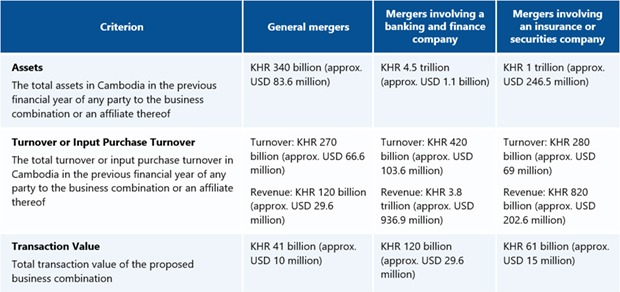
In current practice, the term “turnover” typically refers to a company’s total sales revenue, while “input purchase turnover” denotes the value of materials or equipment acquired for production purposes. Although this reflects the initial interpretation of these terms, it is advisable to seek confirmation or clarification from the CCC before the filing to ensure accuracy and alignment with their current definitions, as it is conceivable that the interpretation may change.

Decision No. 095 leaves room for the Ministry of Commerce to amend these thresholds as deemed necessary.

Outlook

In the last two years, Cambodia has steadily issued regulations to strengthen its legal framework for competition. Although gaps remain, especially with regard to enforcement of fines and certain unclear terms, more regulations are likely in 2025 and 2026.


RELATED INSIGHTS​ 

February 7, 2023
Attorneys from Tilleke & Gibbins’ office in Phnom Penh have contributed an updated Cambodia chapter to Foreign Investment Review 2023, a global guide to the legal and regulatory environment for foreign investment in 29 jurisdictions around the world. Published and distributed by Lexology Getting the Deal Through (GTDT), the guide is focused on law and policy regarding foreign investment oversight, regulatory frameworks, procedural requirements, and other notable concerns for foreign investors. The Cambodia chapter was updated by Jay Cohen, partner and director of Tilleke & Gibbins’ Phnom Penh office, and Nitikar Nith, associate. The chapter focuses most closely on the law and policy section, which explains the government’s policies and practices regarding foreign direct investment, the main investment laws and their scope, and the relevant authorities responsible for regulating mergers, acquisitions, and other business transactions. The chapter also brings up key recent developments, such as the prospect of Cambodia establishing a competition regulator. A PDF of the Cambodia chapter can be downloaded through the button below. Tilleke & Gibbins also provided the Laos, Myanmar, and Vietnam chapters to Foreign Investment Review 2023. To browse the full guide for all 29 jurisdictions, please visit the Getting the Deal Through website.
February 6, 2023
Thailand’s Department of Business Development (DBD) has clarified that even after the amended Civil and Commercial Code (CCC) comes into effect on February 7, 2023, companies with articles of association pursuant to the previous CCC will still have to follow the previous requirements for publication of shareholders’ meeting notices. The amended CCC removes the requirement for companies to publish a notice in a local newspaper when calling a general meeting of shareholders. Instead, companies can call a general meeting of shareholders either by sending a notice by post with acknowledgement of receipt to every shareholder whose name appears in the register of shareholders or by delivering the notice in person. However, the amended CCC still requires companies that have issued share certificates to bearers to publish a notice at least once in a local newspaper or via electronic means, as prescribed by the relevant ministerial regulations. Notwithstanding these updated requirements, the DBD has issued a clarification explaining that the amended CCC coming into effect on February 7 will not usher in a blanket change to the way most companies are required to notify shareholders about a general shareholders’ meeting. If a company’s articles of association were made pursuant to a prior version of the CCC, that company will still need to publish a notice calling for a general meeting of shareholders in a local newspaper—even after the new amendment becomes effective. If companies would like to change their practice so that they no longer have to publish this notice, they will need to amend their articles of association after the effective date of the amended CCC. For more information on the new requirements of the amended CCC, or on any aspect of corporate laws and corporate governance in Thailand, please contact Prisna Sungwanna at [email protected], or Kobchai Nitungkorn at
January 25, 2023
Thailand’s Energy Regulatory Commission (ERC) has issued four new regulations under the Energy Business Act B.E. 2550 (2007) setting forth competition regimes to control both anticompetitive conduct and market structure in the energy business sector. The regulations were published in the Government Gazette on December 19, 2022, and took effect the following day. The key provisions of these ERC competition regulations largely mirror those articulated in the Trade Competition Act B.E. 2560 (2017) and its subordinate legislation. The most significant features of these competition regulations are summarized below. Market Definition Regulation The ERC’s market definition regulation (officially the ERC Regulation re: Market Definition and Relevant Market of Related Energy Services B.E. 2565) outlines the general framework for defining relevant markets in the energy sector. The factors to be taken into consideration include types of energy licenses, geographical areas, competition conditions, and interchangeability of energy services. In the annex to this regulation, the ERC has classified the relevant energy service markets as follows: Power business activities include power generation, power transmission system services, power distribution system services, power distribution services, and power system control services. Natural gas business activities include natural gas transmission through pipelines via natural gas transmission systems, natural gas procurement and wholesale via natural gas distribution systems, natural gas retail via natural gas distribution systems, and storage and regasification of liquefied natural gas. The ERC will review its market definitions and relevant energy service markets from time to time, taking into account changes in technology and competition conditions as well as feedback from public hearings. Market Dominance Regulation Under the ERC’s market dominance regulation (officially the ERC Regulation re: Criteria on Business Operator having a Market Dominance B.E. 2565), the ERC is empowered to proactively determine and declare which license-holding energy business operators have a dominant position
January 16, 2023
The January–March 2023 issue of Asia Franchise & Business Opportunities magazine features an article by two franchising specialists in Tilleke & Gibbins’ Bangkok office. Written by Alan Adcock, partner, and Sher Hann Chua, consultant, the article provides a summary of the legislative developments of 2022 most relevant to franchisors and franchisees. The update looks especially at amendments to Thailand’s unfair trade practices in franchising, as well as the far-reaching Personal Data Protection Act, which is reshaping the way businesses—including franchises—are handling the personal data of customers, partners, and employees. The article is accompanied by a Chinese-language summary of the developments. The full article can be read online in the January–March 2023 issue of Asia Franchise & Business Opportunities.