You are using an outdated browser and your browsing experience will not be optimal. Please update to the latest version of Microsoft Edge, Google Chrome or Mozilla Firefox. Install Microsoft Edge

March 29, 2023

Cambodia Issues Decision on Thresholds for Merger Filings

On March 14, 2023, the Competition Commission of Cambodia (CCC) set out its merger filing thresholds in Decision No. 095 on Thresholds for Prior Notification of Business Mergers. This was a follow-up to the recent issuance of a regulation outlining the requirements and procedures for merger and acquisition filings. Decision No. 095 applies to all business combinations subject to premerger notification requirements under this prior regulation.

The thresholds for when the CCC must be notified of a merger are laid out in the table below.
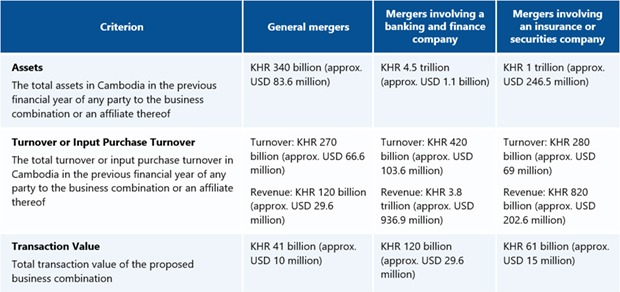
In current practice, the term “turnover” typically refers to a company’s total sales revenue, while “input purchase turnover” denotes the value of materials or equipment acquired for production purposes. Although this reflects the initial interpretation of these terms, it is advisable to seek confirmation or clarification from the CCC before the filing to ensure accuracy and alignment with their current definitions, as it is conceivable that the interpretation may change.

Decision No. 095 leaves room for the Ministry of Commerce to amend these thresholds as deemed necessary.

Outlook

In the last two years, Cambodia has steadily issued regulations to strengthen its legal framework for competition. Although gaps remain, especially with regard to enforcement of fines and certain unclear terms, more regulations are likely in 2025 and 2026.


RELATED INSIGHTS​ 

February 8, 2023
Thailand has a robust legal framework for competition, with laws and regulations in place to prevent anticompetitive conduct and market concentration and to promote fair competition. However, as the business environment in the country continues to evolve, it is important for companies operating in Thailand to stay informed about the latest developments in competition laws and regulations. Generally, Thailand’s competition regime is based on the Trade Competition Act B.E. 2560 (2017) (the TCA) and its implementing regulations, except for certain industries which are governed by sector-specific competition regulations. The TCA is designed to promote free and fair competition by suppressing anticompetitive behaviors. In this article, we will examine what businesses can expect in the coming year, and what they need to be aware of in order to stay compliant. A Maturing Regulatory Structure The Trade Competition Commission of Thailand (TCCT) is the agency responsible for enforcing competition laws and regulations in Thailand. The TCCT has the authority to oversee the market structure, act to maintain competitiveness in various industries, investigate misconduct, and take action against companies that engage in anticompetitive practices, such as abuse of market dominance, cartels, and unfair trade practices. It also has discretionary power to consider applications for a merger of two or more businesses that may cause monopoly or market dominance. While the TCA and the TCCT had limited success in the decades after the original TCA’s enactment in 1999, a new TCA in 2017 made several significant changes to the previous version of the law. The 2017 TCA guarantees the independence of the TCCT from political and business interventions. It also introduces administrative penalties for less-serious offenses, including non-hardcore cartels, unfair trade practices, and neglect of merger filing duties. Since then, the TCCT has been more active in its issuance of subordinate regulations to
February 7, 2023
Phuong Thi Minh Tran, an associate in Tilleke & Gibbins’ office Ho Chi Minh City, contributed the Vietnam chapter of Foreign Investment Review 2023, a recently published global guide to the legal and regulatory environment for foreign investment in 29 jurisdictions worldwide. Published and distributed by Getting the Deal Through (GTDT), the guide discusses law and policy on oversight of foreign investment, regulatory frameworks, procedural requirements, and other important stipulations for foreign investors. The Vietnam chapter covers the following topics: Law and Policy: Government policies and practices, main laws and their scope of application (including details on investment promotional measures), definitions, rules for state-owned enterprises and sovereign wealth funds, relevant authorities and oversight, and national interest provisions. Procedure: Jurisdictional thresholds, national interest clearance, securing approval, the review process for competition clearance and associated penalties, involvement of authorities, facilitation of clearance, and post-closing regulatory powers. Substantive assessment: Substantive tests for clearance, authorities’ consultation with other countries and other relevant parties, transactional prohibitions and objections, mitigating arrangements and challenges to a decision, and protection of confidential information. Recent cases, updates, and trends: Relevant recent case law, key recent and ongoing developments. A PDF of the Vietnam chapter can be accessed through the button below. Tilleke & Gibbins also contributed the Cambodia, Laos, and Myanmar chapters to Foreign Investment Review 2023. To browse all 29 jurisdictions covered by the guide, please visit the Getting the Deal Through website.
February 7, 2023
Nwe Oo, a senior associate in Tilleke & Gibbins’ office in Yangon, contributed an updated Myanmar chapter to the recently published Foreign Investment Review 2023, a global guide to the legal and regulatory environment for foreign investment in 29 jurisdictions worldwide. Published and distributed by Lexology Getting the Deal Through (GTDT), the guide discusses law and policy on oversight of foreign investment, regulatory frameworks, procedural requirements, and other important concerns for foreign investors. The Myanmar chapter covers the following topics: Law and Policy: Government policies and practices, main laws and their scope of application (including details on investment promotional measures), definitions, rules for state-owned enterprises and sovereign wealth funds, relevant authorities and oversight, and national interest provisions. Procedure: Jurisdictional thresholds, national interest clearance, securing approval, the review process for competition clearance and associated penalties, involvement of authorities, facilitation of clearance, and post-closing regulatory powers. Substantive assessment: Substantive tests for clearance, authorities’ consultation with other countries and other relevant parties, transactional prohibitions and objections, mitigating arrangements and challenges to a decision, and protection of confidential information. Recent cases, updates, and trends: Relevant recent case law, key recent and ongoing developments. A PDF of the Myanmar chapter can be downloaded through the button below. Tilleke & Gibbins also contributed the Cambodia, Laos, and Vietnam chapters to Foreign Investment Review 2023. To browse the full guide covering all 29 jurisdictions, please visit the Getting the Deal Through website.
February 7, 2023
Dino Santaniello, head of Tilleke & Gibbins’ office in Vientiane, provided an updated Laos chapter for Foreign Investment Review 2023, a global guide to the legal and regulatory environment for foreign investment in 29 jurisdictions worldwide. Published and distributed by Lexology Getting the Deal Through (GTDT), the guide discusses law and policy on oversight of foreign investment, regulatory frameworks, procedural requirements, and other important considerations for foreign investors. The Laos chapter aims to give investors an understanding of what to expect when establishing operations and operating in the Lao market, covering: Law and Policy: Government policies and practices, main laws and their scope of application (including details on investment promotional measures), definitions, rules for state-owned enterprises and sovereign wealth funds, relevant authorities and oversight, and national interest provisions. Procedure: Jurisdictional thresholds, national interest clearance, securing approval, the review process for competition clearance and associated penalties, involvement of authorities, facilitation of clearance, and post-closing regulatory powers. Substantive assessment: Substantive tests for clearance, authorities’ consultation with other countries and other relevant parties, transactional prohibitions and objections, mitigating arrangements and challenges to a decision, and protection of confidential information. Recent cases, updates, and trends: Relevant recent case law, key recent and ongoing developments. A PDF of the Laos chapter can be accessed through the button below. Tilleke & Gibbins also contributed the Cambodia, Myanmar, and Vietnam chapters to Foreign Investment Review 2023. To browse the full guide covering all 29 jurisdictions, please visit the Getting the Deal Through website.