You are using an outdated browser and your browsing experience will not be optimal. Please update to the latest version of Microsoft Edge, Google Chrome or Mozilla Firefox. Install Microsoft Edge

March 29, 2023

Cambodia Issues Decision on Thresholds for Merger Filings

On March 14, 2023, the Competition Commission of Cambodia (CCC) set out its merger filing thresholds in Decision No. 095 on Thresholds for Prior Notification of Business Mergers. This was a follow-up to the recent issuance of a regulation outlining the requirements and procedures for merger and acquisition filings. Decision No. 095 applies to all business combinations subject to premerger notification requirements under this prior regulation.

The thresholds for when the CCC must be notified of a merger are laid out in the table below.
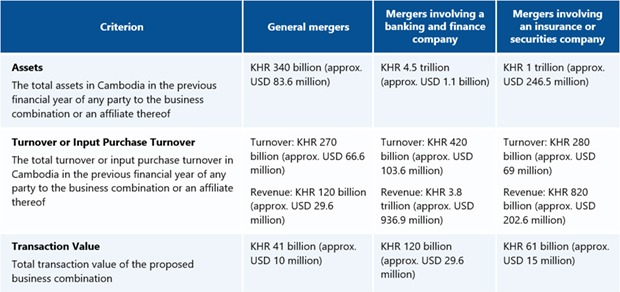
In current practice, the term “turnover” typically refers to a company’s total sales revenue, while “input purchase turnover” denotes the value of materials or equipment acquired for production purposes. Although this reflects the initial interpretation of these terms, it is advisable to seek confirmation or clarification from the CCC before the filing to ensure accuracy and alignment with their current definitions, as it is conceivable that the interpretation may change.

Decision No. 095 leaves room for the Ministry of Commerce to amend these thresholds as deemed necessary.

Outlook

In the last two years, Cambodia has steadily issued regulations to strengthen its legal framework for competition. Although gaps remain, especially with regard to enforcement of fines and certain unclear terms, more regulations are likely in 2025 and 2026.


RELATED INSIGHTS​ 

March 31, 2026
On December 10, 2025, the National Assembly of Vietnam adopted Law on Vocational Education No. 124/2025/QH15, which took effect on January 1, 2026, replacing Law on Vocational Education No. 74/2014/QH13 of 2014. The new law broadens the categories of institutions eligible to deliver vocational training, introduces vocational upper secondary schools, and shifts governance structures for private institutions from ownership-representative boards of management to stakeholder-based school councils. These reforms aim to diversify training providers, align programs with labor market needs, and create a more flexible, open vocational education ecosystem, offering expanded opportunities for foreign and domestic investors, universities, and enterprises. Some highlights of the new Law on Vocational Education are presented below. Expansion of Vocational Training Levels and Programs In addition to elementary, intermediate, and college—the three levels of vocational training program set out under the 2014 Law on Vocational Education—the new law expands the structure by introducing two new levels: Vocational high school training programs are placed between elementary and intermediate levels, and are aimed at combining upper secondary education with vocational training, expanding options for learners after graduating from the lower secondary level. Other vocational training programs are not specified in detail under the new law, but aim to equip learners with the capability to perform and handle one or several simple tasks of an occupation. Expansion of Vocational Education Providers The new law reclassifies and extends vocational education providers by classifying them into two distinct categories: Vocational education institutions, which include colleges, intermediate schools, and vocational high schools. Establishments participating in vocational education activities, which include vocational education centers, vocational-continuing education centers, continuing education centers, other centers with vocational education functions, enterprises, cooperatives, and higher education institutions. Vocational education providers may provide one vocational training level only, or several/all levels, depending on the type of provider. The
March 31, 2026
Thailand’s Office of the Consumer Protection Board has opened a public hearing period on draft regulations governing the transfer of direct sales and direct marketing businesses. The draft Notification of the Direct Sales and Direct Marketing Committee: Criteria and Procedures for Business Transfer and Amendment of Registration for Direct Sales or Direct Marketing Businesses establishes a compliance-focused process with strict documentation requirements and timelines for transferring direct sales and direct marketing businesses. The proposed framework also defines the roles of transferors and transferees and establishes application procedures with the Office of the Consumer Protection Board. Applications may be submitted in person or electronically and will be examined to confirm they are complete, authentic, and compliant with legal requirements. This includes verification that: The transferee meets all required qualifications; No disqualifying factors apply; and The applicant is not subject to legal restrictions. The public hearing period is open until April 29, 2026. Direct sales and direct marketing business operators should prepare for these proposed requirements to ensure compliant implementation once the regulations are finalized.
March 30, 2026
On March 24, 2026, the Trade Competition Commission of Thailand (TCCT) published its long-anticipated Guidelines on Multi-Sided Platforms and E-Commerce Businesses in the Government Gazette, following the conclusion of a public hearing conducted last year. The guidelines entered into force on March 25, 2026, and significantly expand the application of Thai competition law to digital platform ecosystems. These rules introduce targeted restrictions on platform conduct, such as price-ranking algorithms and tying and bunding, that leverages network effects, and will have far-reaching implications across Thailand’s digital economy—affecting not only platform operators but also platform participants, including sellers, logistics providers, advertisers, and payment service providers operating on or alongside such platforms. The guidelines clarify how existing prohibitions under the Trade Competition Act B.E. 2560 (2017) (TCA)—including abuse of market dominance, cartel conduct, and unfair trade practices—apply in the context of platform-based business models. While many provisions reflect earlier draft guidelines, the final version delivers more precise definitions and clearer enforcement parameters, increasing regulatory certainty while also raising compliance expectations. Applicability The guidelines introduce core definitions that determine their coverage: Multi-sided platform: A platform that acts as an intermediary connecting two or more groups of users, enabling them to have direct interaction in order to exchange or rely on services from one another. Examples include digital platforms for trading goods or services (e-commerce), as defined below. Digital platform for trading goods or services (e-commerce): A platform that acts as an intermediary connecting the distribution, purchase, sale, or exchange of goods or services. This includes operations carried out to facilitate transactions or interactions between business operators through an electronic transaction system, regardless of whether a service fee is charged. Operator of a digital platform business for trading goods or services: A provider of digital platform services for trading goods or services, as described
March 27, 2026
Thailand’s National Broadcasting and Telecommunications Commission (NBTC) has publicly indicated that it is preparing a new regulatory framework for data center operators that may introduce foreign-ownership restrictions. In particular, the NBTC is considering reclassifying data center operations from a type 1 telecommunications business license to a type 3 license. If implemented, this change would subject data center operators to a significantly more stringent regulatory regime, especially in relation to foreign ownership and control. The NBTC has indicated that it intends to propose a draft framework to the NBTC board. This would be followed by a public hearing process, with a view to implementing the new rules within 2026. Under the Telecommunications Business Act B.E. 2544 (2001), as amended, telecommunications businesses operating under type 3 licenses are subject to foreign ownership restrictions, including a requirement that less than 50% of the total issued shares be held by foreign shareholders. In addition, type 3 licensees are subject to foreign dominance restrictions, which prohibit arrangements that allow foreigners to dominate the business. These foreign dominance restrictions are broad in scope and may capture various forms of direct and indirect control or influence. This includes circumstances in which a foreign national is able to influence or control the formulation of policy, management, or business operations, or the appointment of directors or senior executives. At this stage, the exact scope of the proposed rules remains unclear. Businesses with existing or planned data center operations in Thailand should therefore monitor upcoming NBTC developments in this regard and prepare for the expected public hearing process.