You are using an outdated browser and your browsing experience will not be optimal. Please update to the latest version of Microsoft Edge, Google Chrome or Mozilla Firefox. Install Microsoft Edge

March 29, 2023

Cambodia Issues Decision on Thresholds for Merger Filings

On March 14, 2023, the Competition Commission of Cambodia (CCC) set out its merger filing thresholds in Decision No. 095 on Thresholds for Prior Notification of Business Mergers. This was a follow-up to the recent issuance of a regulation outlining the requirements and procedures for merger and acquisition filings. Decision No. 095 applies to all business combinations subject to premerger notification requirements under this prior regulation.

The thresholds for when the CCC must be notified of a merger are laid out in the table below.
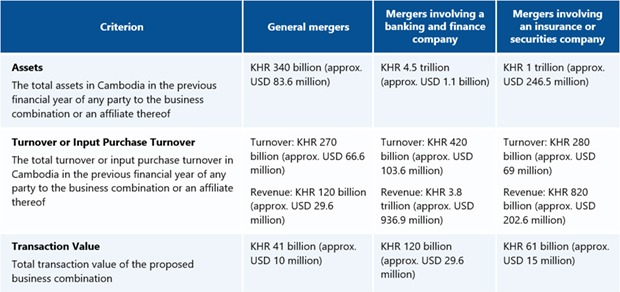
In current practice, the term “turnover” typically refers to a company’s total sales revenue, while “input purchase turnover” denotes the value of materials or equipment acquired for production purposes. Although this reflects the initial interpretation of these terms, it is advisable to seek confirmation or clarification from the CCC before the filing to ensure accuracy and alignment with their current definitions, as it is conceivable that the interpretation may change.

Decision No. 095 leaves room for the Ministry of Commerce to amend these thresholds as deemed necessary.

Outlook

In the last two years, Cambodia has steadily issued regulations to strengthen its legal framework for competition. Although gaps remain, especially with regard to enforcement of fines and certain unclear terms, more regulations are likely in 2025 and 2026.


RELATED INSIGHTS​ 

August 12, 2024
With the growing prominence of ESG (Environmental, Social, and Governance) factors, businesses in Vietnam are increasingly recognizing their importance in driving global demand, societal impact, and economic value. A comprehensive acknowledgment of ESG-related legal requirements is critical for investors and companies operating in Vietnam to meet stakeholder expectations and ensure compliance. Our guide provides a basic overview of the rapidly evolving ESG landscape in Vietnam, covering a range of key issues for companies doing business in the country: What is ESG, and what does the ESG legal framework look like in Vietnam? Who needs to follow ESG regulations in Vietnam? What are the benefits of ESG compliance? How can enterprises enhance ESG best practices in Vietnam? Please click on the link below to view the full article.
August 7, 2024
A recent case at the Myanmar Competition Commission has set a significant precedent in the country’s approach to unfair competition practices. The case, involving a Thai manufacturer of cement grout and tile adhesive products and a local Myanmar producer, highlighted the Commission’s willingness to address issues of deceptive marketing and unfair competition. Background The case centered around a Thai manufacturer who has been distributing their cement grout and tile adhesive products in Myanmar for many years through local distribution agents. The company had established a well-known brand and a strong reputation for quality in the Myanmar market. In recent years, the Thai company discovered that a local individual in Myanmar was manufacturing and selling similar products with packaging nearly identical to their own. The local producer was using the same mark device, color, and packaging design themes, and the products contained deceptive information. Legal Proceedings After an initial cease-and-desist letter failed to resolve the issue, a complaint was submitted to the Myanmar Competition Commission. The case was notable because the Commission typically does not address issues of copying designs, marks, colors, or packaging themes. However, the complaint emphasized that the local individual was misleading customers and competing unfairly by using deceptive information and copying distinctive designs and themes. Lawyers from Tilleke & Gibbins, representing the Thai manufacturer, provided extensive documentation proving their client’s long-standing presence in the Myanmar market and the local individual’s deceptive practices. The Commission’s Investigation Committee conducted a thorough investigation, including market surveys and hearings involving both parties. Commission’s Decision After nearly a year of deliberation, on July 4, 2024, the Decision-Making Committee of the Myanmar Competition Commission ruled in favor of the Thai manufacturer. The decision required the local individual to: Immediately cease the production and distribution of cement grout and tile adhesive products bearing
August 5, 2024
Thailand has continued to face economic challenges since the COVID-19 pandemic, and some businesses have struggled to survive. One of most important measures that indebted businesses in Thailand can take is to file a business rehabilitation petition with the Bankruptcy Court. The Bankruptcy Act B.E. 2483 (1940) provides “automatic stay” measures to protect the debtors that have entered the business rehabilitation process, and during this time creditors have duties and rights under the Bankruptcy Act as well. Once Thailand’s Bankruptcy Court accepts a rehabilitation petition and issues an order for rehabilitation, the debtor is under this automatic stay protection against actions from the creditor to seek debt repayments, and the creditors are only allowed to pursue their debt repayments by submitting a debt repayment application to the official receiver within one month of publication of the plan preparer’s appointment in the Government Gazette. These are general conditions specified in the Bankruptcy Act. However, there are several practical precautions that are not specified in the Bankruptcy Act but that creditors should take during rehabilitation. Below are several steps creditors need to consider taking at various stages of the rehabilitation process. 1. Appointing a local Thai representative to act on behalf of the creditor in the rehabilitation The rehabilitation process requires much more than just submitting the debt repayment application within the fixed one-month period and then waiting for the result. It also involves contacting, meeting, and discussing with the official receiver, plan preparer, other creditors, or debtor representative to investigate or settle any arguments on the debt. Moreover, the language used in all the processes and documents is usually Thai. In practice, creditors—especially foreign creditors—should authorize a Thai attorney or representative through a valid power of attorney (POA) to represent them during all the rehabilitation proceedings. This includes the investigative
March 25, 2024
Attorneys from Tilleke & Gibbins in Vietnam have provided an updated Vietnam chapter for Fashion Law 2024, a guide to law surrounding the business of fashion in jurisdictions around the world. The guide, which covers 20 key jurisdictions in the global fashion industry, offers insights into local legal frameworks for a range of issues, such as brand enforcement and protection, e-commerce and marketing, and sustainability. The Vietnam chapter of Fashion Law 2024 provides detailed information on the following topics: Main intellectual property rights for fashion products Contractual arrangements in manufacturing, distribution, and advertising Regulations and enforcement of online marketing Unfair competition rules and judicial interpretation Specific regulations on sustainability and ESG in fashion Special import and export rules for fashion products The full Vietnam chapter is available for free through the button below and on the Global Legal Post website. Tilleke & Gibbins also contributed the Thailand chapter to the guide.