You are using an outdated browser and your browsing experience will not be optimal. Please update to the latest version of Microsoft Edge, Google Chrome or Mozilla Firefox. Install Microsoft Edge

March 29, 2023

Cambodia Issues Decision on Thresholds for Merger Filings

On March 14, 2023, the Competition Commission of Cambodia (CCC) set out its merger filing thresholds in Decision No. 095 on Thresholds for Prior Notification of Business Mergers. This was a follow-up to the recent issuance of a regulation outlining the requirements and procedures for merger and acquisition filings. Decision No. 095 applies to all business combinations subject to premerger notification requirements under this prior regulation.

The thresholds for when the CCC must be notified of a merger are laid out in the table below.
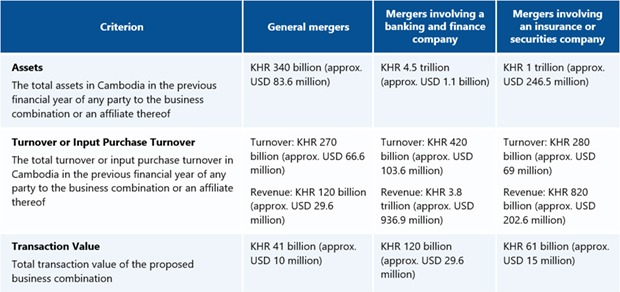
In current practice, the term “turnover” typically refers to a company’s total sales revenue, while “input purchase turnover” denotes the value of materials or equipment acquired for production purposes. Although this reflects the initial interpretation of these terms, it is advisable to seek confirmation or clarification from the CCC before the filing to ensure accuracy and alignment with their current definitions, as it is conceivable that the interpretation may change.

Decision No. 095 leaves room for the Ministry of Commerce to amend these thresholds as deemed necessary.

Outlook

In the last two years, Cambodia has steadily issued regulations to strengthen its legal framework for competition. Although gaps remain, especially with regard to enforcement of fines and certain unclear terms, more regulations are likely in 2025 and 2026.


RELATED INSIGHTS​ 

December 4, 2024
Thailand Legal Basics, a valuable primer for foreign investors, explores all aspects of living and doing business in Thailand. Written by specialists at Tilleke & Gibbins in Bangkok, it is the only comprehensive English-language guide to the Thai legal system with a focus on the concerns of foreign business and investment.
November 27, 2024
In Thailand, a business rehabilitation plan in court-supervised rehabilitation proceedings is a crucial element of the business rehabilitation process that outlines how a debtor’s assets will be managed. It also provides guidance for resolving a debtor’s business challenges so that the business can survive and continue to generate returns, increasing the likelihood that its creditors will be repaid. Key Plan Components The Bankruptcy Act B.E. 2483 sets forth the following components to be covered in a rehabilitation plan: The reasons for rehabilitation; Details about the debtor’s assets, liabilities, and other binding obligations at the time the court-ordered rehabilitation; Principles and methods of the rehabilitation; Redemption of collateral when there are secured creditors and guarantor liabilities; Ways to resolve problems arising from a temporary lack of liquidity during plan implementation; Action to be taken when a claim or debt is assigned; Name, qualifications, and letter of consent of the plan administrator, as well as information on compensation; Appointment and release of the plan administrator; Period in which the plan will be implemented (maximum of five years); and Refusal of the debtor’s assets or refusal of contractual rights if the debtor’s assets or contractual rights have obligations that exceed the benefits they yield. Considering the diverse nature and challenges of each debtor’s business, the details listed here are only general guidelines for what should be included in a rehabilitation plan. The planner has the flexibility to create a plan with different details or guidelines than those outlined above to best suit the nature and challenges of the debtor’s business. The planner can also omit some of the mentioned requirements if they are not relevant to the debtor’s business. Concerns of Relevance Court approval of the rehabilitation plan. Once the plan is approved by a meeting of the creditors, it is necessary
November 11, 2024
The Vietnamese government has demonstrated a strong commitment to building a digital government, digital economy, and digital society through its recently issued national strategy on digital infrastructure. Under Decision No. 1132/QD-TTg dated October 19, 2024, on “Digital Infrastructure Strategy to 2025 with Orientation to 2030,” the government will create supportive conditions for both domestic and international businesses to invest in digital infrastructure with cybersecurity as a priority. Recognized as vital to the economy, this digital infrastructure will consist of four main components: (i) telecommunications and internet infrastructure, (ii) data infrastructure, (iii) physical-digital infrastructure, and (iv) digital utility infrastructure, including digital technology as a service. Key goals for 2025 include universal fiber optic access for households, 100% 5G coverage across all provinces and cities, deployment of at least two new international undersea fiber optic cables, establishment of AI data centers, development of green-standard data centers, and platforms for IoT, AI, big data, blockchain, and cybersecurity. By 2030, goals include fiber access with speeds of at least 1 Gbps, 5G coverage for 99% of the population, readiness for 6G trials, six additional international undersea fiber optic cables, development of a hyperscale data center, and positioning Vietnam as a digital hub. To achieve these goals, the government has outlined some core tasks, creating significant opportunities for both foreign and domestic investors: Developing telecommunications and internet infrastructure for widespread fiber optic and 5G access, while preparing for emerging technologies like 6G, Open RAN, satellite, and IpV6. Telecommunication enterprises will jointly invest in and share the use of international fiber optic cable routes to ensure efficient capacity utilization and optimize investment capital. Attracting foreign and domestic investment to establish hyperscale data centers and cloud computing services that meet global standards. Creating physical-digital infrastructure by integrating technology across key sectors such as transportation, energy, healthcare,
September 18, 2024
Following the endorsement of the report on the study of opening entertainment complexes by Thailand’s House of Representatives and Cabinet in early 2024, the draft Entertainment Complex Bill, B.E. … (the “Entertainment Complex Bill”) finally became open for public hearing and is now under the consideration of the Ministry of Finance. The Entertainment Complex Bill aims to liberalize and facilitate the establishment of entertainment complexes that include casinos, allowing participation from domestic and foreign investors alike. Key Takeaways Under the Entertainment Complex Bill, an “entertainment complex” is a venue that operates at least four types of entertainment businesses alongside a casino. These may include five-star hotels, restaurants and bars, game centers, and department stores, among others. Based on the information publicly available as of the date of this publication, the Entertainment Complex Bill and its prospective subordinate legislation should encompass the following key requirements. Licensing requirements: Business operators seeking to operate an entertainment complex business must first obtain a license. To qualify, applicants must: (1) be a company incorporated in Thailand and (2) have a minimum paid-up capital of THB 10 billion. This license will operate as a “super license” covering not only casino activities but also other operations within the complex, such as hotels, restaurants, bars, and game centers, which, under normal circumstances, may require separate licenses or permits. The license will be valid for 30 years and may be renewed for an additional 10-year term upon expiration. The license fees may depend on the location of the entertainment complex. Minimum investment requirements: Based on the preparatory works by the drafting committee, entertainment complex business licenses may be classified into four different categories based on the size of the investment: small, medium, large, and extra-large. At this stage, licenses for the extra-large category, requiring an investment of THB