You are using an outdated browser and your browsing experience will not be optimal. Please update to the latest version of Microsoft Edge, Google Chrome or Mozilla Firefox. Install Microsoft Edge

March 29, 2023

Cambodia Issues Decision on Thresholds for Merger Filings

On March 14, 2023, the Competition Commission of Cambodia (CCC) set out its merger filing thresholds in Decision No. 095 on Thresholds for Prior Notification of Business Mergers. This was a follow-up to the recent issuance of a regulation outlining the requirements and procedures for merger and acquisition filings. Decision No. 095 applies to all business combinations subject to premerger notification requirements under this prior regulation.

The thresholds for when the CCC must be notified of a merger are laid out in the table below.
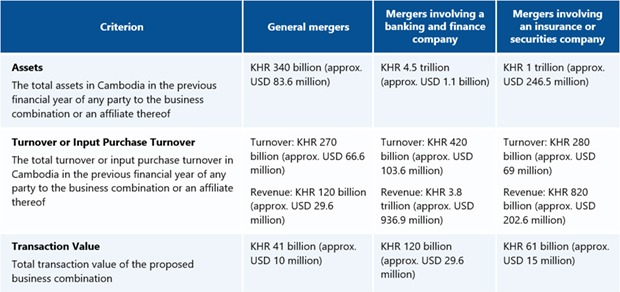
In current practice, the term “turnover” typically refers to a company’s total sales revenue, while “input purchase turnover” denotes the value of materials or equipment acquired for production purposes. Although this reflects the initial interpretation of these terms, it is advisable to seek confirmation or clarification from the CCC before the filing to ensure accuracy and alignment with their current definitions, as it is conceivable that the interpretation may change.

Decision No. 095 leaves room for the Ministry of Commerce to amend these thresholds as deemed necessary.

Outlook

In the last two years, Cambodia has steadily issued regulations to strengthen its legal framework for competition. Although gaps remain, especially with regard to enforcement of fines and certain unclear terms, more regulations are likely in 2025 and 2026.


RELATED INSIGHTS​ 

January 8, 2025
Thailand’s Board of Investment (BOI) has issued regulations revising its criteria for certain foreign companies that receive promotional privileges to own land under limited circumstances. The revised allowance is detailed in the Notification of the Board of Investment No. 16/2567 Re: Criteria for Permitting Foreign Juristic Persons Receiving Investment Promotion to Hold Land Ownership for Office and Residence, which was published in the Government Gazette on December 9, 2024, after having been officially issued on November 1, 2024. The notification was made in conjunction with the subordinate Notification of the Office of the Board of Investment No. Por. 8/2567 Re: Criteria and Conditions for Permitting Foreign Juristic Persons Receiving Investment Promotion to Own Land for Office and Residence for Operational-Level Workers to Operate Business Granted Investment Promotion, dated November 4, 2024. Under the new BOI notification and subordinate notification, foreign juristic persons that receive promotional privileges from the BOI, with paid-up registered capital of at least THB 50 million, are eligible to own land for office use or residential purposes, subject to certain criteria and conditions: Office use. Land used for this purpose must be for an office of the relevant BOI-promoted business, with an area limit of 5 rai (8,000 square meters). Residential use. Land used for this purpose must be for the residences of operational-level workers (i.e., unskilled laborers), with an area limit of 20 rai (32,000 square meters). In addition, there must be common facilities (e.g., parking, first-aid room, kitchen, and other amenities, as approved by the BOI). The land must be located within 10 kilometers of the place of business operation, and the number of rooms must be consistent with the number of workers. For more information on this notification, or on any aspect of property law in Thailand, please contact Chaiwat Keratisuthisathorn at  [email protected],
January 3, 2025
Thailand has adopted the OECD’s global minimum tax framework through the Emergency Decree on Top-Up Tax B.E. 2567 (2024). Published in the Government Gazette on December 26, 2024, this legislation implements a 15% global minimum effective tax rate for large multinational enterprise (MNE) groups. The emergency decree took effect on January 1, 2025. The emergency decree was enacted through expedited procedures to implement “pillar two” of the OECD’s Base Erosion and Profit Shifting (BEPS) 2.0 project’s Global Anti-Base Erosion (GloBE) Rules. This swift implementation ensures Thailand can collect relevant tax revenues and prevents potential revenue losses from MNEs that might otherwise shift profits to jurisdictions with lower tax rates or to countries that have already implemented similar top-up tax legislation. Key aspects of Thailand’s implementation of the global minimum tax through the emergency decree are described below. Top-Up Tax The emergency decree introduces a dual mechanism for collecting additional top-up tax from MNEs whose effective tax rate falls below 15%. The first mechanism is a domestic top-up tax that targets MNEs operating within Thailand when their local effective tax rate is lower than 15%. The second mechanism is the income inclusion rule, which determines when a company’s foreign income should be included in the parent (main) company’s taxable income. This rule applies to Thai-based entities—including ultimate parent entities (UPE), intermediate parent entities, and partially owned parent entities—that hold ownership stakes in low-tax foreign jurisdictions. Scope MNEs subject to Thailand’s implementation of the global minimum tax framework are defined in the emergency decree as those whose UPEs report consolidated revenue of at least EUR 750 million (approximately THB 28 billion) in at least two of the four accounting periods preceding the relevant fiscal year. Reporting and Payment In-scope MNEs must comply with specific reporting obligations to the Thai Revenue Department. The filing deadline is set
December 20, 2024
With intellectual property playing an ever-increasing role in economic development, the need to harness, promote, and protect ASEAN innovation remains urgent as integration progresses. Among its objectives, the ASEAN Economic Community aims to transform the region into a hub of innovation and competitiveness and ensure that the region remains an active participant in the international IP community. With ASEAN member states increasing IP generation and further committing to global IP regimes, the region is increasingly looking toward sophisticated IP ownership and holding structures. IP Holding Companies ASEAN-based companies continue to centralize ownership of their IP assets in offshore holding and licensing vehicles—an approach multinational companies headquartered elsewhere have been using for a number of years. IP-intensive companies look to locate their IP portfolios in low-tax jurisdictions with strong IP registration and protection laws. The company then licenses the IP to operating companies in the group or to third-party licensees, franchisees, agents, distributors, and other partners in return for royalties or license fees. These special-purpose vehicles are typically referred to as IP holding companies. IP holding companies are popular because they can help corporations minimize tax, gain tax benefits or concessions, protect IP from bankruptcy or other claims against the parent company, and focus management attention on the IP portfolio as an income generator. Tax and IP Holding Companies Tax is the primary reason most companies park their IP in separate IP holding vehicles. Sometimes, companies choose to establish their IP holding company in a no-tax, low-tax, or preferred-tax jurisdiction close to their home country. The selected jurisdiction should also be a country with a large and well-established tax treaty network. Double taxation treaties are key considerations in jurisdiction shopping. If the IP assets need to be pledged as security for future borrowings or if they are to be included
December 4, 2024
Tilleke & Gibbins has contributed the Cambodia, Laos, Myanmar, Thailand, and Vietnam chapters to Restructuring in Southeast Asia, a comparative guide produced by Drew Network Asia (DNA). The publication outlines the principal debt restructuring processes available to corporate debtors across nine Southeast Asian jurisdictions and provides an accessible overview for lenders, creditors, and companies navigating financial distress in the region. Structured in a question-and-answer format, each jurisdictional chapter addresses the same core topics, allowing readers to compare approaches across markets. The guide covers key issues such as available restructuring mechanisms, court-supervised and out-of-court options, the roles and powers of creditors, and the implications of restructuring on ongoing business operations. As with other DNA resources, the guide aims to provide practical orientation rather than exhaustive analysis. Legislative developments and jurisdiction-specific considerations may affect the applicability of certain procedures, and readers requiring tailored advice are encouraged to contact the practitioners listed at the end of each chapter. The full guide is available for download using the button below or directly from the DNA website.