You are using an outdated browser and your browsing experience will not be optimal. Please update to the latest version of Microsoft Edge, Google Chrome or Mozilla Firefox. Install Microsoft Edge

March 29, 2023

Cambodia Issues Decision on Thresholds for Merger Filings

On March 14, 2023, the Competition Commission of Cambodia (CCC) set out its merger filing thresholds in Decision No. 095 on Thresholds for Prior Notification of Business Mergers. This was a follow-up to the recent issuance of a regulation outlining the requirements and procedures for merger and acquisition filings. Decision No. 095 applies to all business combinations subject to premerger notification requirements under this prior regulation.

The thresholds for when the CCC must be notified of a merger are laid out in the table below.
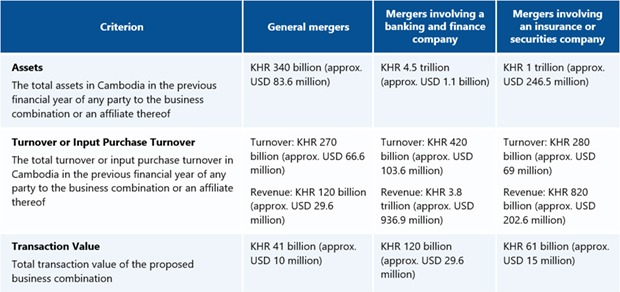
In current practice, the term “turnover” typically refers to a company’s total sales revenue, while “input purchase turnover” denotes the value of materials or equipment acquired for production purposes. Although this reflects the initial interpretation of these terms, it is advisable to seek confirmation or clarification from the CCC before the filing to ensure accuracy and alignment with their current definitions, as it is conceivable that the interpretation may change.

Decision No. 095 leaves room for the Ministry of Commerce to amend these thresholds as deemed necessary.

Outlook

In the last two years, Cambodia has steadily issued regulations to strengthen its legal framework for competition. Although gaps remain, especially with regard to enforcement of fines and certain unclear terms, more regulations are likely in 2025 and 2026.


RELATED INSIGHTS​ 

January 16, 2025
On January 13, 2025, Thailand’s cabinet approved in principle the draft Entertainment Complex Act, as proposed by the Ministry of Finance. This landmark legislative proposal, which would allow casinos as part of larger “entertainment complexes,” will now proceed through further parliamentary review and approval. Key provisions of the draft act are described below. Corporate structure: Entertainment complexes must be operated by Thai-registered limited companies or public limited companies with a minimum paid-up capital of THB 10 billion. Directors of the licensed entity must be individuals and have the qualifications and none of the prohibited characteristics specified in the draft act. The draft act does not impose restrictions on foreign-majority ownership structures; however, it is worth monitoring whether any amendments addressing this matter are introduced during the legislative process. Operating conditions: Each entertainment complex must be located in an area designated under a royal decree. It must also include at least four types of entertainment businesses listed in the annex to the draft act (e.g., shopping mall, hotel, sports stadium, amusement park), along with a casino. The allocation of casino space must comply with regulations to be specified at a later date. Licensing conditions: Licenses will be valid for 30 years, renewable in increments of up to 10 years. The license issuance fee is THB 5 billion, the annual fee is THB 1 billion, and the renewal fee is THB 5 billion. The Entertainment Complex Policy Committee, chaired by the prime minister, will review and approve applications. Online gambling restrictions: Licensees are prohibited from offering gambling through internet-connected systems or electronic devices that allow access from outside the casino premises. Labor requirements: Thai and foreign employee ratios must adhere to prescribed regulations. Land privileges: Lease agreements for land use are limited to 50 years. Renewal is permitted for up to
January 15, 2025
Myanmar’s Directorate of Investment and Company Administration (DICA) has issued new documentation requirements for Myanmar-registered companies making changes to their shares or directors. Effective January 8, 2025, the DICA will only approve such changes when accompanied by specific supporting evidence as required under the Myanmar Companies Law 2017 (MCL). Key Changes and Requirements For share transfers, companies must submit the required application form, along with the following documents: Resolution from the company’s board of directors approving the change of shares or share transfer. Copy of the share-transfer agreement signed by both parties, with proof of stamp duty payment. For director changes, companies must submit the required application form, along with the following documents: Copy of new director’s ID or passport. Shareholder resolution approving the change of the director(s). New director’s consent to act (for appointments) or signed resignation (for departures) In addition to announcing the new documentation requirements, the DICA also reminded companies of an April 2023 announcement that requires companies to submit certain other required documentation within two months of establishment to the DICA by email. Next Steps Companies planning share transfers or director changes must ensure they prepare the complete documentation package before submission to the DICA. For more information on this announcement or assistance with corporate secretarial matters, please contact Tilleke & Gibbins at [email protected].
January 10, 2025
Project finance specialists from Tilleke & Gibbins’ Bangkok office have once again contributed the Thailand chapter to the latest edition of The Legal 500’s Project Finance guide. Part of The Legal 500’s Country Comparative Guides series, the publication serves as a valuable resource for investors and businesses seeking detailed insights into project finance in key jurisdictions worldwide. Each Q&A-style chapter offers comprehensive guidance on the legal frameworks impacting various aspects of project finance, including: Ownership structures and corporate governance; Security interests, regimes, and enforcement; Regulatory requirements and consents; Foreign exchange considerations; Environmental, social, and governance (ESG) issues; Public-private partnerships; Foreign judgments; Tax considerations; Common funding structures; and Insurance law principles. In addition to the Thailand chapter, Tilleke & Gibbins has contributed the Vietnam chapter to the guide. The Thailand chapter is available as a PDF through the link below. The full guide can also be accessed for free on The Legal 500 website.
January 10, 2025
Tilleke & Gibbins’ project finance team in Vietnam has contributed the Vietnam chapter to the 2025 edition of The Legal 500’s Project Finance guide. As part of The Legal 500’s Country Comparative Guides series, this publication provides businesses and investors with crucial information about the legal and regulatory aspects of project finance across jurisdictions worldwide. The Q&A-format chapters deliver detailed insights into the legal regimes governing an array of project finance topics, including: Ownership structures and corporate governance; Security interests, regimes, and enforcement; Regulatory requirements and consents; Foreign exchange considerations; Environmental, social, and governance (ESG) issues; Public-private partnerships; Foreign judgments; Tax considerations; Common funding structures; and Insurance law principles. Tilleke & Gibbins also prepared the Thailand chapter for this edition. The Vietnam chapter is available as a PDF via the button below, with the full guide freely accessible on The Legal 500 website.