You are using an outdated browser and your browsing experience will not be optimal. Please update to the latest version of Microsoft Edge, Google Chrome or Mozilla Firefox. Install Microsoft Edge

March 29, 2023

Cambodia Issues Decision on Thresholds for Merger Filings

On March 14, 2023, the Competition Commission of Cambodia (CCC) set out its merger filing thresholds in Decision No. 095 on Thresholds for Prior Notification of Business Mergers. This was a follow-up to the recent issuance of a regulation outlining the requirements and procedures for merger and acquisition filings. Decision No. 095 applies to all business combinations subject to premerger notification requirements under this prior regulation.

The thresholds for when the CCC must be notified of a merger are laid out in the table below.
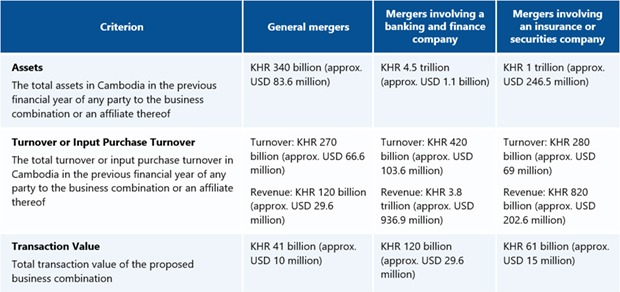
In current practice, the term “turnover” typically refers to a company’s total sales revenue, while “input purchase turnover” denotes the value of materials or equipment acquired for production purposes. Although this reflects the initial interpretation of these terms, it is advisable to seek confirmation or clarification from the CCC before the filing to ensure accuracy and alignment with their current definitions, as it is conceivable that the interpretation may change.

Decision No. 095 leaves room for the Ministry of Commerce to amend these thresholds as deemed necessary.

Outlook

In the last two years, Cambodia has steadily issued regulations to strengthen its legal framework for competition. Although gaps remain, especially with regard to enforcement of fines and certain unclear terms, more regulations are likely in 2025 and 2026.


RELATED INSIGHTS​ 

July 2, 2025
On June 17, 2025, Cambodia’s Ministry of Economy and Finance issued Instruction No. 18574 on Tax Obligations for Share Premiums to clarify that enterprises are not required to pay any income tax on share premiums that meet the conditions set out in the instruction. As outlined in the relevant provisions of the Law on Taxation (Royal Kram No. NS/RKM/0523/004) and Prakas No. 578 MEF.PrK.GDT on Tax on Income, taxable income is the difference between an asset’s value at the beginning and end of a period. This calculation deducts capital contributions, which are not taxable. A share premium is the amount of money that a company receives in excess of the par value of a share when the company issues new shares to a shareholder through a share subscription. In other words, share premiums are capital contributions made by shareholders into the equity of the company and, as a result, are not taxable. However, the government may nevertheless view share premiums as taxable if the company fails to meet certain legal conditions. Cambodian law requires share subscriptions to be properly recorded in the company’s accounting books and supported by documentary evidence. The recent instruction states that if an enterprise does not have proper documentation, any increase in equity, such as a capital increase through share premiums, will be treated as taxable income in accordance with the law. The instruction provides the following example: Enterprise A issues 200,000 new shares to an investor. The shares were registered with a par value of KHR 4,000 per share and were sold for a sale price of KHR 10,000 per share. The share premium of KHR 1.2 billion, which is calculated by subtracting the total par value (KHR 800 million) from the total value of the new capital (KHR 2 billion), is a capital
July 2, 2025
As of July 1, 2025, all companies in Vietnam have new addresses. The country’s administrative map has been redrawn and relabeled as part of an ambitious government restructuring, and every address in the country has been modified to at least a small degree due to provinces merging, the district level of local government being eliminated, and the surviving administrative divisions being reconfigured and renamed. Companies operating in Vietnam should note the guidance below regarding their obligations. Business Registration Guidance issued by Vietnam’s Ministry of Finance under Official Letter No. 4370/BTC-DNTN dated April 5, 2025, regarding business registration in the event of changes to administrative boundaries, provides the following principles: Enterprises may continue to use their existing Enterprise Registration Certificates even when administrative boundaries have changed. There is no requirement to register a change of address solely due to these changes. Enterprises may choose to update their registered addresses either when submitting applications for other business registration changes or at their own discretion. Tax-Related Matters The Tax Department of the Ministry of Finance and Regional Tax Sub-Departments have further issued the following guidance on tax-related matters: The tax authorities will issue notifications regarding the update of taxpayers’ addresses according to the new administrative boundaries. These notifications will also include information on the directly managing tax authority. The notifications will be communicated via the taxpayer’s electronic tax transaction account, or the taxpayer’s email address through the legal representative’s eTax Mobile application. These notifications will serve as a basis for taxpayers to explain to relevant authorities or clarify to customers in cases where the address shown on the invoice is the address updated by the tax authority according to the new administrative boundaries, but the information on the Enterprise Registration Certificate still shows the address according to the old administrative boundaries. Summary
June 30, 2025
On April 29, 2025, the State Bank of Vietnam (SBV) issued Circular No. 03/2025/TT-NHNN (Circular 03), which provides detailed guidance on the opening and use of Vietnamese dong (VND) accounts by non-resident foreign investors engaging in indirect investment activities in Vietnam. Circular 03, which took effect on June 16, 2025, amends Circular No. 06/2019/TT-NHNN of the SBV on the management of foreign exchange for foreign direct investment activities in Vietnam (Circular 06) and replaces Circular No. 05/2014/TT-NHNN of the SBV guiding the opening and use of indirect investment capital accounts for implementation of foreign indirect investment activities in Vietnam (Circular 05). Below are some of the key points of Circular 03. Change of Account Name Circular 03 renames “indirect investment capital account” to “indirect investment account” (IIA). This change aligns with the terminology used in other legislation, ensuring consistency across Vietnam’s legal framework governing foreign exchange and investment activities. Additionally, by removing the word “capital,” the new term better encompasses the full range of transactions that may be conducted through these accounts, such as share transfer and other forms of indirect investment-related activities. This helps prevent misinterpretation and facilitates compliance for foreign investors operating in Vietnam. Account Types Circular 03 clearly delineates account types and investor residency status as follows: For non-resident foreign investors: The opening and use of investment accounts in VND is for carrying out transactions related to indirect investment activities. For resident foreign investors: Credit and debit transactions are made through payment accounts in VND in accordance with relevant laws. Additional Permitted Uses of IIAs In addition to the cash inflows and outflows authorized under Circular 05, Circular 03 introduces more cash transactions that can be conducted via IIAs. These include: Receiving interest and other legal income when conducting stock purchase transactions that do not require
June 25, 2025
In Thailand, in-court business rehabilitation is a legal proceeding that enhances a debtor’s chance to restructure business operations for corporate debtors who are unable to repay their debts. The purpose of this proceeding is to allow the debtor to continue operating the business and generate income to repay creditors. The amounts that creditors receive in the rehabilitation proceeding are greater than the amounts creditors would receive if the debtor went bankrupt. The law is not designed to allow debtors or creditors to use the business rehabilitation process in bad faith for their benefit or to defraud another party. Accordingly, the Business Rehabilitation Law, which is included in the Thai Bankruptcy Act B.E. 2483 (1940), provides criminal liability for actions taken before or during the process. This article addresses the key points regarding criminal liability for safeguarding debtors and creditors in business rehabilitation proceedings from any parties who act in bad faith. Criminal Liability in Business Rehabilitation The following provisions establish the framework for criminal liability in business rehabilitation cases, ensuring that all parties act with integrity throughout the process. The Bankruptcy Act of Thailand B.E. 2483 (1940) provides the relevant provisions regarding the business rehabilitation process. Additionally, if a company debtor or its authorized directors are found to have committed fraud or malfeasance under the Bankruptcy Act, they can also be held criminally liable under the Penal Code or related criminal statutes. The rehabilitation process aims to help a business recover financially under the supervision of the court. When the court approves the rehabilitation plan, the court appoints a business rehabilitation plan administrator to manage and implement the process. However, if it is discovered that the debtor, its executives, or even the plan administrator engaged in illegal activities prior to or during the rehabilitation process—such as tax evasion, embezzlement,