You are using an outdated browser and your browsing experience will not be optimal. Please update to the latest version of Microsoft Edge, Google Chrome or Mozilla Firefox. Install Microsoft Edge

March 29, 2023

Cambodia Issues Decision on Thresholds for Merger Filings

On March 14, 2023, the Competition Commission of Cambodia (CCC) set out its merger filing thresholds in Decision No. 095 on Thresholds for Prior Notification of Business Mergers. This was a follow-up to the recent issuance of a regulation outlining the requirements and procedures for merger and acquisition filings. Decision No. 095 applies to all business combinations subject to premerger notification requirements under this prior regulation.

The thresholds for when the CCC must be notified of a merger are laid out in the table below.
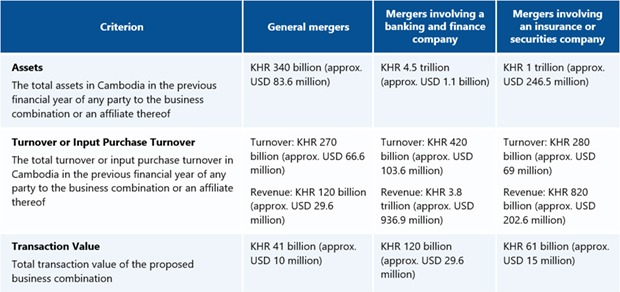
In current practice, the term “turnover” typically refers to a company’s total sales revenue, while “input purchase turnover” denotes the value of materials or equipment acquired for production purposes. Although this reflects the initial interpretation of these terms, it is advisable to seek confirmation or clarification from the CCC before the filing to ensure accuracy and alignment with their current definitions, as it is conceivable that the interpretation may change.

Decision No. 095 leaves room for the Ministry of Commerce to amend these thresholds as deemed necessary.

Outlook

In the last two years, Cambodia has steadily issued regulations to strengthen its legal framework for competition. Although gaps remain, especially with regard to enforcement of fines and certain unclear terms, more regulations are likely in 2025 and 2026.


RELATED INSIGHTS​ 

September 2, 2025
Thailand’s Office of the Consumer Protection Board (OCPB) has initiated a sweeping regulatory review of licensed direct sale and direct marketing businesses in Thailand and is in the process of notifying business operators to submit their annual business report and financial statement to the OCPB as part of their postlicensing obligations. This move marks a significant escalation in the government’s efforts to enforce compliance and transparency in the sector, which has faced growing scrutiny in recent years. Key Regulatory Considerations All businesses holding a direct sales or direct marketing license are required to submit their audited financial statement along with their business operation report to the OCPB within 60 days from the end of their fiscal year (extendable for up to 30 days by request, if necessary). The OCPB is currently conducting license audits as part of its enforcement duties. The office aims to complete audits for at least 90% of the 2,983 registered businesses that have obtained their license since 2022. This includes a review of the business conduct of the license holder. New license applications are also under scrutiny. Applicants are currently being subjected to background checks, and the OCPB has signaled a more rigorous vetting process moving forward. Impact of Noncompliance Failure to comply with these reporting obligations may result in escalating enforcement actions, including: Official notice to rectify noncompliance within a specified timeframe. Revocation of business registration, if the operator fails to respond. Revocation of business registration could result in a five-year prohibition on reapplying for a direct sales or direct marketing license following the revocation. The OCPB has already initiated outreach efforts, including SMS and email notifications, and has hosted seminars to raise awareness of these obligations. These measures are part of a broader initiative to enhance transparency and consumer trust in the sector. Businesses operating in the direct selling and
August 29, 2025
On August 15, 2025, Laos’ Immigration Police Department introduced a pilot online arrival registration system for foreign passport holders entering the country. Under the new system, visitors to Laos will be able to register their arrival online up to three days in advance and will be exempt from filling out paper forms at the border. Starting September 1, 2025, online registrations will be accepted at four major international border checkpoints: Wattay International Airport in Vientiane, Luang Prabang International Airport, Pakse International Airport in Champasak Province, and the First Lao-Thai Friendship Bridge linking Vientiane and Nong Khai Province in Thailand. Foreign passport holders arriving in Laos from this date onward will be able to complete the online registration via the official website of the Department of Immigration: http://www.immigration.gov.la/. Upon successful registration, travelers will receive a QR code valid for three days, which must be presented to border authorities upon arrival to verify the registration. During the pilot phase, which is expected to run until early 2026, travelers who have not registered online will still have the option to complete a paper form at the checkpoint. After the pilot phase, the online registration system will become mandatory nationwide, and paper forms will no longer be accepted. This initiative marks a significant step toward modernizing Laos’ immigration procedures. Transitioning from traditional paper-based entry forms to a streamlined digital system will greatly enhance efficiency at border checkpoints. The submission of traveler information ahead of arrival is expected to drastically reduce processing times and alleviate congestion at arrival counters, especially during peak travel periods.
August 27, 2025
Myanmar’s Directorate of Investment and Company Administration (DICA) has issued an announcement reinforcing compliance obligations under the Myanmar Companies Law (MCL). This follows recent updates to reporting requirements and signals increased regulatory scrutiny regarding registered office addresses and directors’ residential information submitted online via MyCO, Myanmar’s company registration system. Key Compliance Areas Under the MCL, every company must maintain a registered office for official communication and legal correspondence. Any change to this address must be reported to the DICA registrar. In April 2023, DICA introduced additional reporting obligations for newly incorporated companies. The additional rules require companies to submit their Annual Return accompanied by verification documents within two months of incorporation. These documents include a recommendation letter from the relevant township police station or ward administrator confirming the operational status and physical location of the registered office. Directors’ residential addresses must also be verified through similar documentation, and foreign directors are required to submit the arrival notification form issued by the Immigration Department. For companies operating through a virtual office, clarification from a DICA official indicates that the virtual office address must correspond with the registered address submitted via MyCO. A recommendation letter confirming the validity and operational status of the virtual office must be submitted. Legal Consequences The recent announcement signals that DICA will begin enforcing these requirements in earnest. Failure to comply with the additional reporting obligations may result in inspections and enforcement actions by the DICA registrar, or complaints from third parties. It may also lead to penalties or other legal consequences as prescribed under the MCL. Recommended Actions It is strongly advised that all newly incorporated companies and their directors: Review their MyCO submissions for accuracy. Secure the required supporting documents within the Annual Return deadline. Ensure that all address information reflects the company’s actual
August 21, 2025
On August 19, 2025, the Trade Competition Commission of Thailand (TCCT) released its draft Guidelines on the Consideration of Unfair Trade Practices and Conduct Constituting Monopoly, Reducing Competition, or Restricting Competition in Multi-Sided Platform Businesses in the Category of Digital Platforms for the Sale of Goods or Services (E-commerce). A public comment period on the guidelines is open until September 18. The draft provides the first detailed framework for how the TCCT will interpret and enforce the substantive provisions under the Trade Competition Act against digital platforms, which have a unique network effect and require complex competition analysis. This development will profoundly impact the operations of e-commerce platforms, sellers, and associated service providers in Thailand. The guidelines primarily target e-commerce digital platform business operators, which are defined as follows: E-commerce digital platform: A medium facilitating the sale, purchase, or exchange of goods or services, including any operations to create transactions or interactions between business operators via an electronic transaction system, regardless of whether service fees are charged. E-commerce digital platform business operator: A service provider of a digital platform for the sale of goods or services who acts as an intermediary facilitating the sale of goods or services, including any operations to create transactions or interactions through an electronic transaction system by receiving orders for goods or services transacted via an electronic system, whether in the form of an e-marketplace, a social marketplace, or any other form that connects purchase orders for goods or services with business operators through an electronic system. Prohibited Conduct The guidelines classify potentially anticompetitive conduct and unfair trade practices into two categories: price-related and non-price-related conduct. 1. Price-related conduct The TCCT is targeting pricing strategies that can harm competition. Key prohibited behaviors include: Price below cost: Setting prices below the average total cost without