On July 24, 2026, a new 12.5% Section 301 tariff took effect on most imports from Thailand into the United States. The tariff was imposed by the Office of the US Trade Representative (USTR) under Section 301 of the Trade Act of 1974, following a finding that Thailand had failed to impose and effectively enforce a prohibition on imports of goods produced with forced labor. The new tariff replaced the temporary 10% Section 122 surcharge that had applied since February 24, 2026, following the US Supreme Court’s invalidation of the prior tariffs imposed under the International Emergency Economic Powers Act (IEEPA).
The 12.5% tariff is not the only potential source of additional US duties on Thai-origin goods. Thailand is also subject to a separate Section 301 investigation concerning structural excess manufacturing capacity, which could result in additional duties. Unlike the Section 122 surcharge, which was capped at 15% and limited to 150 days, Section 301 provides a more flexible framework for imposing and maintaining trade measures. Section 301 actions are generally subject to a four-year termination rule but may continue following a review if continuation is requested. The new tariff therefore represents a potentially longer-term change in the tariff treatment of Thai-origin goods entering the US market.
This article explains the legal and policy developments that led to the new tariff, how the Section 301 tariff differs from the tariff regimes that preceded it, Thailand’s response and ongoing negotiations with the United States, and the practical implications for businesses that manufacture, export, import, or distribute goods between Thailand and the United States.
From IEEPA to Section 122 to Section 301
IEEPA Era (April 2025–February 2026)
Beginning in April 2025, the US administration imposed sweeping tariffs under the International Emergency Economic Powers Act (IEEPA), invoking national emergencies relating to trade deficits and other concerns. Thailand was subject to a tariff rate of 36% under this regime.
The use of IEEPA to impose tariffs was unprecedented and was quickly challenged in US courts. On February 20, 2026, the US Supreme Court held that IEEPA does not authorize the president to impose tariffs. The decision invalidated the legal basis for the IEEPA tariffs and required the administration to pursue alternative statutory authorities for imposing import duties.
Section 122 Bridge (February 24–July 23, 2026)
Within days of the Supreme Court’s decision, the administration turned to Section 122 of the Trade Act of 1974, which authorizes the president to impose temporary import surcharges to address balance-of-payments problems. A 10% global surcharge took effect on February 24, 2026.
Section 122, however, contains important limitations. The statute generally caps a surcharge at 15% and limits its duration to 150 days unless Congress authorizes an extension. Because the surcharge was scheduled to expire at 12:01 a.m. on July 24, 2026, the administration turned to other available legal authorities to continue the tariff measures.
Section 301 Investigations (March–July 2026)
On March 12, 2026, USTR initiated a Section 301 investigation into Thailand, along with 59 other major US trading partners, concerning a lack of effective prohibitions on the importation of goods produced with forced labor.
In its June 2, 2026, findings, USTR determined that Thailand had failed to impose and effectively enforce such a prohibition and that Thailand’s practices were unreasonable and burdened or restricted US commerce. USTR considered Thailand’s efforts to strengthen labor practices domestically and in international supply chains, including Thailand’s proposed Human Rights and Environmental Bill and the draft law’s due diligence framework. USTR nevertheless concluded that Thailand’s existing measures did not establish a legal prohibition on the importation of goods produced with forced labor.
USTR subsequently proposed an additional 12.5% tariff for economies that had not adopted and effectively enforced a forced-labor import prohibition. Following further public comments and hearings, USTR announced on July 23, 2026, that Thailand would be subject to the 12.5% Section 301 tariff, effective July 24.
How the New Tariff Differs from IEEPA and Section 122
The following table summarizes the key differences among the three tariff regimes as applied to Thailand:
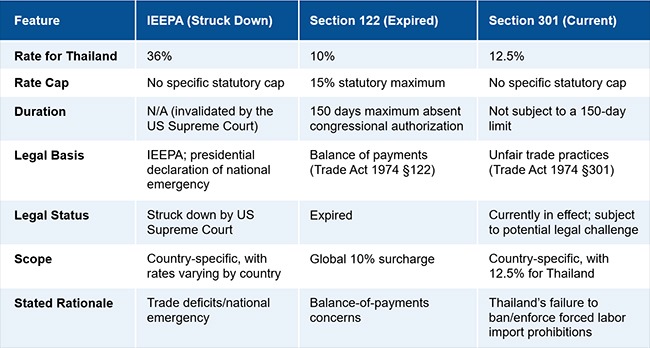
The new Section 301 tariff rests on a different statutory authority from the IEEPA tariffs invalidated by the US Supreme Court and the temporary Section 122 surcharge that preceded it. Section 301 has also withstood constitutional challenges to its use in imposing tariffs, providing a more established legal framework for the current tariff authority.
Most importantly for businesses, Section 301 is not subject to the 15% rate ceiling or 150-day duration limit applicable to Section 122. The 12.5% tariff is therefore potentially a longer-term measure, subject to Section 301’s statutory review and termination provisions. Businesses importing Thai goods into the United States should accordingly plan on the basis that the tariff may remain in effect rather than treating it as another temporary surcharge.
Thailand’s Response and Negotiations
Thailand engaged with US authorities throughout the Section 301 process and sought to reduce the tariff from 12.5% to 10% and obtain additional product exemptions, including for Thai jasmine rice. In its negotiations, Thailand emphasized the significant role of US companies in Thailand’s manufacturing and export sector, arguing that tariffs on Thai-origin goods would also increase costs for US businesses operating in Thailand and using Thai manufacturing facilities as part of their supply chains. Thailand also disputed concerns about circumvention and transshipment, emphasizing the substantial Thai content of its exports, which it reported generally ranges from 70% to 90%, with no product containing less than 60% Thai content.
Thailand ultimately did not secure a reduction from the 12.5% rate. It also declined certain US demands that it considered inconsistent with broader domestic policy interests. At the same time, Thailand is pursuing measures that could support future efforts to improve tariff treatment, including a proposed human rights due diligence framework, stronger procedures for verifying that exported goods are produced without forced labor, and an agreement on reciprocal trade (ART) with the United States.
Progress of the ART Negotiations
Thailand is accelerating its negotiations with the United States on an ART. Thailand is seeking tariff conditions comparable to those granted to Malaysia and Indonesia, which face a 10% rate under the forced-labor-related measure. Under USTR’s framework for those countries, however, that lower rate is not granted automatically upon signing an agreement but is linked to specified import-ban measures or commitments, including commitments made through an ART.
Thailand has also been contesting US concerns about transshipment by providing additional information concerning production capacity and country-of-origin issues.
Even if a negotiating text is completed, the ART would not take effect immediately in Thailand. The agreement would first require cabinet approval, followed by public hearings and submission to Parliament.
Business Impact
The 12.5% Section 301 tariff generally applies in addition to applicable most-favored-nation (MFN) duties, increasing the cost of importing covered Thai-origin goods into the United States. Although the rate is lower than the 36% IEEPA tariff previously imposed on Thailand, the Section 301 measure is potentially longer-term and should be factored into pricing and sourcing decisions.
Not all Thai-origin goods are subject to the additional 12.5% tariff. USTR’s July 23 action excludes certain products and transactions, including specified products already subject to Section 232 tariffs and other categories identified in the implementing measures. The exclusions are product-specific, and businesses should review the applicable tariff provisions rather than assume that an entire industry or broad product category is exempt.
The treatment of textiles is also subject to a separate mechanism under which certain tariff benefits may be available based on the use of US-origin textile inputs. The mechanism is expected to take effect no earlier than September 1, 2026.
Businesses Most Likely to Be Affected
The tariff is particularly relevant to:
- Thai manufacturers and exporters whose products are not covered by an exclusion;
- US companies manufacturing in Thailand and importing their Thai-origin production into the United States;
- Automotive, rubber, and machinery businesses, which face additional potential exposure from the separate structural excess capacity investigation; and
- Companies with China-linked supply chains, which should ensure that their country-of-origin determinations and supporting documentation are robust.
Businesses in Thailand’s automotive, rubber, and machinery sectors should also monitor the separate Section 301 investigation into structural excess manufacturing capacity that USTR initiated in March 2026. USTR’s notice lists 16 economies, including Thailand, Malaysia, Indonesia, and Vietnam. This investigation is distinct from the forced-labor investigation that resulted in the current 12.5% tariff, and it could lead to additional duties before the ART negotiations are completed. Because Section 301 does not set a fixed upper limit on tariff rates, any resulting duties could significantly add to the burden that affected Thai goods already face under the current 12.5% rate.
Recommendations for Importers of Thai Goods
Businesses importing Thai-origin goods into the United States should consider taking the following steps:
- Assess tariff exposure: Review products imported from Thailand, their Harmonized Tariff Schedule classifications, applicable MFN duties, and whether any product-specific exclusion applies.
- Review origin documentation: Confirm that country-of-origin determinations are properly supported, particularly where products incorporate materials or components from China or other third countries.
- Review supply-chain compliance: Strengthen traceability and documentation relating to the production of goods in Thailand, particularly where forced-labor risks may arise.
- Review commercial agreements: Examine Delivered Duty Paid (DDP) arrangements, duty-allocation provisions, tariff-adjustment clauses, and other contractual provisions that determine which party bears additional import costs.
- Evaluate customs planning opportunities: Where appropriate, businesses should review classification, valuation, and origin positions and consider whether mechanisms such as first-sale valuation or a binding US Customs and Border Protection ruling could reduce costs or provide greater certainty.
Businesses should also continue to monitor:
- The structural excess capacity investigation, particularly its potential impact on Thailand’s automotive, rubber, and machinery sectors;
- Thailand’s forced-labor and human rights reforms, including the proposed human rights due diligence framework;
- US-Thailand trade negotiations, including any Agreement on Reciprocal Trade and potential changes to tariff rates or product exclusions; and
- US customs guidance and enforcement, including developments affecting classification, valuation, and country-of-origin determinations.
Considerations for Thai Exporters
For Thai businesses selling into the US market, the 12.5% Section 301 tariff should be treated as a new baseline for planning purposes, rather than another short-term tariff measure. While the rate is substantially lower than the 36% IEEPA tariff previously imposed on Thailand, the Section 301 framework provides no comparable short-term expiration and could keep the additional cost in place for the foreseeable future. At the same time, active negotiations between Thailand and the United States could result in changes to tariff treatment and the broader trade framework.