You are using an outdated browser and your browsing experience will not be optimal. Please update to the latest version of Microsoft Edge, Google Chrome or Mozilla Firefox. Install Microsoft Edge

January 12, 2022

BOI Expands Promoted Activities for Electric Vehicle Manufacturers

Thailand’s Board of Investment (BOI) recently published BOI Notification No. Sor. 8/2564, which extends the scope of investment promotion covering electronic vehicle (EV) industry manufacturers to include the production of “automotive platforms” for electric vehicles, and creates a new category of BOI promoted activities covering the manufacture of electric bicycles (E-bikes).

Automotive Platforms

The following investment promotion categories have been extended:

  • 4.24 – Manufacture of Battery Electric Vehicles
  • 4.26 – Manufacture of Electric Battery Tricycles
  • 4.27 – Manufacture of Electric Battery Busses and Trucks

These categories now include the manufacture of “automotive platforms”—which must include an energy storage system, charging module, and front and rear axle module—benefiting from similar tax incentives and subject to additional conditions, as detailed below.
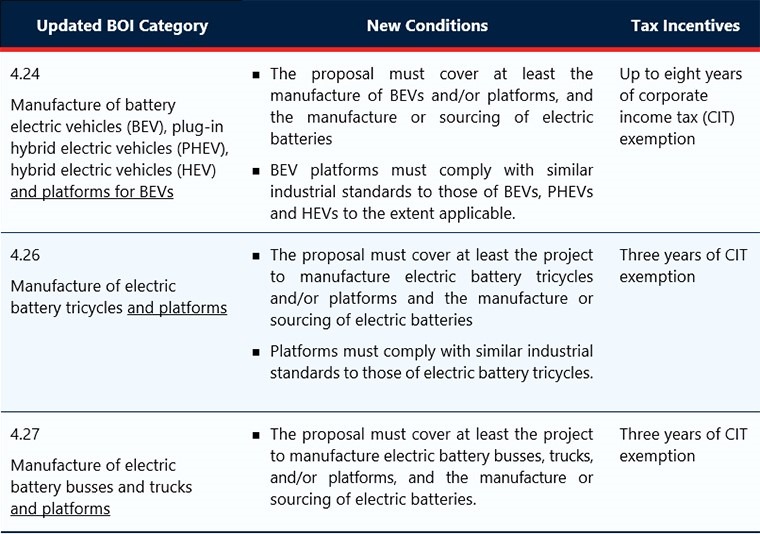
New BOI Promotional Category for E-Bike Production

The BOI has also introduced a new category, No. 4.28, covering the manufacture of E-bikes. Projects under this category will be eligible for a three-year CIT exemption with an additional one-year exemption if certain criteria are met.

Applications for this category must cover the manufacture of E-bikes, the manufacture or sourcing of electric batteries, and a management plan for used batteries.

In addition to the general conditions for EV projects (industrial standards, manufacturing timelines, etc.), the BOI has also imposed the following conditions specific to E-bike projects:

  • E-bike frames must be produced from light-weight materials such as aluminum alloy, chromium–molybdenum alloy steel (chrome moly), titanium alloy, and carbon fiber; and
  • E-bike batteries must adopt environmentally-friendly technology.

Interestingly the BOI allows E-bike production lines to jointly use manufacturing lines for ordinary bicycles. However, the sale of ordinary bicycles is regarded as non-BOI-promoted income and will not be entitled to BOI tax incentives.

These new provisions, intended to stimulate both local and foreign investments in the electric automotive industry, seem to complete the BOI promotion scheme for the full range of electric vehicles. They will hopefully accelerate the expansion of Thailand’s electric vehicle production market, and the adoption of environmentally friendly vehicle technology in Thailand.

For more details on any aspect of investment promotion in Thailand, please contact Napassorn Lertussavavivat at [email protected] or +66 2056 5662, or Supasit Saypan at [email protected] or +66 2056 5994.

RELATED INSIGHTS​ 

July 27, 2026
Vietnam’s new E-Commerce Law, which took effect on 1 July 2026 along with its implementing Decree No. 248/2026/ND-CP (Decree 248), marks a significant development in the country’s approach to online intellectual property (IP) enforcement, reflecting a clear shift from a reactive model of intermediary liability to one that expects platforms to play a more active role in preventing infringement. From notice-and-takedown to platform responsibility The most significant change introduced by the E-Commerce Law is the transformation of the legal role of e-commerce platforms. The existing safe harbor provisions under the IP Law and the copyright notice-and-takedown regime established by Decree 17/2023/ND-CP (Decree 17) largely required intermediaries to act only after receiving notice of infringement. Once infringing content had been removed, the platform’s legal obligation was generally considered fulfilled. The new legislation adopts a fundamentally different approach. Article 17 of the E-Commerce Law requires intermediary platforms to screen information relating to goods and services before publication in order to prevent listings involving counterfeit or IP-infringing goods, and goods of unknown origin. Rather than relying exclusively on complaints from rights holders, platforms are now expected to implement preventive measures before infringing listings become publicly available. Decree 248 further requires platforms to update keyword filters based on recommendations issued by competent authorities. These filtering mechanisms are intended to prevent prohibited listings from appearing on the platform and represent a further move away from a purely complaint-driven enforcement model. The legislation also introduces Vietnam’s first statutory stay-down obligation. Under the E-Commerce Law and Decree 248, major digital platforms must maintain automated systems capable of reviewing, warning against, and removing unlawful listings while also implementing measures to prevent repeat violations, defined under Decree 248 as conduct that has previously been identified and handled by the platform, but continues to recur. This obligation addresses one
July 27, 2026
A new decree on penalties for violations related to the crypto asset market creates compliance risks for offshore crypto asset exchanges in Vietnam that do not hold, and practically cannot obtain, a Vietnamese license, and for Vietnamese users who continue to transact on those platforms. Decree No. 284/2026/ND-CP (Decree 284), issued by the government of Vietnam on July 16, 2026, formally establishes an administrative penalty framework for violations related to crypto assets and the crypto asset market. The decree takes effect on September 1, 2026, and will remain in force for the duration of the five-year pilot program under Resolution No. 05/2025/NQ-CP, which is scheduled to end in September 2030. Direct Penalties on Vietnamese Users The most immediate commercial risk to offshore platforms is that their Vietnamese users now face direct personal liability for using their exchanges. Vietnamese users who trade crypto assets outside of a Ministry of Finance-licensed service provider face fines of up to VND 50 million (approximately USD 1,900). Vietnamese users trading in crypto assets that are offered or issued to foreign users face higher penalties of up to VND 100 million (approximately USD 3,800). It is expected that Vietnamese users will be more willing to migrate away from offshore platforms now that there is a risk of real enforcement against them. Penalties on Unlicensed Service Providers Violations of providing crypto asset services or advertising crypto-related services without a license face fines of up to VND 200 million (approximately USD 7,700). Operating a crypto asset trading market without proper authorization falls within the same highest penalty bands. Organizations that violate issuance, provision, or disclosure rules may face fines of up to VND 200 million. Although the maximum administrative fine per violation is capped at VND 200 million for organizations and VND 100 million for individuals, these
July 21, 2026
On July 6, 2026, Myanmar’s Ministry of Finance and Revenue introduced revised procedures governing the importation and exportation of goods and vehicles, replacing the framework that had been in place since 2017. The revised procedures were introduced in Notification No. 115/2026, which establishes updated compliance requirements and penalties for importers and exporters, covering licensing, declarations, product specifications, prior arrival of goods, and imports or exports made without the required licenses or permits. Scope Unlike its predecessor (Notification No. 6/2017), which focused primarily on import-related noncompliance, the new notification regulates both import and export activities and introduces a separate penalty schedule for export violations. Exporters are now required to ensure that their exports comply with the approvals stated in export licenses and permits, match the information declared in export declarations, and are supported by the required licenses, permits, and accompanying documents. Import Compliance and Penalties The new notification imposes several compliance requirements on importers. Importers must ensure that the country of origin, branding, labeling, and other product information are consistent with the relevant import license or permit, import declaration, and the imported goods. For vehicles and machinery, the model year must match the year approved by the Ministry of Commerce. Importers must also ensure that goods are not imported before the issuance or after the expiry of the import license or permit, and that the imported quantity does not exceed the approved amount. Failure to comply with these requirements may result in regulatory action. As for the notification’s revised penalties for noncompliance with import licensing requirements, imports made without the required import license, permit, or import declaration may be subject to fines ranging from one to three times the assessable value (AV) of the goods, depending on the category of goods involved. Certain vehicles and machinery, as well as specific
July 21, 2026
Thailand’s Ministry of Digital Economy and Society (MDES) published a notification establishing an expedited court-ordered takedown mechanism for online content in cases of “urgent necessity.” The notification, which was issued on July 17, 2026, under the Computer Crime Act B.E. 2550 (2007), as amended, took effect the following day. It significantly expands the categories of content subject to rapid government-initiated removal. Content Categories Subject to Takedown The notification defines “urgent necessity” (section 20, paragraph 5, of the Computer Crime Act) as circumstances where any delay in suppressing computer data may impact national security, religion, the monarchy, good morals, social culture, or public order. In this regard, it establishes four broad categories of content: Computer Crime Act offenses. National security offenses. IP and other criminal offenses, where it is contrary to public order or good morals and a competent officer has requested its suppression. Content contrary to public order or good morals, a broad residual category encompassing 14 subcategories approved by the Computer Data Screening Committee. The fourth category is the most expansive. Its 14 subcategories include: Content defaming, mocking, satirizing, or devaluing the monarchy. Online gambling advertising or facilitation. Offering illegal firearms for sale. Offering baraku (hookah) products or e-cigarettes for sale. Offering cannabis inflorescences or processed cannabis products for sale. Advertising or soliciting prostitution. Content inciting violence, hatred, or social division. Unauthorized overseas employment advertising. Offering boiled kratom juice for sale. Online sale or advertising of alcoholic beverages. Content satirizing or degrading Buddhism. Money lending at interest rates exceeding legally prescribed limits. Advertising or disseminating information about surrogacy services. Forgery of documents, cards, or official documents. Enforcement Procedure In cases of urgent necessity, a competent official assigned by the MDES permanent secretary must file a petition with supporting evidence to the court with jurisdiction, requesting an order to