You are using an outdated browser and your browsing experience will not be optimal. Please update to the latest version of Microsoft Edge, Google Chrome or Mozilla Firefox. Install Microsoft Edge

September 6, 2024

ASEAN: Big Changes on Vitamin and Mineral Limits for Health Supplements

Addressing technical barriers to trade is a key priority for the Association of Southeast Asian Nations (ASEAN) as part of trade facilitation in achieving the single market and production base under the ASEAN Economic Community directive agreed in 2015. The region has been undertaking positive steps toward standard harmonization in ASEAN priority sectors, integrating and bringing about regulatory convergence by taking into account the diversities that exist in the ten ASEAN member states.

Health supplements in ASEAN are under the responsibility of the Traditional Medicine and Health Supplement Product Working Group (TMHS PWG). One of the TMHS PWG’s outputs is the ASEAN Agreement on a Regulatory Framework for Health Supplements, which includes various technical requirements for health supplements that participating member states must adopt by adjusting their domestic regulations.

The key ingredients of these health supplements are vitamins and minerals. While all ASEAN countries allow the use of vitamins and minerals in health supplements, the amounts allowed for use vary, depending on the nutritional requirements deemed appropriate by each country.

Partly in response to these efforts for regional harmonization, there have been important changes to vitamin and mineral limits in certain ASEAN countries that are worth monitoring. Some of these are outlined below.

Thailand

In January 2024, the Thai Food and Drug Administration (TFDA) updated the Thai Recommended Daily Intake (Thai RDI) guidelines for the Thai population. Subsequently, the TFDA adjusted the vitamin and mineral limits in order to comply with the updated Thai RDI and to follow the ASEAN Agreement on a Regulatory Framework for Health Supplements.

The TFDA’s adjustment of vitamin and mineral limits for use in food supplements came in Notification of the Ministry of Public Health (No. 448) B.E. 2566 (2023) Re: Food Supplements (No. 5), which was published in the Government Gazette on January 4, 2024. It increased the maximum limits for certain vitamins and minerals (see breakdown below) up to the limits that had previously only been allowed in drugs. The minimum limits of vitamins and minerals for use in food supplements should be more than 15% of Thai RDIs, as set out in the Notification of the Ministry of Public Health (No. 445) B.E. 2566 (2023) Re: Nutrition Labels. This notification took effect on July 2, 2024.

Before that date, if a party wished to use more than 60 mg of Vitamin C or more than 2 mcg of Vitamin B12 in a health supplement, they would have needed to register the product as a medicine (not a health supplement) in Thailand. Now, health supplements are allowed to use 1,000 mg of vitamin C and 600 mcg of vitamin B12—a level that previously would have required registration as a medicine.

Health supplements are classified as a type of food in Thailand—this differs from some other countries, which may include health supplements in the medicine group. The registration process for health supplements is straightforward and takes a short time (about one to two months) to receive approval. On the other hand, drug registration is more complex and time-consuming. Health supplement companies widely agree that the time needed to receive license approval is one of the main obstacles for a business getting their products to market.

This change allows products that in the past had to be registered as medicines to now be accepted as health supplements in Thailand. This regulatory change will help promote the health supplement business in Thailand and ASEAN.

Indonesia

In Indonesia, the maximum limits for vitamins and minerals for use in health supplements were first updated by the Indonesian FDA (known as BPOM) with the issuance of BPOM Regulation No. 11 of 2020 concerning the Criteria and Procedure for Health Supplement Registration, which has since been revoked by BPOM Regulation No. 32 of 2022. There is currently a draft amendment to BPOM Regulation No. 32 of 2022 that has not yet been finalized. However, the draft amendment does not propose any changes to the current maximum limits for vitamins and minerals.

This shows how BPOM has been actively updating the regulatory framework on health supplements due to the large presence of health supplement products in Indonesia. Businesses in this sector therefore need to be sure of the latest requirements before registering their health supplement products in Indonesia.

Vietnam

In contrast to the changes seen in recent years in Indonesia and Thailand, Vietnam has not amended or drafted any amendments to domestic regulations related to the maximum levels of vitamins and minerals in health foods since 2014. The current maximum limits for vitamins and minerals in Vietnam are not matched to those in neighboring countries or to those in the ASEAN Agreement on a Regulatory Framework for Health Supplements. Nevertheless, Vietnam may consider revising the maximum limits at some point to comply with the ASEAN standards.

In Vietnam, health supplements are classified as food rather than medicine. Under Vietnam’s current regulations, the vitamin and mineral content in health supplements (calculated according to the manufacturer’s recommended daily dose) must not exceed the maximum intake threshold for vitamins and minerals prescribed in Circular 43/2014/TT-BYT.

If the maximum intake threshold is not specified, the related Codex regulations or those of relevant international organizations apply.

Breakdown

The following table summarizes the current maximum daily limits for vitamins and minerals in health supplements for adults in Thailand, Indonesia, and Vietnam. It also shows how the limits have changed compared to the previous regulations in each country.
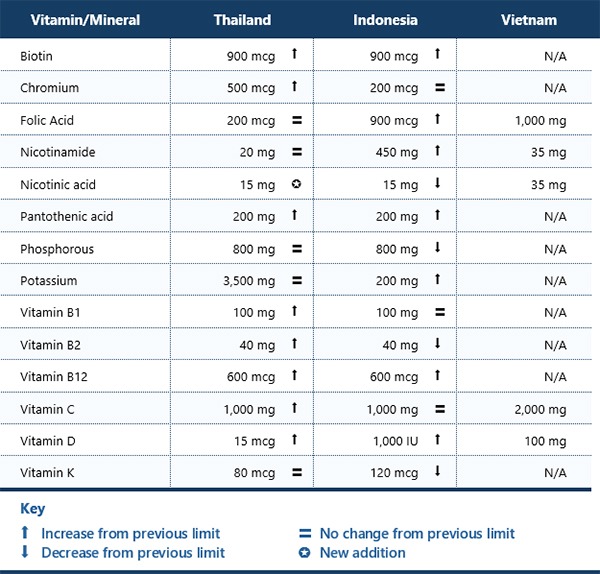
Where the limits are marked as not available, manufacturers may either follow the limitations under the ASEAN Agreement on a Regulatory Framework for Health Supplements or assume vitamins and mineral limits in health supplements based on generally accepted scientific data and taking into consideration, as appropriate, the varying degrees of sensitivity of different consumer groups.


RELATED INSIGHTS​ 

July 8, 2025
On July 3, 2025, Vietnam’s Ministry of Health (MOH) issued Circular No. 34/2025/TT-BYT amending some articles of Circular No. 06/2011/TT-BYT on the management of cosmetics products (Circular 34), which provides the current regulations on the product notification process for cosmetics (cosmetic notification). Circular 34 will come into effect on August 18, 2025. Changes to Cosmetic Notification Some of the key stipulations of Circular 34 are outlined below. Addition of submission route for notification Circular 34 officially adds online submission via the National Public Service Portal as an accepted type of cosmetic notification, in addition to direct submission and submission via post. Clearer regulations on preparing cosmetic notification form Circular 34 provides clarification on the signing requirements for cosmetic notification forms. For online submissions, both e-signatures and digital signatures are accepted. For offline submissions, the circular explicitly states that stamped/generated signatures are not acceptable. There are no substantive changes to existing requirements regarding grouping of products in a single declaration, ingredient listing, or language used in the notification form. Circular 34 only introduces formatting adjustments to these provisions. Updated administrative procedures Circular 34 updates requirements on digital procedures and authentication for online submission with references to new government decrees. In addition, processing timelines for cosmetic notification are further clarified, in particular, five working days for feedback on incomplete dossiers and five working days for approval after receiving complete supplemental dossiers. Revised requirements for import of samples for testing and research An updated Appendix 14-MP form is introduced with Circular 34, in which the receiving authority is updated from the Drug Administration of Vietnam to the specialized health agency under the provincial People’s Committee. Both online and direct submission of the request are allowed. The approval timeline is three working days from the date of reviewing the request. Transition clause Notifications
July 8, 2025
On June 29, 2025, the government of Vietnam issued Decree No. 163/2025/ND-CP providing detailed guidance on the implementation of the amended Law on Pharmacy (Decree 163). Decree 163, like the amended Law on Pharmacy, took effect on July 1, 2025, officially replacing Decree No. 54/2017/ND-CP (Decree 54). The new decree introduces comprehensive regulations across key areas of pharmaceutical management such as pharmacy practice certificates, certificates of eligibility for pharmaceutical business, import and export of drugs and drug materials, GMP inspection of foreign manufacturers, drug and drug material recall, certificates of drug advertising content, and drug price management. Key Changes in Decree 163 Some outstanding changes and additions in Decree 163 are presented below. Destruction of Specially Controlled Drugs It is no longer required to obtain approval from the competent authority before the destruction of narcotic, psychotropic, and precursor drugs, and pharmaceutical ingredients that are narcotic or psychotropic substances, or precursors used in drugs. Instead, notification must be provided at least seven working days in advance, including the proposed destruction date and a detailed list of items to be destroyed. E-commerce in Pharmaceuticals Pharmaceutical businesses operating via e-commerce platforms must publicly disclose the following information to ensure transparency and consumer safety: (i) certificate of eligibility for pharmaceutical business, (ii) pharmacy practice certificate of the person responsible for pharmaceutical expertise, and (iii) drug information. Shelf-Life Requirements for Imported Products For drugs and ingredients with a total shelf life of nine months or less, at least one-third of the shelf life must remain at the time of customs clearance. Drugs with a shelf life of 30 days or less must still be within their shelf life at the time of clearance. Control of Imported Products Drugs subject to import control include all drugs with marketing authorization (MA), except for (i) drugs that
May 28, 2025
Tilleke & Gibbins attorneys in Vietnam have contributed the 2025 edition of Doing Business in Vietnam, a comprehensive Q&A-style resource from Thomson Reuters Practical Law that provides essential insights for companies navigating business operations in Vietnam. The guide presents a detailed overview of the country’s legal framework and regulatory environment, reflecting recent updates in Vietnamese legislation and practice. This annually updated guide offers key information on the following areas: Legal system: Structure of the Vietnamese judiciary and the role of codified law. Foreign investment: Conditions for market access, licensing requirements, foreign ownership restrictions, and investment incentives. Business vehicles: Formation and operation of legal entities, including limited liability companies, joint-stock companies, and representative offices. Employment: Employment contracts, social insurance, labor rights, and procedures for hiring foreign nationals. Tax: Overview of corporate income tax, personal income tax, value-added tax, and other tax obligations. Intellectual property: Procedures for protecting and enforcing patents, trademarks, copyrights, and other IP rights. Data protection: Compliance requirements under Vietnam’s data privacy laws, including the Personal Data Protection Decree. Competition law: Antitrust rules and regulatory oversight under the Law on Competition. Anti-bribery and corruption: Legal framework and enforcement practices aimed at curbing corrupt activities. E-commerce and digital business: Regulations governing online platforms, digital content, and cross-border services. Marketing and advertising: Laws and guidelines on advertising standards and consumer protection. Product regulation and liability: Safety requirements, product liability issues, and roles of relevant authorities. Doing Business in Vietnam is part of Practical Law’s global series of legal guides designed to support international practitioners and businesses. To access the most recent edition of the Vietnam guide, visit the Practical Law website and sign up for a free trial.
May 28, 2025
Thailand’s Food and Drug Administration (FDA) has launched a strategic collaboration with leading e-commerce platforms Lazada and Shopee to strengthen regulatory oversight of health-related products sold online. This partnership is part of a broader initiative to enhance consumer protection, enforce compliance with Thai health regulations, and foster a safer digital marketplace for health products. As part of this initiative, the Thai FDA is urging all sellers—particularly cross-border vendors—to secure proper FDA registration for their products before market entry. The objective is to ensure that only legally authorized, safe, and quality-assured healthcare products are available to Thai consumers. In pursuit of this goal, the FDA has been working closely with Lazada and Shopee to implement proactive surveillance mechanisms aimed at identifying and removing noncompliant, substandard, or unregistered products. This collaboration has already yielded measurable results. Between September 2023 and 2024, Lazada supported regulatory enforcement by removing 9,454 noncompliant listings and delisting 30 vendors. In addition, 134 sellers were subjected to legal proceedings for regulatory violations. Shopee has taken a similarly rigorous stance, committing to the immediate removal of products found to be in breach of FDA regulations. The platform has also provided educational materials for merchants and implemented consumer complaint mechanisms to enhance accountability. Looking ahead, the Thai FDA plans to roll out a data integration system utilizing API technology, enabling seamless and secure exchange of regulatory data between the agency and e-commerce platforms. This system will be supported by comprehensive training for both Thai FDA officials and e-commerce staff, with a particular focus on the use of the Thai government’s Law Enforcement Request Portal, a secure communication channel for coordinating enforcement actions between government agencies and platform operators. Additionally, a joint product inspection framework is currently under development in partnership with Lazada and Shopee. This framework will incorporate strict