
You are using an outdated browser and your browsing experience will not be optimal. Please update to the latest version of Microsoft Edge, Google Chrome or Mozilla Firefox. Install Microsoft Edge

February 3, 2023

A Review of the Japan-Vietnam Patent Prosecution Highway

Overview

Although Vietnam has a number of mechanisms for accelerating the patent examination process, most of them have not lived up to the expectations of applicants. However, a fast-track patent prosecution highway (PPH) program was opened for the first time between the Intellectual Property Office of Vietnam (IP Office) and the Japan Patent Office (JPO) in January 2016, creating opportunities for all applications originating from Japan.

The PPH program has been rolled out in the following stages:
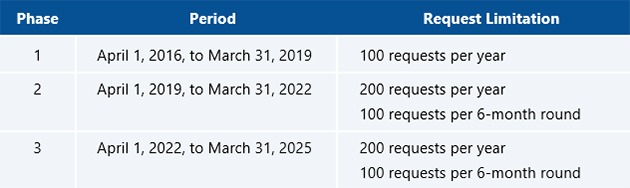
After more than six years of implementation, this program is considered successful and can be extended to support Japanese enterprises in establishing patent rights in Vietnam.

Effectiveness

This program has many advantages, such as:

  • Applications originating from Japan are usually of good quality with clear and coherent specification It is possible that the IP Office’s requirements for specifications are already very consistent with Japanese applicants’ way of drafting specifications thanks to the JPO’s training programs for the IP Office.
  • Patents in Japan usually have a short examination timeline and are granted very quickly, even within the application filing timeline in Vietnam (12 months from the priority date for applications filed under the Paris Convention and 31 months from the priority date for applications filed as PCT national phase applications).
  • The coordination between the JPO and the IP Office has been very good. PPH applications are processed in a quick and efficient manner.
  • Japanese applicants and their representatives also often coordinate well with the IP Office to rectify formality shortcomings and avoid prolongation of the examination period.

Although there are no official statistics from the IP Office, according to independent statistics for applications whose PPH requests were filed by Tilleke & Gibbins’ associate firm (one of the most prolific filers under the PPH), the examination period for applications under the PPH has been significantly shortened, compared to the period for substantive examination as prescribed by law (18 months):

  • The average period for receiving the first office action as from the date of the PPH request is 8.53 months.
  • The average period for receiving a notice of allowance without an office action from the date of requesting PPH is 7.98 months.

Further, the prescribed 18-month time limit for examination is often difficult to achieve for various reasons, and the actual examination period for applications not under the PPH program is typically much longer than 18 months in practice. Obviously, the PPH has been providing a tremendous time benefit to Japanese applicants.

Current Status

Since its inception, the PPH program has attracted the attention of many Japanese enterprises and industrial property representatives in Vietnam. In fact, in the first rounds of this program, the timeline for the number of requests to reach the limit was often very short, and in many cases the limit was reached on the very first day the round was opened.
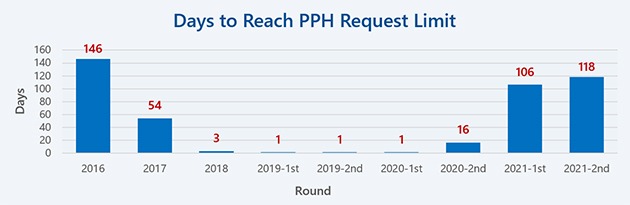
However, despite the PPH’s apparent effectiveness, recent monitoring of the number of applications as well as the time limit for filing PPH requests shows that this program has not been attracting the attention of Japanese applicants as much as before. According to the above figure, the number of days to reach the request limit has increased in every period since 2020. By 2022, the first round, which was opened on April 1, 2022, had not even reached 100 requests after six months, and the 34 remaining spots were moved to the second round, which was opened on October 1, 2022.

It is not clear why Japanese applicants have shown reduced interest in the PPH program after its initial popularity, though it is worth noting that the time period in which the number of PPH requests was slower to reach the limit (from October 2020 to mid-2022), coincided with the period when Japan and Vietnam were most affected by the Covid-19 pandemic. This may have affected the management strategy of Japanese enterprises as well as the budget for promoting IP portfolios.

Upcoming Changes

Article 114 of Vietnam’s amended IP Law, which took effect on January 1, 2023, allows the IP Office to use the results of substantive examination of a patent application claiming the same invention filed with a foreign patent office in the process of assessing the patentability of the corresponding Vietnamese application. The latest draft of a circular to replace Circular 01/2007, which guides the implementation of the IP Law, also includes provisions intended to allow an applicant to proactively request the IP Office to proceed in this manner. Also according to this draft circular, if the IP Office accepts the applicant’s request, a communication on substantive examination results must be issued for the Vietnamese application within 12 months from the date of the request.

As such, Article 114 of the IP Law seems to open a new door for patent applicants in accelerating the examination process in Vietnam. This program is expected to be equally effective and possibly even more effective than existing acceleration programs. The scope of expedited examination is extended to applicants from all countries and is not limited only to applications originating from Japan and South Korea (which has its own PPH with Vietnam) or applications with equivalent applications filed in ASEAN countries under the ASPEC program.

Although on the positive side, the expedited process will give applicants more options, on the other hand, because of the overlap in the results that can serve as basis for examination, this new program will “steal” applications from the PPH program. Thus, once the new program goes into effect, Japanese applicants will no longer have a significant advantage over applicants from other countries that can use foreign results. However, according to the statistics cited above, the average examination period of the PPH program may still be shorter, and the PPH program has been operating in a stable manner; hence, in the early period once the new program is in place, the Japan PPH may still be more attractive.

As Vietnam currently does not have a mechanism for extending the protection term of a patent, the early granting of a protection title is still an advantage. The PPH remains an effective channel for Japanese applicants in expediting the examination and granting of patents in Vietnam.

RELATED INSIGHTS​ 

July 31, 2024
On the afternoon of 19 April 2024, a cramped courtroom at the People’s Court of Hanoi was the setting for the first criminal trial of a case of copyright and related rights infringement in Vietnam, regarding the act of illegal streaming of English Premier League football matches on online platforms. This case is expected to open the door for the criminal prosecution of other cases of copyright and related rights infringement on the internet, an area that has faced numerous difficulties over the past two decades. First criminal case of illegal streaming Vietnamese criminal law has long had provisions in place for criminal handling of copyright infringement crimes, specifically in Article 131 of the 1999 Penal Code. However, more than 20 years after this law took effect, and even though Vietnam enacted the 2015 Penal Code with subsequent amendments, these regulations have remained mainly a law on paper only, and many significant and serious cases causing great frustration for rights holders and society have not been criminally prosecuted. The case in question was initiated by a denunciation of the BestBuyIPTV subscription service by the Football Association Premier League Limited (the “Premier League”) and the Alliance for Creativity and Entertainment (“ACE”), a coalition of global entertainment companies and film studios dedicated to combating digital piracy and copyright infringement. BestBuyIPTV had illegally streamed Premier League matches and other protected works without authorization of the rights holders. In 2023, after an extensive investigation, the Cybersecurity and High-Tech Crime Prevention Division (PA05) and the Police Department for Investigating Corruption, Smuggling, and Economic Crimes (PC03) of the Hanoi police brought a case for criminal copyright infringement, pursuant to Article 225 of the 2015 Penal Code, against the offender, an individual named Le Hai Nam, consolidating the dossiers for the People’s Procuracy to indict this
July 24, 2024
Experts from Tilleke & Gibbins’ intellectual property team have contributed an updated Intellectual Property Transactions in Vietnam to Thomson Reuters Practical Law, a high-level comparative overview of  laws and regulations across multiple jurisdictions. Intellectual Property Transactions focuses on business-related aspects of intellectual property, such as the value of intellectual assets in M&A transactions, and the licensing of IP portfolios. Key topics covered in the chapter include: IP assignment: Basis and formalities for assignments of patents, utility models, trademarks, copyright, design rights, trade secrets, confidential information, and domain names. IP licensing: Scope and formalities for licensing patents, utility models, trademarks, copyright, design rights, and trade secrets. Research and development collaborations. IP audits. IP aspects of M&A: Due diligence, warranties/indemnities, and transfer of IPRs. Employee and consultant agreements. Practical Law, a legal reference resource from Thomson Reuters, publishes a range of guides for hundreds of jurisdictions and practice areas. The Intellectual Property Transactions Global Guide is a valuable resource for legal practitioners, covering numerous jurisdictions worldwide. To view the latest version of the Intellectual Property Transactions in Vietnam overview, please visit the Practical Law website and enroll in the free Practical Law trial to gain full access.
July 24, 2024
Intellectual property specialists from Tilleke & Gibbins in Thailand have contributed an updated Intellectual Property Transactions in Thailand overview for Thomson Reuters Practical Law, an online publication that provides comprehensive legal guides for jurisdictions worldwide. The Thailand overview was authored by Darani Vachanavuttivong, managing partner of Tilleke & Gibbins and managing director of the firm’s regional IP practice; Titikaan Ungbhakorn, senior associate and patent agent; and San Chaithiraphant, senior associate. The chapter delivers a high-level examination of critical aspects of IP law, including IP assignment and licensing, research and development collaborations, IP in mergers and acquisitions (M&A), securing loans with intellectual property rights, settlement agreements, employee-related IP issues, competition law, taxation, and non-tariff trade barriers. Key topics covered in the chapter include: IP assignment: Basis and formalities for assignments of patents, utility models, trademarks, copyright, design rights, trade secrets, confidential information, and domain names. IP licensing: Scope and formalities for licensing patents, utility models, trademarks, copyright, design rights, and trade secrets. Research and development collaborations: Management of improvements, derivatives, and joint ownership of IP. IP aspects of M&A: Due diligence and critical considerations during mergers and acquisitions. Practical Law, a legal reference resource from Thomson Reuters, publishes a range of guides for hundreds of jurisdictions and practice areas. The Intellectual Property Transactions Global Guide is a valuable resource for legal practitioners, covering numerous jurisdictions worldwide. To view the latest version of the Intellectual Property Transactions in Thailand overview, please visit the Practical Law website and enroll in the free Practical Law trial to gain full access.
July 22, 2024
Appeals of unfavorable decisions on protection in the IP field are very common in Vietnam. In 2023, there were 845 appeals filed at the IP Office, including 780 trademark appeals. In most cases, however, applicants view the appeal procedure as almost a last resort, as the lengthy examination process can lead to serious delays in appeal settlement. In fact, it can take four to seven years, or even longer, for an appeal to be resolved, and a disappointingly low number of cases are settled each year, despite the towering number of appeals pending. Nonetheless, there are reasons for optimism. Inspection and Appeal Department On 1 July 2024, the IP Office issued Decision No. 575/QD-SHTT promulgating the Regulations on Organization and Operation of the Inspection and Appeal Department – formerly the Enforcement and Appeal Department – whose functions include, among others, advising and assisting the Director General of the IP Office in resolving appeals related to the process of establishing IP rights. The Inspection and Appeal Department has the duty to handle appeals and denunciations related to the process of establishing IP rights, as well as requests for termination and cancellation of the validity of registrations. In addition, it can provide expert opinions, and appoint knowledgeable personnel to participate in the IP Office’s Advisory Council to settle appeals. While the renamed department’s responsibilities do not differ greatly, on paper, from those of the previous Enforcement and Appeal Department, the issuance of new regulations indicates the IP Office’s renewed focus on the importance of improving the appeal procedure. Scope of IP appeals expanded In addition, in November 2023, the Ministry of Science and Technology issued Circular No. 23/2023/TT-BKHCN (“Circular 23”) providing further guidance for implementation of the amended 2022 IP Law and its subordinate legislation. Article 35 of Circular 23 has