
You are using an outdated browser and your browsing experience will not be optimal. Please update to the latest version of Microsoft Edge, Google Chrome or Mozilla Firefox. Install Microsoft Edge

February 3, 2023

A Review of the Japan-Vietnam Patent Prosecution Highway

Overview

Although Vietnam has a number of mechanisms for accelerating the patent examination process, most of them have not lived up to the expectations of applicants. However, a fast-track patent prosecution highway (PPH) program was opened for the first time between the Intellectual Property Office of Vietnam (IP Office) and the Japan Patent Office (JPO) in January 2016, creating opportunities for all applications originating from Japan.

The PPH program has been rolled out in the following stages:
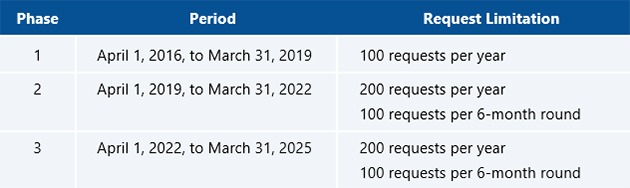
After more than six years of implementation, this program is considered successful and can be extended to support Japanese enterprises in establishing patent rights in Vietnam.

Effectiveness

This program has many advantages, such as:

  • Applications originating from Japan are usually of good quality with clear and coherent specification It is possible that the IP Office’s requirements for specifications are already very consistent with Japanese applicants’ way of drafting specifications thanks to the JPO’s training programs for the IP Office.
  • Patents in Japan usually have a short examination timeline and are granted very quickly, even within the application filing timeline in Vietnam (12 months from the priority date for applications filed under the Paris Convention and 31 months from the priority date for applications filed as PCT national phase applications).
  • The coordination between the JPO and the IP Office has been very good. PPH applications are processed in a quick and efficient manner.
  • Japanese applicants and their representatives also often coordinate well with the IP Office to rectify formality shortcomings and avoid prolongation of the examination period.

Although there are no official statistics from the IP Office, according to independent statistics for applications whose PPH requests were filed by Tilleke & Gibbins’ associate firm (one of the most prolific filers under the PPH), the examination period for applications under the PPH has been significantly shortened, compared to the period for substantive examination as prescribed by law (18 months):

  • The average period for receiving the first office action as from the date of the PPH request is 8.53 months.
  • The average period for receiving a notice of allowance without an office action from the date of requesting PPH is 7.98 months.

Further, the prescribed 18-month time limit for examination is often difficult to achieve for various reasons, and the actual examination period for applications not under the PPH program is typically much longer than 18 months in practice. Obviously, the PPH has been providing a tremendous time benefit to Japanese applicants.

Current Status

Since its inception, the PPH program has attracted the attention of many Japanese enterprises and industrial property representatives in Vietnam. In fact, in the first rounds of this program, the timeline for the number of requests to reach the limit was often very short, and in many cases the limit was reached on the very first day the round was opened.
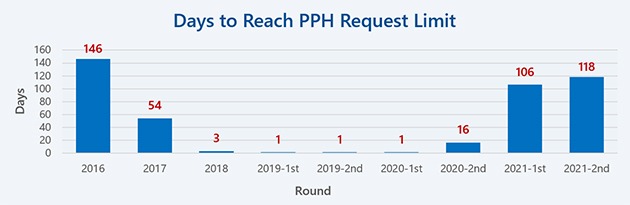
However, despite the PPH’s apparent effectiveness, recent monitoring of the number of applications as well as the time limit for filing PPH requests shows that this program has not been attracting the attention of Japanese applicants as much as before. According to the above figure, the number of days to reach the request limit has increased in every period since 2020. By 2022, the first round, which was opened on April 1, 2022, had not even reached 100 requests after six months, and the 34 remaining spots were moved to the second round, which was opened on October 1, 2022.

It is not clear why Japanese applicants have shown reduced interest in the PPH program after its initial popularity, though it is worth noting that the time period in which the number of PPH requests was slower to reach the limit (from October 2020 to mid-2022), coincided with the period when Japan and Vietnam were most affected by the Covid-19 pandemic. This may have affected the management strategy of Japanese enterprises as well as the budget for promoting IP portfolios.

Upcoming Changes

Article 114 of Vietnam’s amended IP Law, which took effect on January 1, 2023, allows the IP Office to use the results of substantive examination of a patent application claiming the same invention filed with a foreign patent office in the process of assessing the patentability of the corresponding Vietnamese application. The latest draft of a circular to replace Circular 01/2007, which guides the implementation of the IP Law, also includes provisions intended to allow an applicant to proactively request the IP Office to proceed in this manner. Also according to this draft circular, if the IP Office accepts the applicant’s request, a communication on substantive examination results must be issued for the Vietnamese application within 12 months from the date of the request.

As such, Article 114 of the IP Law seems to open a new door for patent applicants in accelerating the examination process in Vietnam. This program is expected to be equally effective and possibly even more effective than existing acceleration programs. The scope of expedited examination is extended to applicants from all countries and is not limited only to applications originating from Japan and South Korea (which has its own PPH with Vietnam) or applications with equivalent applications filed in ASEAN countries under the ASPEC program.

Although on the positive side, the expedited process will give applicants more options, on the other hand, because of the overlap in the results that can serve as basis for examination, this new program will “steal” applications from the PPH program. Thus, once the new program goes into effect, Japanese applicants will no longer have a significant advantage over applicants from other countries that can use foreign results. However, according to the statistics cited above, the average examination period of the PPH program may still be shorter, and the PPH program has been operating in a stable manner; hence, in the early period once the new program is in place, the Japan PPH may still be more attractive.

As Vietnam currently does not have a mechanism for extending the protection term of a patent, the early granting of a protection title is still an advantage. The PPH remains an effective channel for Japanese applicants in expediting the examination and granting of patents in Vietnam.

RELATED INSIGHTS​ 

October 21, 2024
Thailand’s Central Intellectual Property and International Trade (IP&IT) Court has delivered a favorable ruling for Sumitomo Rubber Industries, Ltd., a major player in the tire manufacturing industry, regarding the registration of its motorcycle tire design patent. In this case, Tilleke & Gibbins represented Sumitomo in successfully advocating for recognition of the unique design elements in the company’s motorcycle tire products. Case Overview The case revolved around Sumitomo’s two design patent applications for motorcycle tire designs, which were initially rejected by the Department of Intellectual Property (DIP) on the grounds that they were similar to prior art. Based on an examination of the design elements, primarily focusing on the tire tread patterns, the DIP’s Patent Board had concluded that Sumitomo’s designs were not sufficiently unique to warrant patent protection, as the tread patterns of the new designs were deemed too similar to one found in prior art for tire products. In response, Tilleke & Gibbins filed a complaint with the IP&IT Court on behalf of Sumitomo, seeking a revocation of the Patent Board’s decision and requesting that the court compel the DIP, as the defendant, to proceed with the registration of Sumitomo’s design patents. The complaint emphasized that the designs were novel and distinct, warranting patent protection under Thai law. Legal Strategy The firm’s legal argument focused on the interpretation of Thai patent law, particularly regarding the protection of a product’s external appearance, and emphasized that the determination of a design’s novelty must consider the product’s overall appearance rather than isolating individual features. This approach is consistent with international guidelines on design patents, which require the evaluation of novelty and distinctiveness based on how an informed user would perceive the design as a whole. While Sumitomo’s tire tread patterns may share some superficial similarities to existing designs, the overall impression
October 20, 2024
The annual statistics issued by the Intellectual Property Office of Vietnam (“IP Office”) in recent years show an increase in the number of IP transactions and applications to establish IP rights, including requests for the recordal of assignment of IP rights. Nevertheless, the numbers of trademark assignment recordals approved by the IP Office has not followed this trend, falling from 1,281 requests approved in 2022 to 1,120 requests approved in 2023. This decrease may be due to the IP Office’s overly strict viewpoint in approving trademark assignments, including its rejection of assignment recordal on the ground of conflict with the assignor’s trade name. IP Office’s practice on assignment recordal Vietnam’s IP Law restricts the assignment of trademarks in several cases, as set out in Article 139.4 that “the assignment of the rights to marks must not cause confusion as to properties or origins of goods or services bearing such marks.” Thus, when an assigned mark is identical to the dominant element of the assignor’s company name, the IP Office will view that the assignee’s use of the mark will result in confusion with the assignor’s trade name, and then instantly reject the assignment request. In this case, the IP Office will only accept the assignment if the IP holder can submit documents issued by relevant authorities proving at least one of the following conditions: The assignor has assigned all business premises and operations under its name to the assignee; The assignor has removed business lines relating to the goods/services bearing the trademarks and such removal is recorded in the Enterprise Registration Certificate; The assignor has been dissolved or does not exist after signing the agreement; The assignor has changed its name after signing the agreement so that it does not contain any element identical or similar to the assigned
October 7, 2024
Starting October 15, 2024, Cambodia will implement a new penalty for late patent annuity payments and restorations, according to an unofficial announcement from the country’s Department of Industrial Property under the Ministry of Industry, Science, Technology, and Innovation. This new penalty will apply to patents, utility model certificates, and plant variety protection registrations. To avoid additional charges and prevent the abandonment of any pending applications or the lapse of registrations, applicants and registration owners must pay each annuity within the six months before the annuity period starts, or by its due date. If the annuity is not paid by the due date, a grace period of six months is allowed for late payment, with a daily charge of KHR 500 (approximately USD 0.125) per day. If payment is not made within this grace period, the patent will be deemed withdrawn or will lapse. However, the Patent Office can initiate the restoration process within the last six months of the annuity period. This requires a USD 25 restoration fee plus an additional daily charge of USD 0.125 from the start of the grace period until payment is completed. To avoid additional charges and prevent the potential abandonment of applications or registrations, companies and their appointees need to keep track of all annuity due dates for patents, utility model certificates, and plant variety protection registrations and pay all annuities well in advance of the due date. For more details on this penalty, or on any aspect of intellectual property protection in Cambodia, please contact Tilleke & Gibbins at [email protected].
October 3, 2024
Lawyers from Tilleke & Gibbins’ intellectual property team, under the guidance of Darani Vachanavuttivong, managing partner and managing director of the firm’s intellectual property department, have contributed an update to Thomson Reuters Practical Law’s Intellectual Property Rights in Thailand: Overview guide for 2024. This guide provides a comprehensive overview of intellectual property (IP) laws in Thailand, covering key areas such as patents, trademarks, copyright, trade secrets, and registered designs. It also addresses the enforcement of these rights, as well as the procedures for registering patents, trademarks, and other IP protections. The Thailand chapter outlines important aspects of IP law, including: The conditions and procedures for obtaining patents and registered designs, including the different types of patent protection available. Legal requirements for registering trademarks, including what constitutes a distinctive and legally protectable mark. The scope of copyright protection and the rights granted to creators of original works, including economic and moral rights. Protection of trade secrets and confidential information under the Trade Secrets Act, which safeguards valuable business information. This guide is a valuable resource for legal practitioners and businesses seeking to understand the nuances of Thailand’s IP landscape. To explore the latest version of Intellectual Property Rights in Thailand: Overview, please visit the Practical Law website and enroll in the free Practical Law trial to gain full access.