
You are using an outdated browser and your browsing experience will not be optimal. Please update to the latest version of Microsoft Edge, Google Chrome or Mozilla Firefox. Install Microsoft Edge

February 3, 2023

A Review of the Japan-Vietnam Patent Prosecution Highway

Overview

Although Vietnam has a number of mechanisms for accelerating the patent examination process, most of them have not lived up to the expectations of applicants. However, a fast-track patent prosecution highway (PPH) program was opened for the first time between the Intellectual Property Office of Vietnam (IP Office) and the Japan Patent Office (JPO) in January 2016, creating opportunities for all applications originating from Japan.

The PPH program has been rolled out in the following stages:
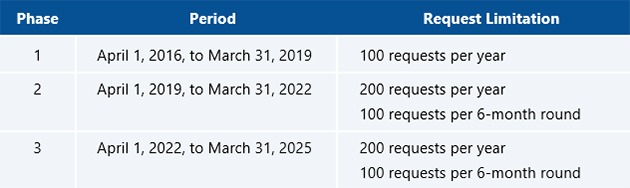
After more than six years of implementation, this program is considered successful and can be extended to support Japanese enterprises in establishing patent rights in Vietnam.

Effectiveness

This program has many advantages, such as:

  • Applications originating from Japan are usually of good quality with clear and coherent specification It is possible that the IP Office’s requirements for specifications are already very consistent with Japanese applicants’ way of drafting specifications thanks to the JPO’s training programs for the IP Office.
  • Patents in Japan usually have a short examination timeline and are granted very quickly, even within the application filing timeline in Vietnam (12 months from the priority date for applications filed under the Paris Convention and 31 months from the priority date for applications filed as PCT national phase applications).
  • The coordination between the JPO and the IP Office has been very good. PPH applications are processed in a quick and efficient manner.
  • Japanese applicants and their representatives also often coordinate well with the IP Office to rectify formality shortcomings and avoid prolongation of the examination period.

Although there are no official statistics from the IP Office, according to independent statistics for applications whose PPH requests were filed by Tilleke & Gibbins’ associate firm (one of the most prolific filers under the PPH), the examination period for applications under the PPH has been significantly shortened, compared to the period for substantive examination as prescribed by law (18 months):

  • The average period for receiving the first office action as from the date of the PPH request is 8.53 months.
  • The average period for receiving a notice of allowance without an office action from the date of requesting PPH is 7.98 months.

Further, the prescribed 18-month time limit for examination is often difficult to achieve for various reasons, and the actual examination period for applications not under the PPH program is typically much longer than 18 months in practice. Obviously, the PPH has been providing a tremendous time benefit to Japanese applicants.

Current Status

Since its inception, the PPH program has attracted the attention of many Japanese enterprises and industrial property representatives in Vietnam. In fact, in the first rounds of this program, the timeline for the number of requests to reach the limit was often very short, and in many cases the limit was reached on the very first day the round was opened.
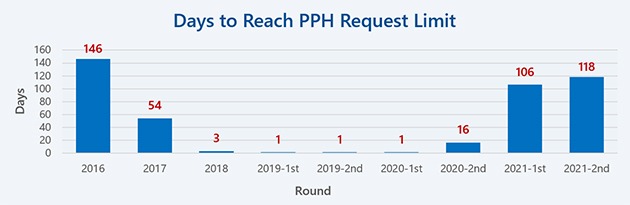
However, despite the PPH’s apparent effectiveness, recent monitoring of the number of applications as well as the time limit for filing PPH requests shows that this program has not been attracting the attention of Japanese applicants as much as before. According to the above figure, the number of days to reach the request limit has increased in every period since 2020. By 2022, the first round, which was opened on April 1, 2022, had not even reached 100 requests after six months, and the 34 remaining spots were moved to the second round, which was opened on October 1, 2022.

It is not clear why Japanese applicants have shown reduced interest in the PPH program after its initial popularity, though it is worth noting that the time period in which the number of PPH requests was slower to reach the limit (from October 2020 to mid-2022), coincided with the period when Japan and Vietnam were most affected by the Covid-19 pandemic. This may have affected the management strategy of Japanese enterprises as well as the budget for promoting IP portfolios.

Upcoming Changes

Article 114 of Vietnam’s amended IP Law, which took effect on January 1, 2023, allows the IP Office to use the results of substantive examination of a patent application claiming the same invention filed with a foreign patent office in the process of assessing the patentability of the corresponding Vietnamese application. The latest draft of a circular to replace Circular 01/2007, which guides the implementation of the IP Law, also includes provisions intended to allow an applicant to proactively request the IP Office to proceed in this manner. Also according to this draft circular, if the IP Office accepts the applicant’s request, a communication on substantive examination results must be issued for the Vietnamese application within 12 months from the date of the request.

As such, Article 114 of the IP Law seems to open a new door for patent applicants in accelerating the examination process in Vietnam. This program is expected to be equally effective and possibly even more effective than existing acceleration programs. The scope of expedited examination is extended to applicants from all countries and is not limited only to applications originating from Japan and South Korea (which has its own PPH with Vietnam) or applications with equivalent applications filed in ASEAN countries under the ASPEC program.

Although on the positive side, the expedited process will give applicants more options, on the other hand, because of the overlap in the results that can serve as basis for examination, this new program will “steal” applications from the PPH program. Thus, once the new program goes into effect, Japanese applicants will no longer have a significant advantage over applicants from other countries that can use foreign results. However, according to the statistics cited above, the average examination period of the PPH program may still be shorter, and the PPH program has been operating in a stable manner; hence, in the early period once the new program is in place, the Japan PPH may still be more attractive.

As Vietnam currently does not have a mechanism for extending the protection term of a patent, the early granting of a protection title is still an advantage. The PPH remains an effective channel for Japanese applicants in expediting the examination and granting of patents in Vietnam.

RELATED INSIGHTS​ 

August 28, 2026
When considering a franchise, many people first think of a restaurant, retail chain, or service outlet. From a legal perspective, however, the foundation of every franchise lies in the right to use a brand, which is typically granted through a trademark license. Trademarks are often the most valuable assets in a franchise system. Through a trademark license, a franchisor authorizes a franchisee to use its trademarks, logos, and branding while maintaining control over how the brand is presented to customers. The Role of Trademarks in Franchise Businesses Under the Trademark Law 2019, a mark is defined as a sign that is capable of distinguishing the goods or services of one undertaking from those of others in the course of trade. This distinguishing function is particularly important in a franchise arrangement, where the franchisee’s use of the franchisor’s trademark allows consumers to recognize the source, quality, and reputation of the business. In this way, trademarks help preserve brand identity, strengthen market recognition, and protect the commercial value of the franchise system. Legal Foundation for Franchise Brand Protection Myanmar presently does not have a specific statutory framework governing franchise arrangements. As a result, franchise agreements are generally regulated under the broader applicable legal framework, including the Contract Act 1872, the Trademark Law 2019, the Competition Law 2015, the Consumer Protection Law 2019, and the relevant implementing rules and regulations. The licensing of trademarks within a franchise arrangement is particularly governed by the Trademark Law 2019. Franchisors should ensure that the trademarks intended to be licensed to franchisees in Myanmar are registered under the Trademark Law 2019 and that the relevant trademark license is properly recorded with the Intellectual Property Department (IPD). Trademark License Recordal Under the Trademark Law 2019, the owner of a registered trademark may grant a license to another
August 27, 2026
It is generally understood that patents are granted for new designs that have not been widely known or used in Thailand and not been disclosed anywhere prior to the date of the patent application. It is trite law that design law protects the distinctive appearance or products. Under Section 3 of the Thai Patent Act B.E. 2522, as amended by the Patent Act (No. 2) B.E. 2535 and the Patent Act (No. 3) B.E. 2542, a design is defined as “any form or composition of lines or colors that gives a product a special appearance and can serve as a pattern for an industrial or handicraft product.” This raises an important question. Can a patent be issued for a product design that contains text, numerals, trademarks, or symbols that do not fall under the definition of a design? This issue commonly arises when attempting to register packaging, labels, and graphical user interfaces (GUIs). Until a few years ago, applicants could file design applications with the Thai Patent Office for designs that contained such elements, provided that an appropriate disclaimer was included. This practice was generally accepted by Thai design examiners at that time, but the Patent Office has since implemented a change in its practice that could have a significant impact on applicants for design patents. Where design representations are submitted as line drawings or computer-aided design (CAD) drawings, the examiner may now issue an office action requiring their removal. This practice, however, appears to be applied inconsistently, as some examiners still exercise their own discretion in determining whether drawings containing these elements are acceptable. Below are examples of a GUI design, a CAD drawing design, and a photographic design representation that illustrates issues relating to the presence of nonallowable elements. GUI design For this GUI design, the submitted
August 27, 2026
Franchising in Thailand has matured into a sizeable commercial sector, but the rules governing franchisor–franchisee relationships remain scattered across general legislation rather than consolidated in a dedicated franchise statute. In this environment, the decisions of the Trade Competition Commission of Thailand (TCCT) have emerged as valuable practical guidance. Thailand follows a civil-law system in which judicial and administrative decisions do not create binding precedent; however, past rulings are nonetheless influential. This article examines the most instructive recent TCCT decisions and distills the practical compliance considerations for franchisors and franchisees operating in Thailand. Postcontract Changes: Justified or Unfair? A recurring issue is whether a franchisor may alter the terms of engagement after contract execution. The TCCT has established that midterm modifications are not inherently unfair; the determinative factors are whether there was a reasonable business justification, adequate advance notice, and a transparent process. In a 2023 coffee franchise matter, for instance, the TCCT declined to find a violation where a franchisor increased raw material prices, noting the increase had been communicated in advance and supported by demonstrable cost pressures. A bubble tea franchise matter reinforces this principle. The TCCT found that postcontract mandatory purchases of branded syrup and flavorings were justified, as the agreement reserved the franchisor’s right to modify product requirements, the materials were sold at or below market prices, and the branded ingredients possessed distinctive qualities deemed essential to franchise quality. The complaint was dismissed, with the additional requirements characterized as a legitimate measure to preserve brand consistency. Considered together, these decisions indicate that post‑contract modifications will be evaluated against three criteria: (1) whether there is a legitimate business rationale, (2) whether adequate advance notice was provided, and (3) whether franchisees were treated equitably throughout the transition. Discriminatory Treatment: Are Renewals and Information Equal? A 2024 automotive dealership
August 20, 2026
As part of its membership in Lex Mundi, Tilleke & Gibbins has released the latest edition of its Guide to Doing Business in Thailand, providing an overview of the legal, regulatory, and commercial considerations for companies establishing or expanding operations in Thailand. The 2026 edition offers practical insight into the country’s business environment, investment framework, and operational requirements. The guide covers a wide range of topics relevant to foreign and domestic investors, including: Investment incentives and promotion schemes Financial facilities and banking regulations Exchange controls and money transfers Import and export regulations Business structures and incorporation options Requirements for establishing a business Operational and compliance considerations Business cessation and insolvency procedures Employment and labor laws Taxation Immigration and visa requirements Prepared by Tilleke & Gibbins lawyers across multiple practice areas, the publication outlines key aspects of doing business in Thailand, including foreign investment restrictions, regulatory compliance obligations, corporate structures, employment requirements, and recent legal and economic developments affecting investors. The publication forms part of Lex Mundi’s Country Guides series, a global collection of jurisdiction-specific reference materials prepared by member firms around the world. Together, these guides help companies evaluate opportunities, compare regulatory environments, and plan international business activities across multiple markets. The full Guide to Doing Business in Thailand 2026 is available through the button below.